WEEKLY HIGHLIGHTS 2026 SECOND HALF
HIGHLIGHTS FOR WEEK OF 28 SEPTEMBER – 4 OCTOBER 2026
My evenings (or Good things don’t just happen on their own)
After returning from my holiday, I have been feeling sort of unhappy about not spending my evenings in the way I want to. Instead, I ended up working late, doing random things or wasting time.
As I have realised from listening to an episode of the Happiness Lab podcast (I cannot remember which!) is that there are two problems causing my failure to enjoy my evenings. Firstly, I do not know how I actually want to spend my evenings. Secondly, I do not make the right decisions to allow me to spend the evenings in the way I want to.
The podcast pointed out that trying to spontaneously decide on an activity is often a recipe for failure. A good example are my lunch time exercise activities.
For instance, I have personally realised that it is not enough to plan that at lunch time I will do some exercise, because when lunch time comes, I will waste a lot of time weighing the pros and cons of different types of exercise. Furthermore, I am mentally not prepared to do a specific type of exercise. As a result, I often end up not doing any exercise.
On most days, I do plan what specific exercise I am going to do and where I will do it, and almost always, I carry through with my plans.
Differently from my lunch time exercise activities, where I know what types of exercise I enjoy doing, and plan accordingly, I do not actually know how I really prefer spending my evenings.
Before we can plan anything, we need to know what exactly we want to do.
When it comes to spending my evenings, there are a few things that I often feel I would like to do:
-
listening to music
-
reading (at home or outside)
-
watching a movie
-
going for a walk
I tried reading outside one night last week and realised that it was not that actually that much fun because almost wherever I go, there are people listening to their phones in speaker mode.
With regards to watching a movie, one problem is that it takes a lot of time. Furthermore, I often end up feeling disappointed by movies I watch. Finally, watching a movie feels more like a distraction than a way to truly relax, reflect and recharge.
On the other hand, listening to music at home and reading at home really is fun.
Going for a walk is enjoyable, too, but compared to reading and listening to music, it seems less attractive. So perhaps I could make this a one-time-a-week activity.
This then allows me to plan how I can actually ensure I reserve time for reading and listening to music in the evenings.
When it comes to my planning, I first need to consider that I want to sleep at 10:30. I also need to take into account that there are days on which I am busy with my running workout or my running training session until around 8:00pm, or where I need to do laundry in the evening.
As such, I need to stop work or any other activities at 8pm. I can then relax in my office for 30min and then go home at 8:30, to spend my ideal evening. On days when I need to do laundry, I need to end work 30 min earlier.
Most importantly, the plan only works if I can strictly follow the rule to stop work and other activities on time, and plan my day accordingly! For the last couple of days I have managed to, and the results have been great.
HIGHLIGHTS FOR WEEK OF 21 – 27 SEPTEMBER 2026

Holiday in Germany
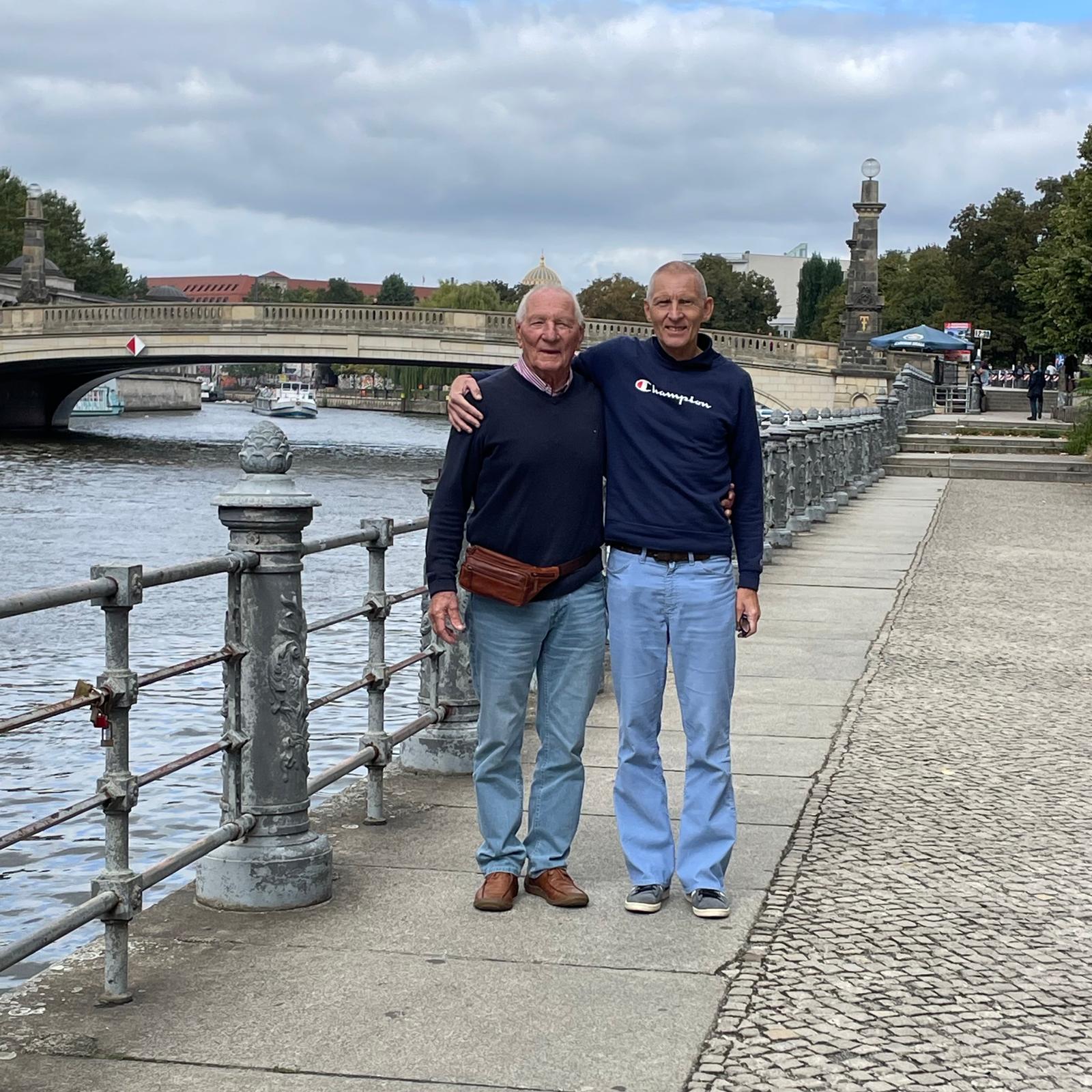
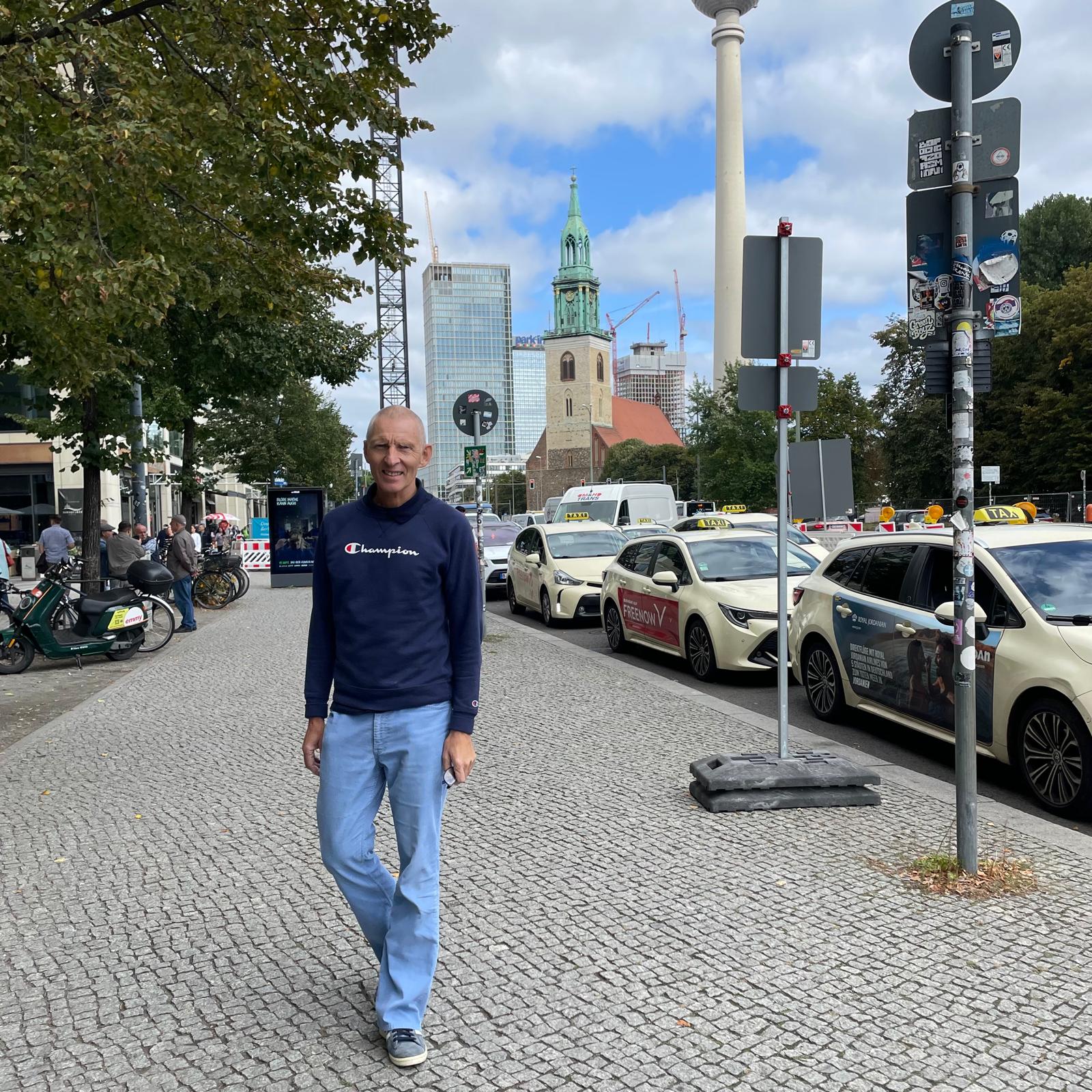
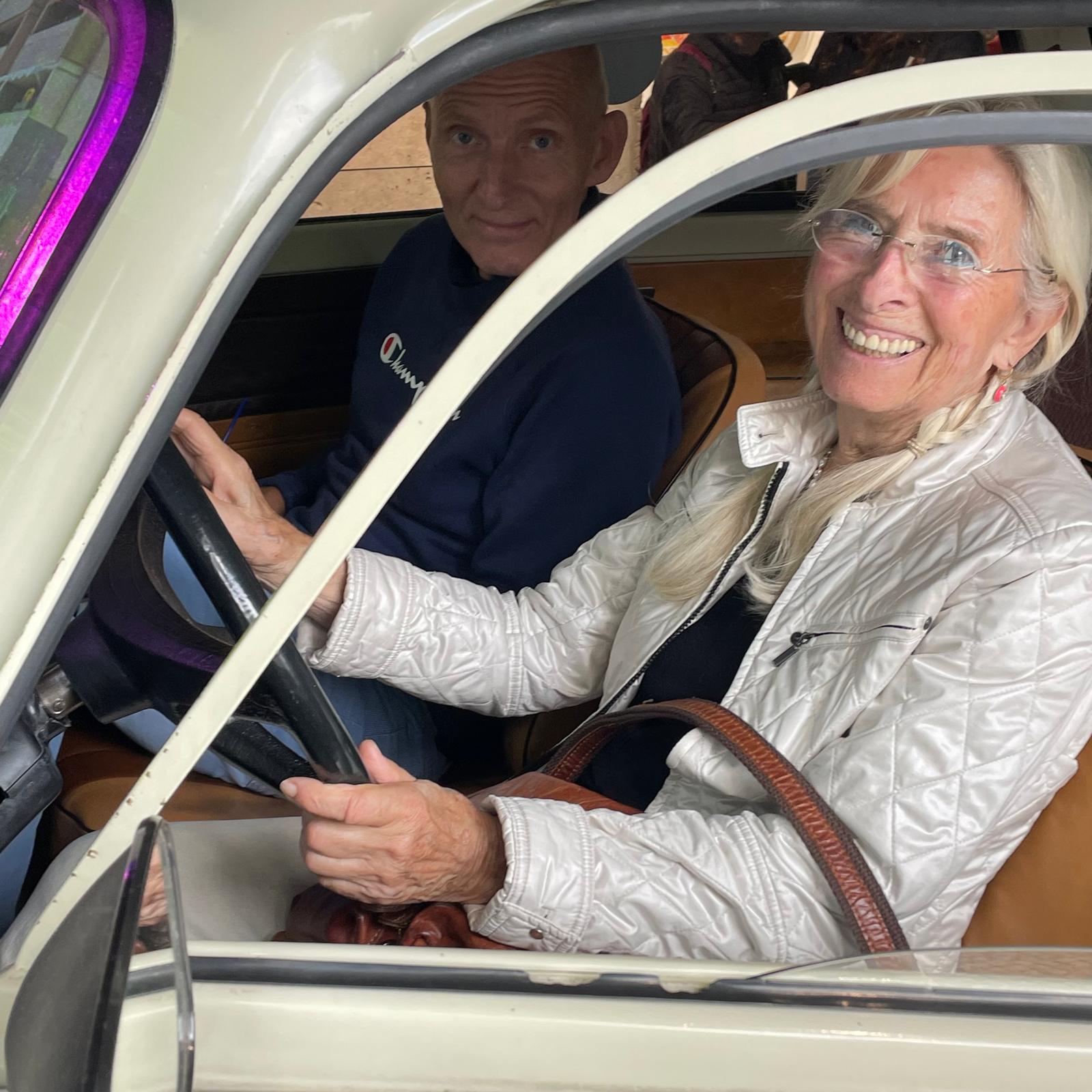
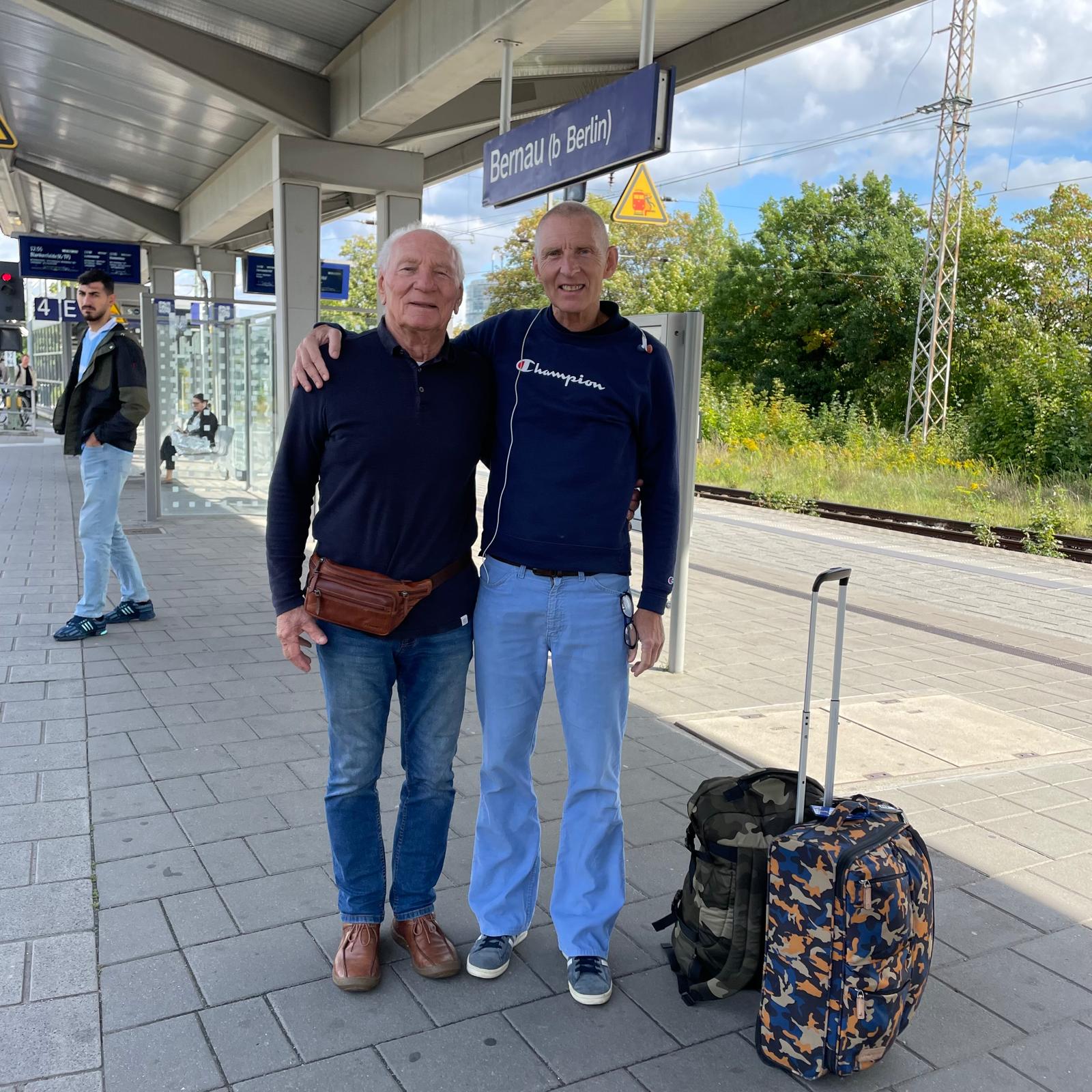
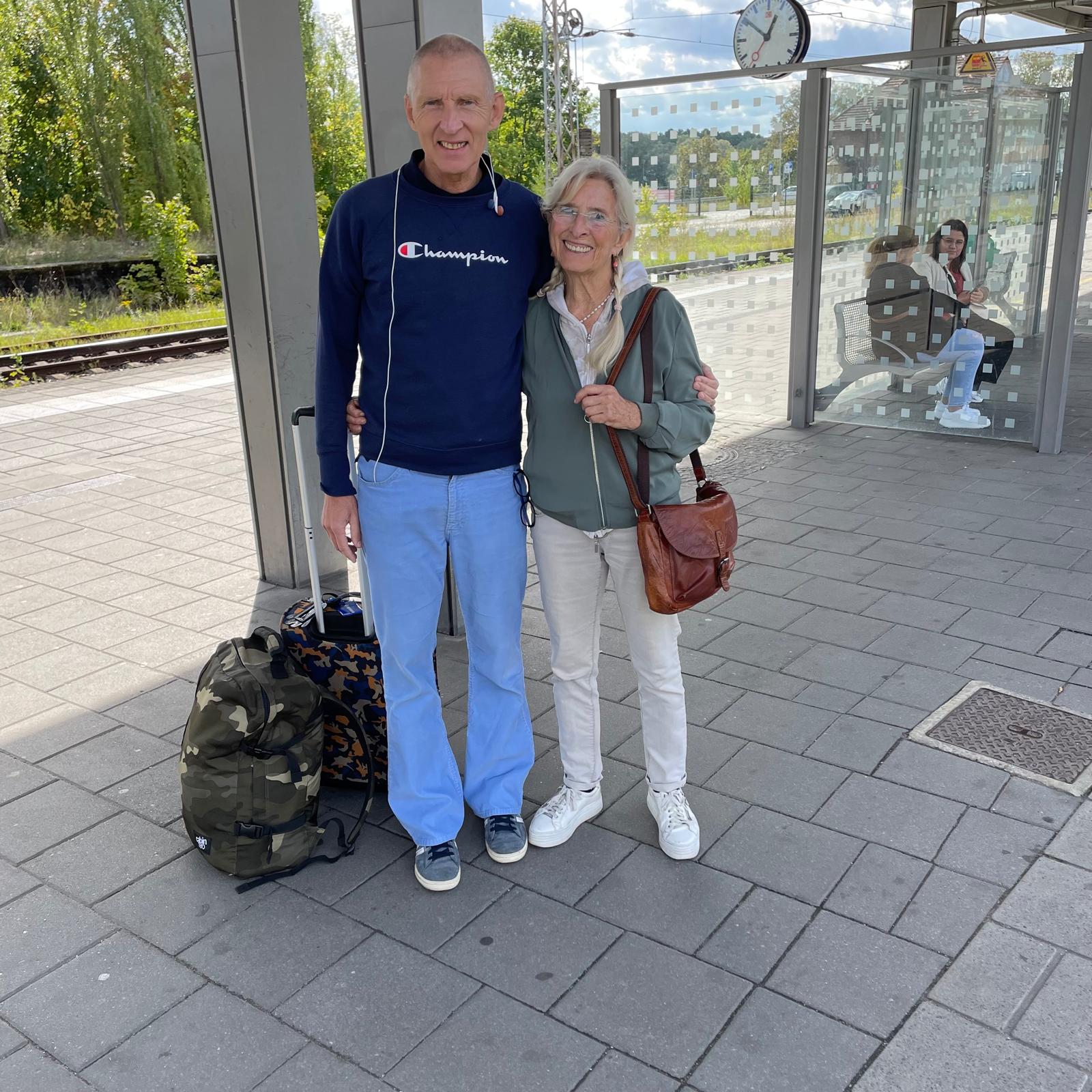
Although I did not participate in the Berlin triathlon as originally planned, as I have discussed two weeks ago, I did manage to spend a few happy days with my parents in Germany.
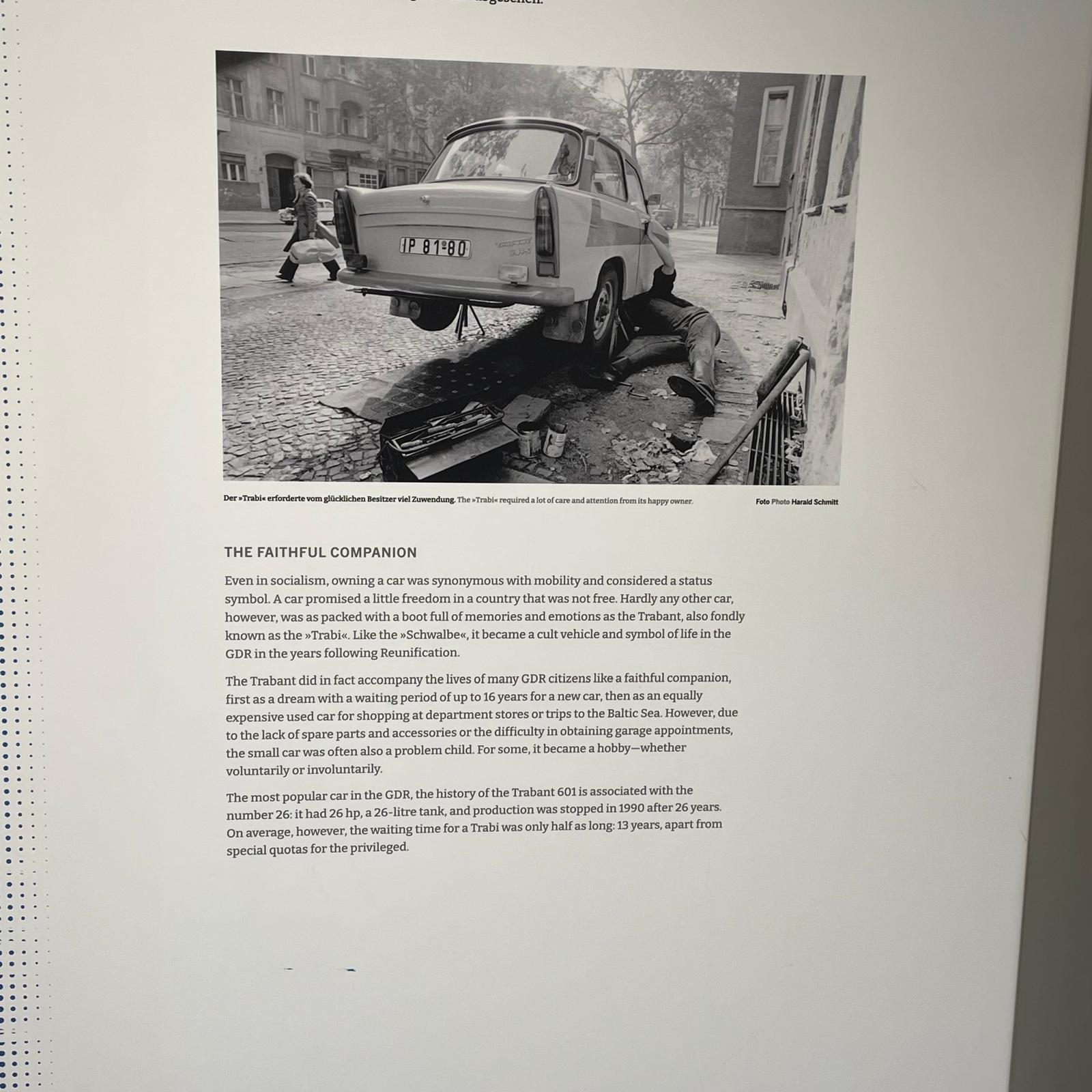
One of the highlights was our visit to the DDR museum in Berlin.
DDR stands for Deutsche Demokratische Republik (i.e. German Democratic Republic), or in short, East Germany, where I grew up.
We also went to watch a movie that played in East Germany in the 1980s before the fall of the wall, called “Spaziergang nach Syrakus” (A Stroll to Syracuse). The movie was about a man longing for the adventure to walk all the way to Syracuse, which is a town in Sicily in the south of Italy, a Western country, which citizens from East Germany were not allowed to travel to. So he decided to flee East Germany, by learning how to sail and then trying to sail his boat across the Baltic Sea to Denmark.
However, the man also loved his wife and his life in East Germany. Hence, he planned something that was unheard of in East Germany – to flee and then try to come back.
His succeeded in escaping. But shortly thereafter, the Berlin wall and the iron curtain between the East and the West came down. When he eventually returned to his home town, everything had changed.
Both visiting the museum and watching the movie brought back many memories of my childhood and youth in East Germany, the weekends we spent together in our garden, our family get-together’s at my grand-parents home, travels with my parents and sister, Christmas at home, and spending time with my grand parents.
What exactly is it that we miss when we were young? For me, to my surprise, the things that came to mind first were people – my family. It seems that what really matters in the long run, at least for me, are our personal relationships.
Interestingly, the Singaporean taxi driver who took me to the airport felt similar about his own youth. He talked about how things used to be different when he was young and lived in then rural Bedok, and how happy those times were. Perhaps he was also thinking of the much closer relationships he had with his friends and family in those times.
When people feel melancholic about the past, they often forget about all the negative aspects and all the progress that has happened and made our lives more convenient. I guess that is part of human nature.
But did all the technological progress since my childhood and youth – computers, mobile phones (or any phones), the internet, not to mention social media and AI – actually help make me a happier person?
The answer is probably ‘not really’.
The things I really enjoy doing now I could do then almost as well as I can do now: exercise, listening to music, reading. They have become more convenient, but the essence has not changed. The same is true for travelling (which at this point I don’t enjoy as much as when I was young). But we lost the most important part, close ties to our family and friends, because when people have the choice to live their own separate lives, they often do.
They do because living our separate lives seems easier and more convenient, and because all the technological progress makes close ties to our family and friends unnecessary.
When I was a student, I had no telephone in my home. So I had to actually visit my friends and family (often unannounced).
When I was a child, we only had one TV set in our living room, and every Saturday we gathered there with my parents and sister to have dinner, eating our favourite meals that my mum prepared, watching our favourite shows. I will never forget those times.
HIGHLIGHTS FOR WEEK OF 14 – 20 SEPTEMBER 2026
Race Against Cancer – 20 September 2026
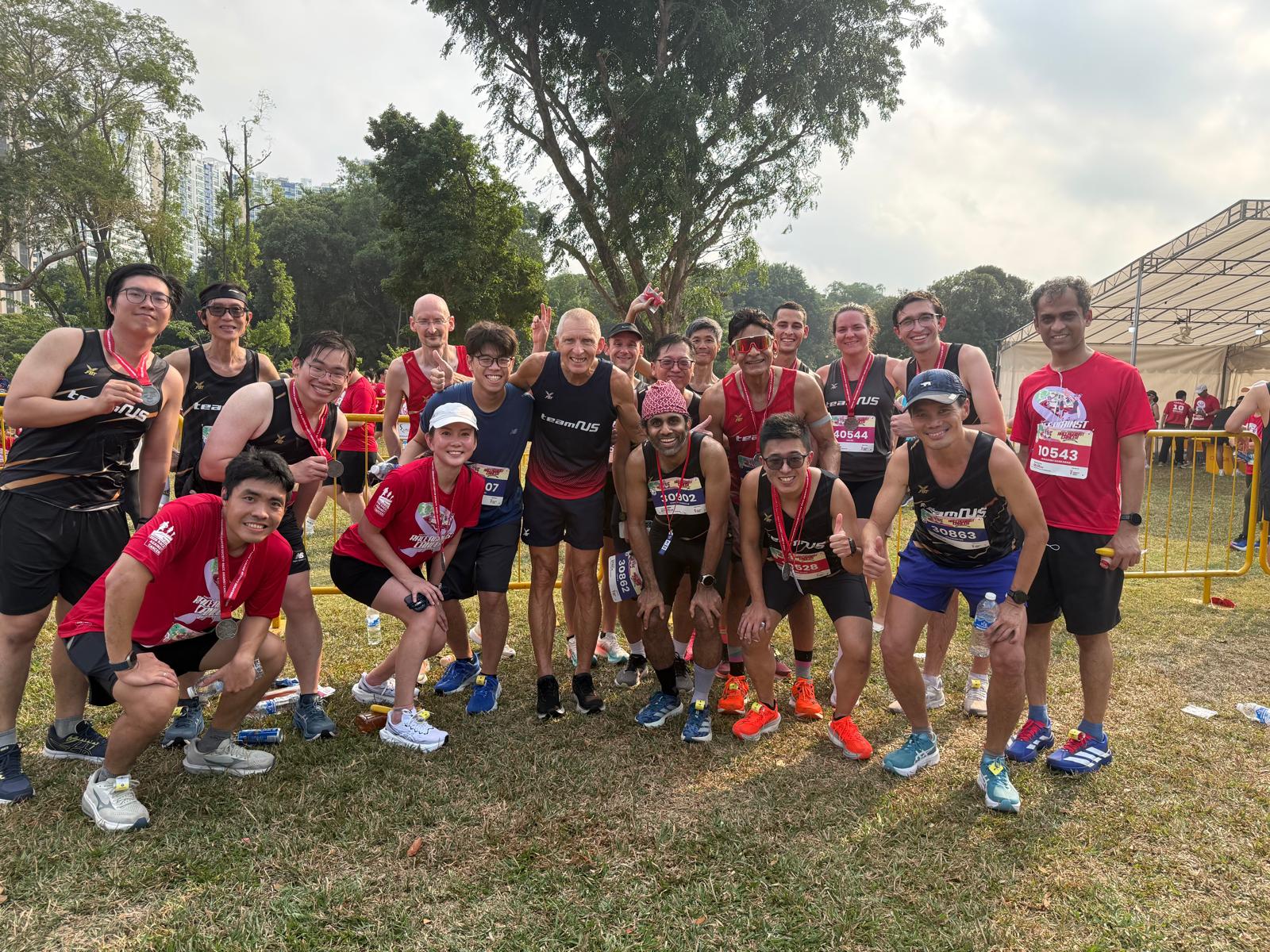
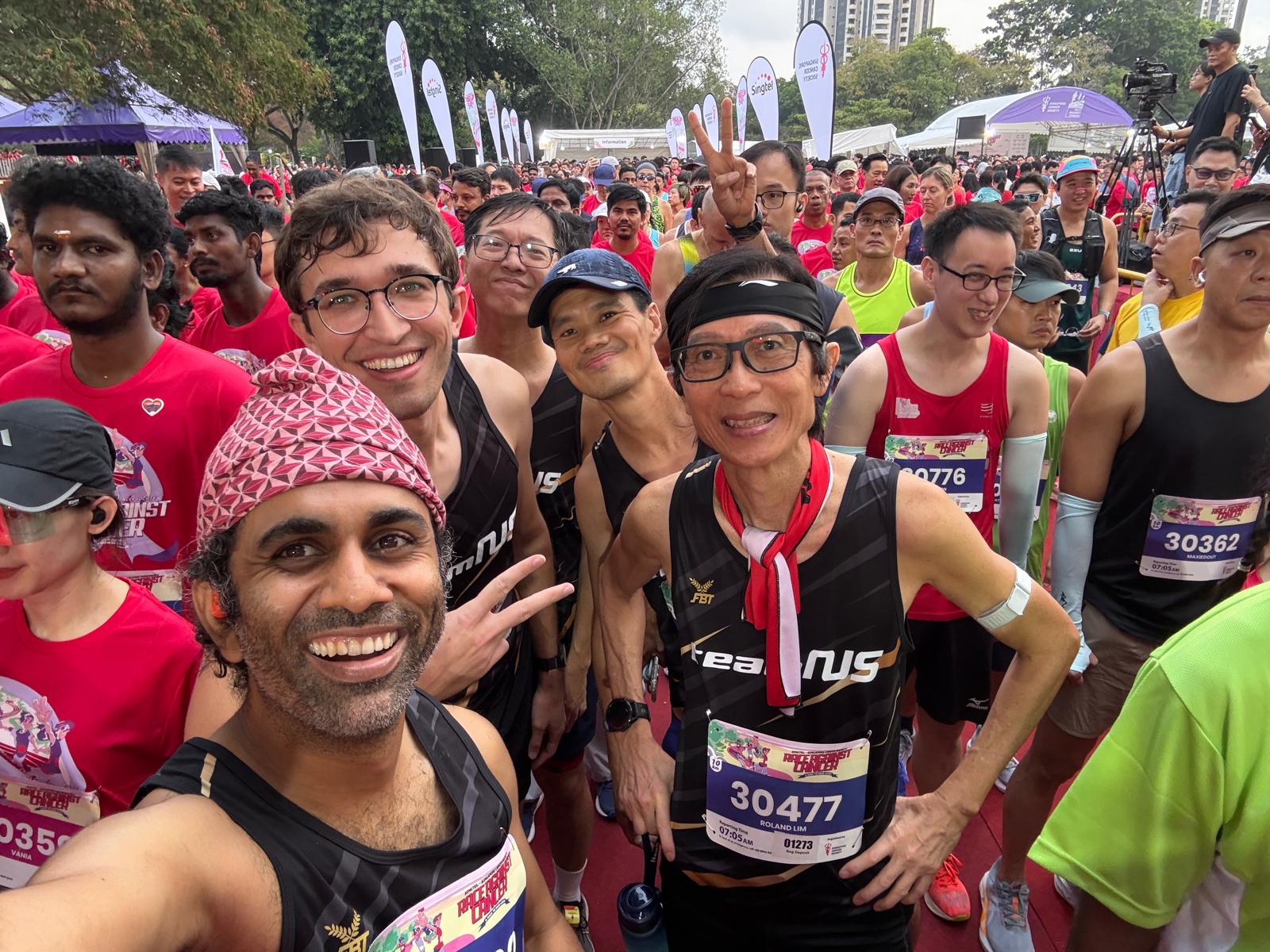
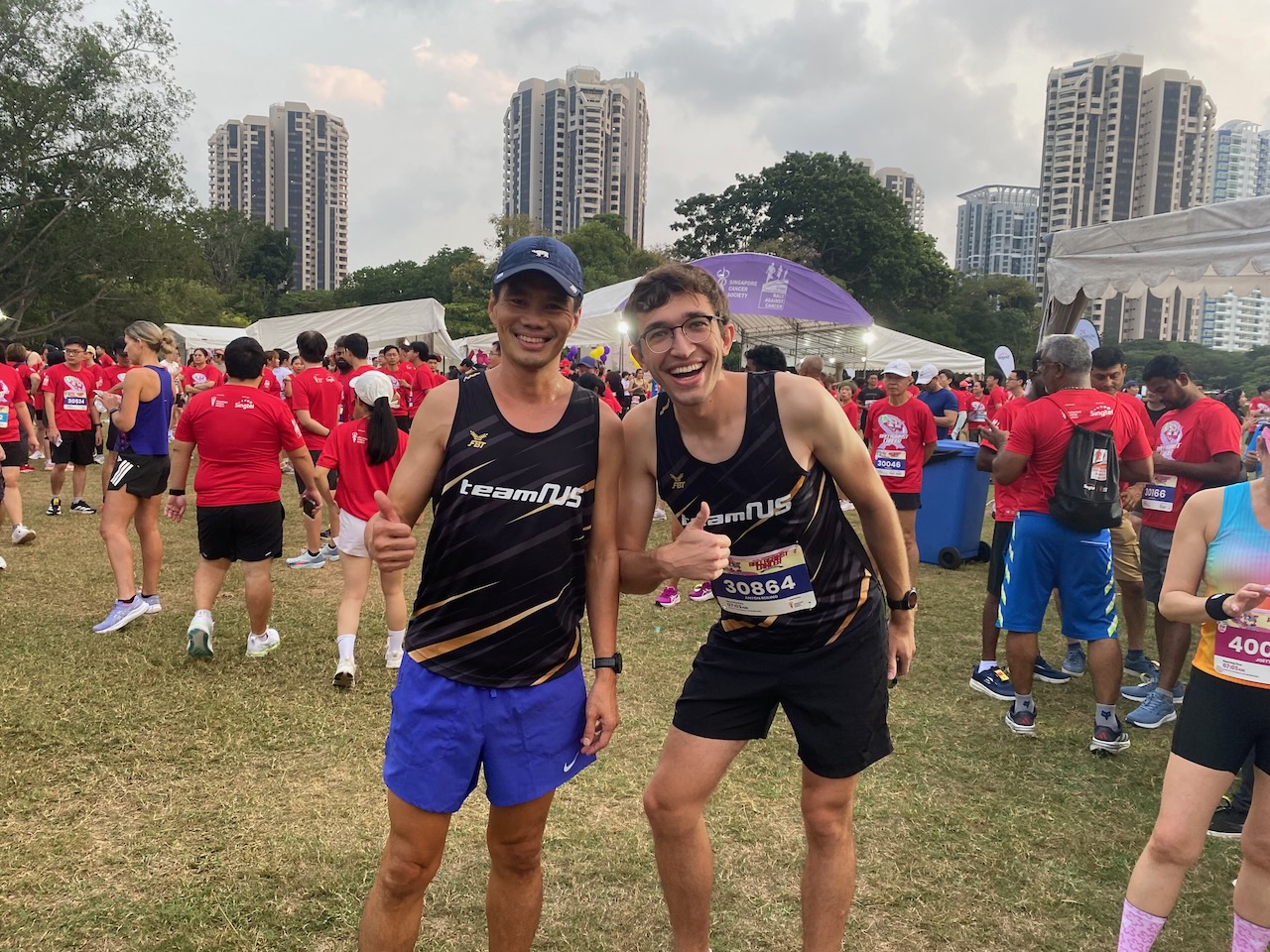
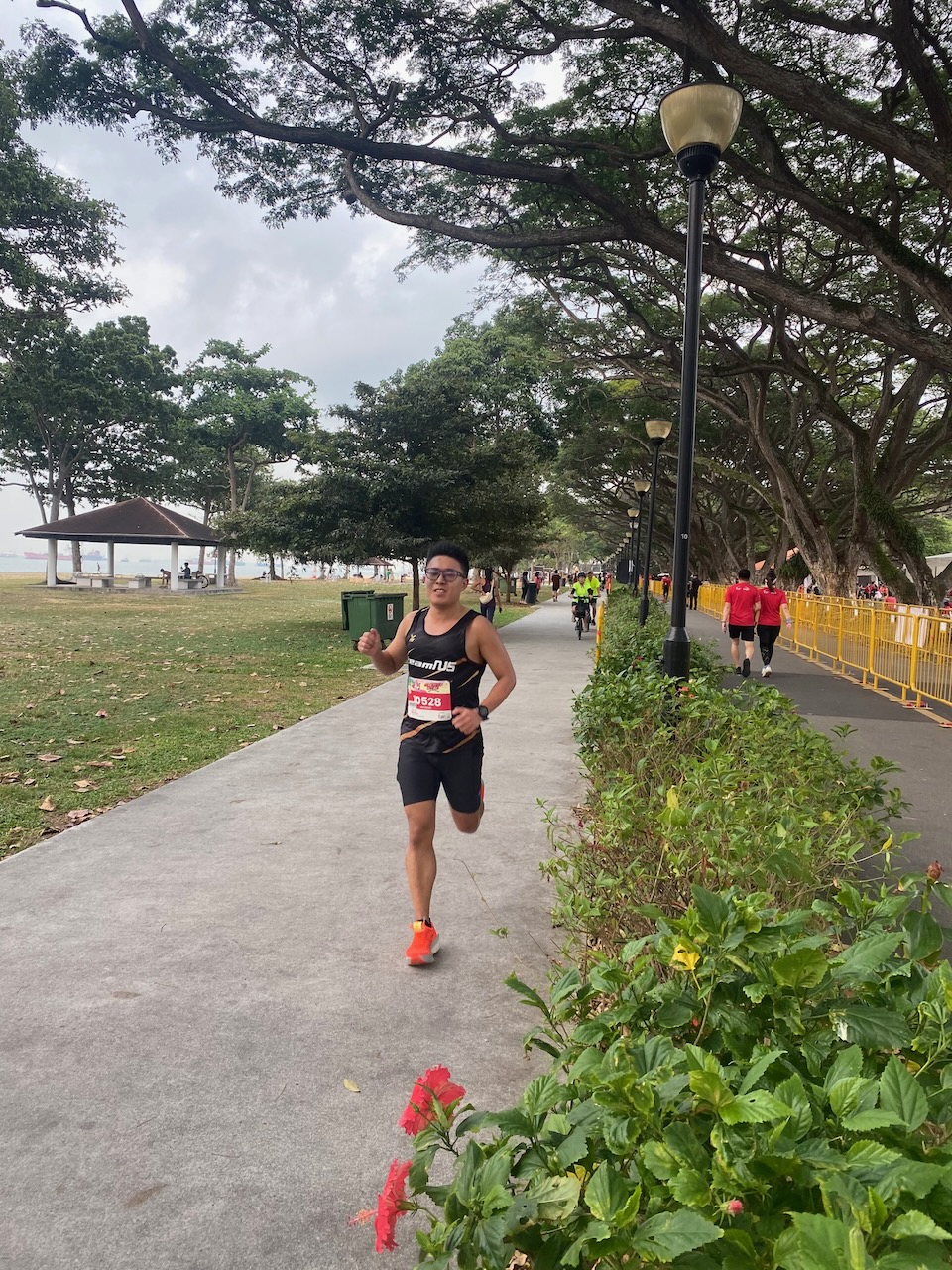
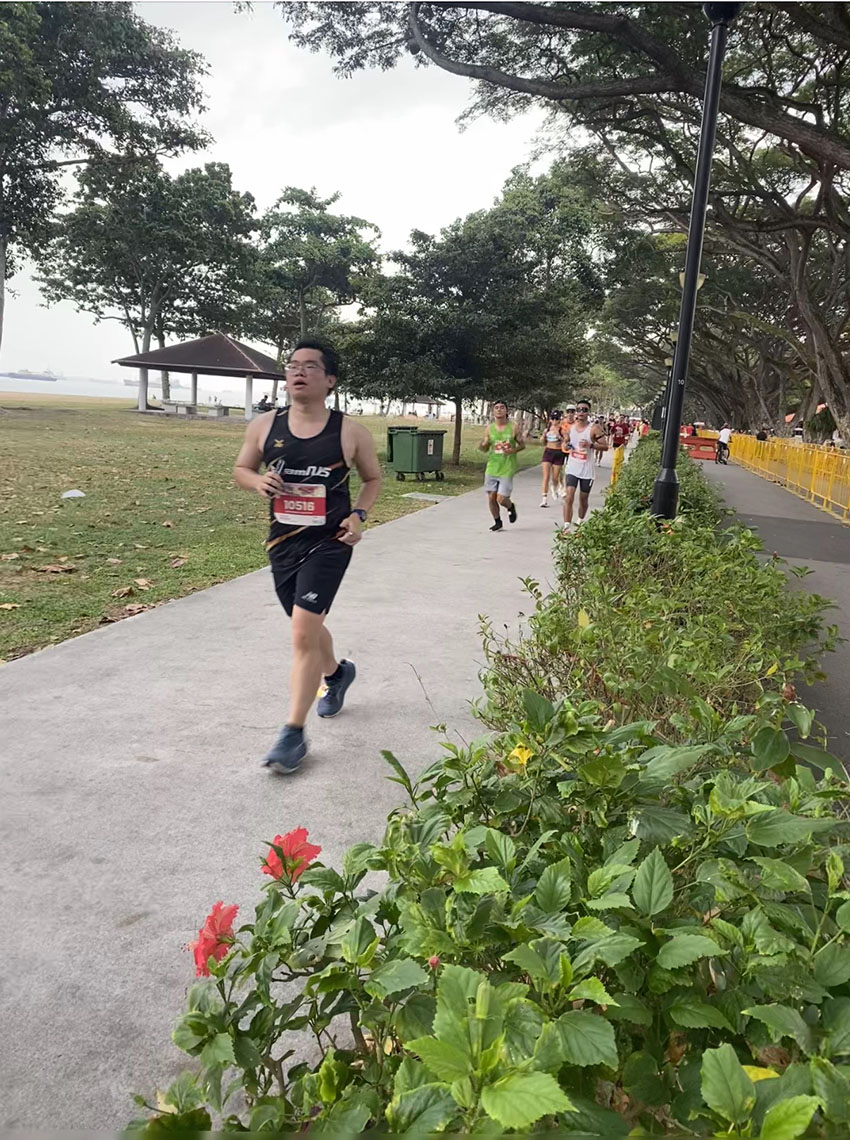
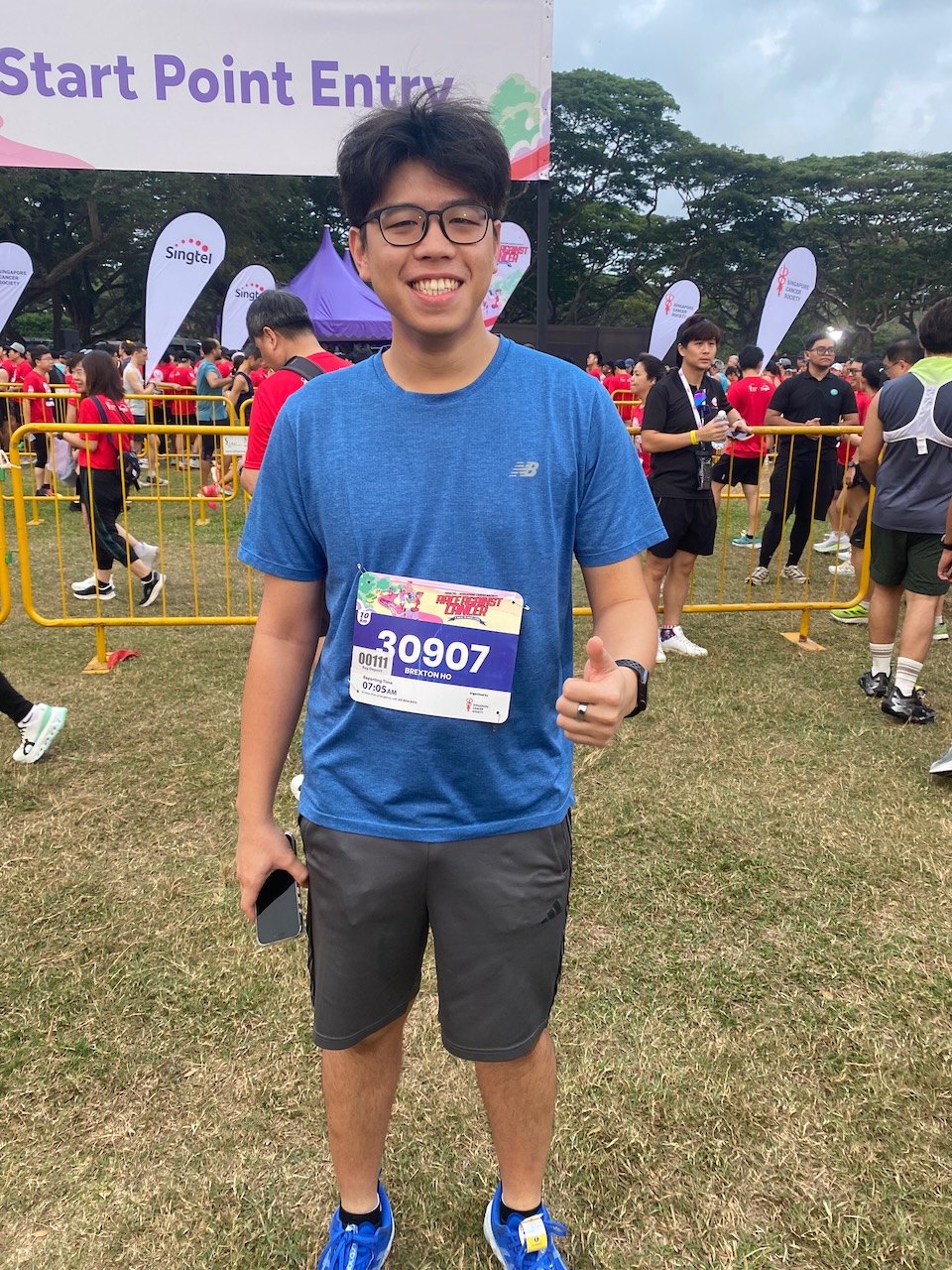
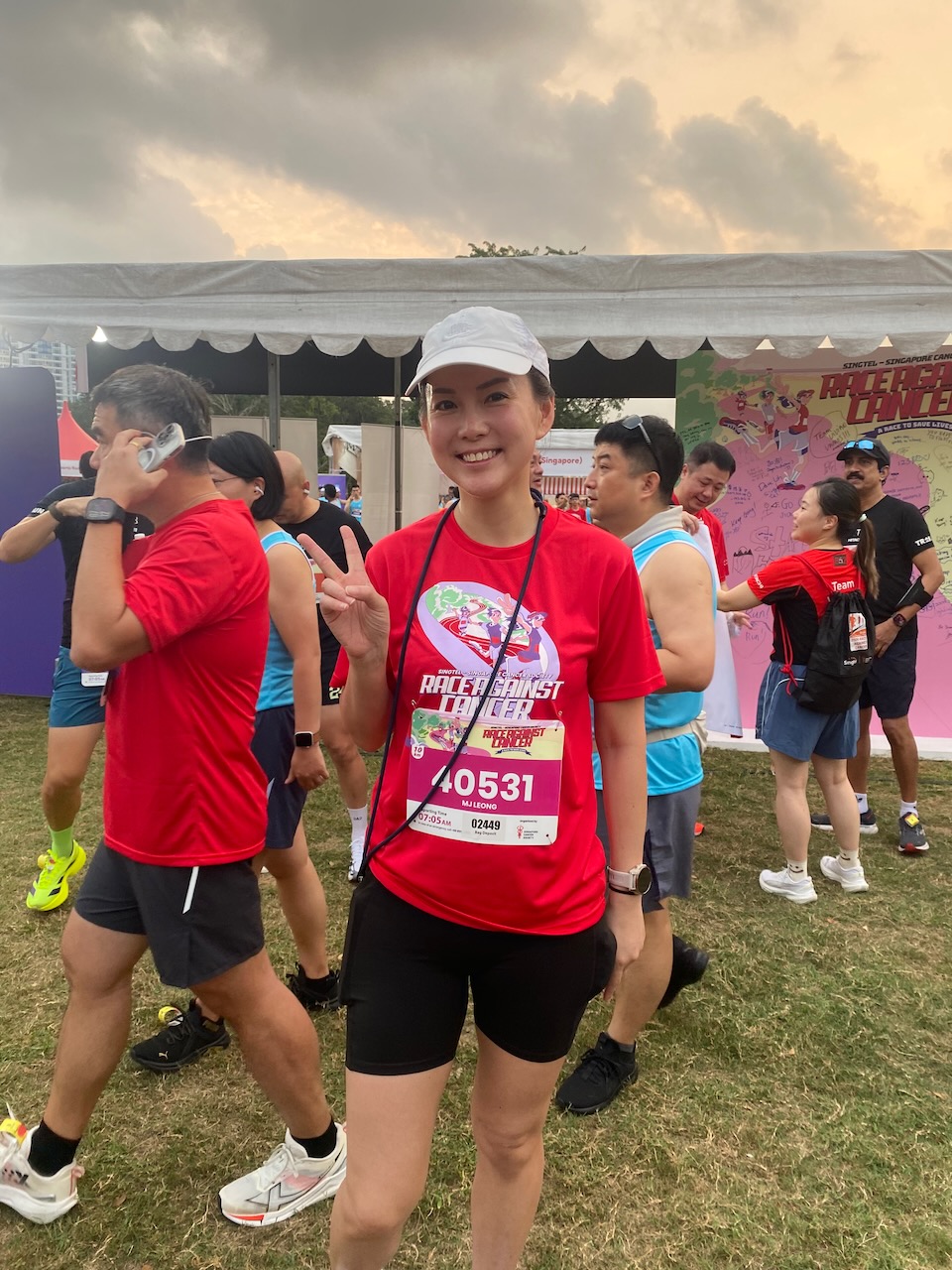
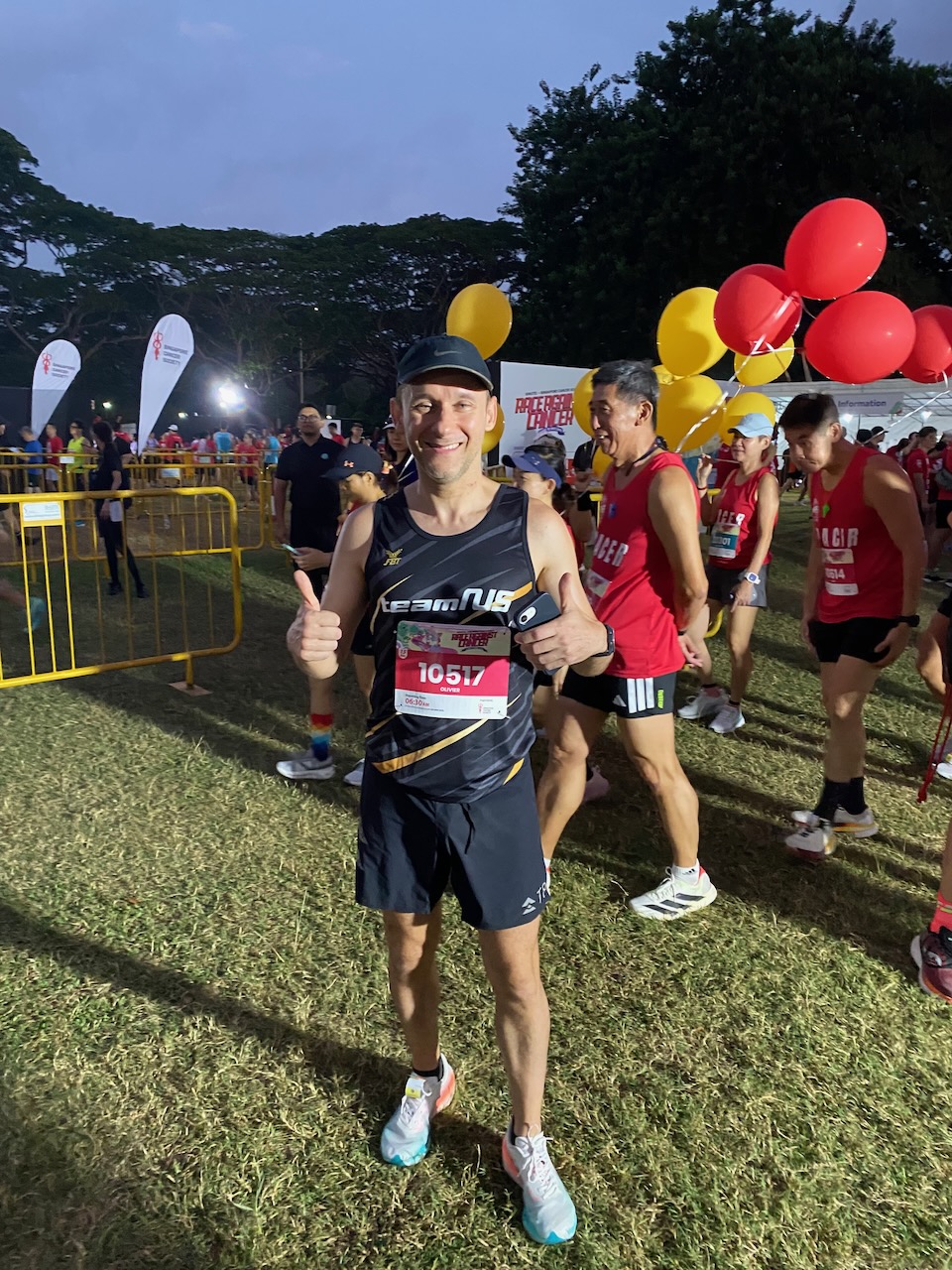
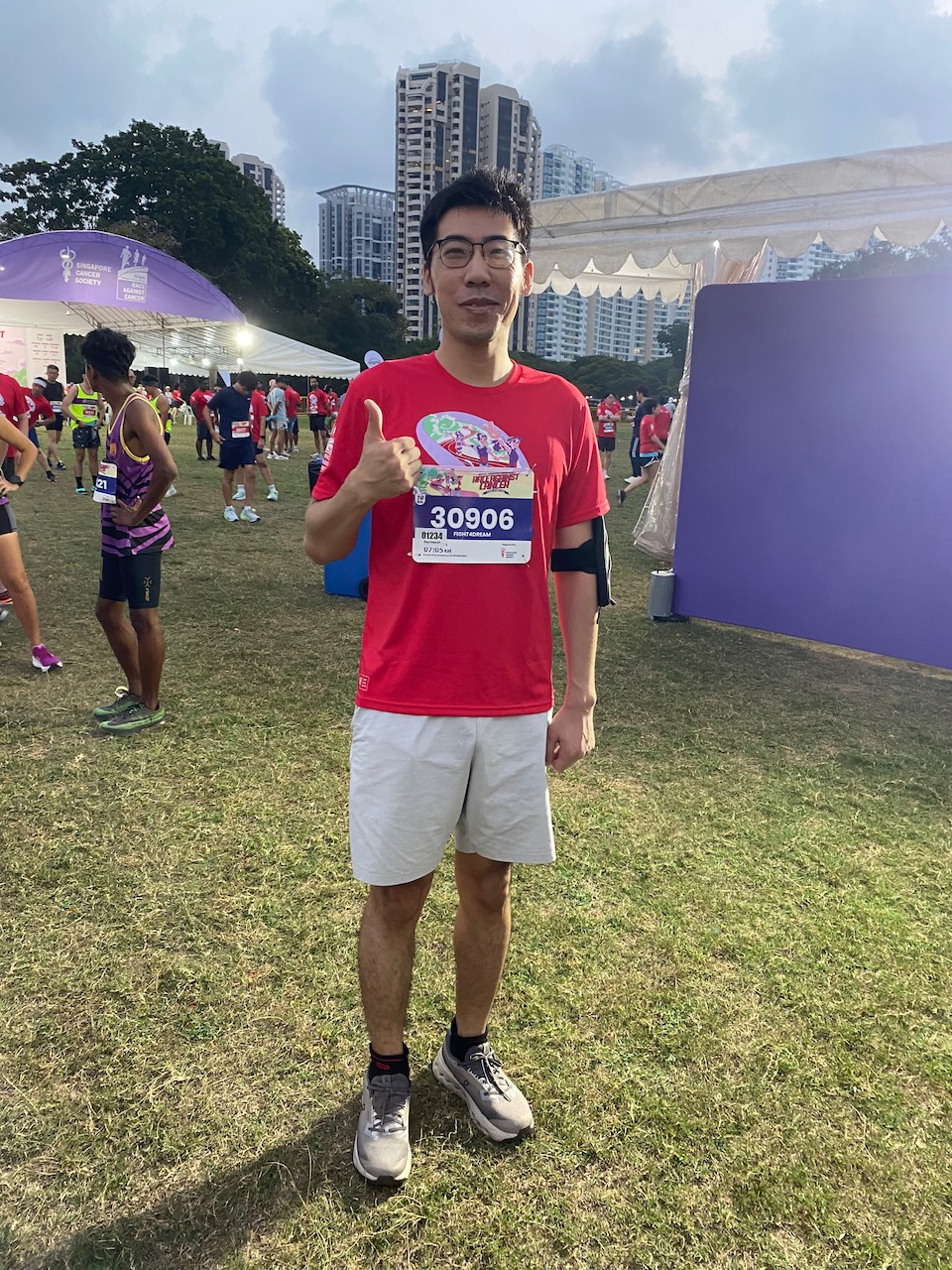
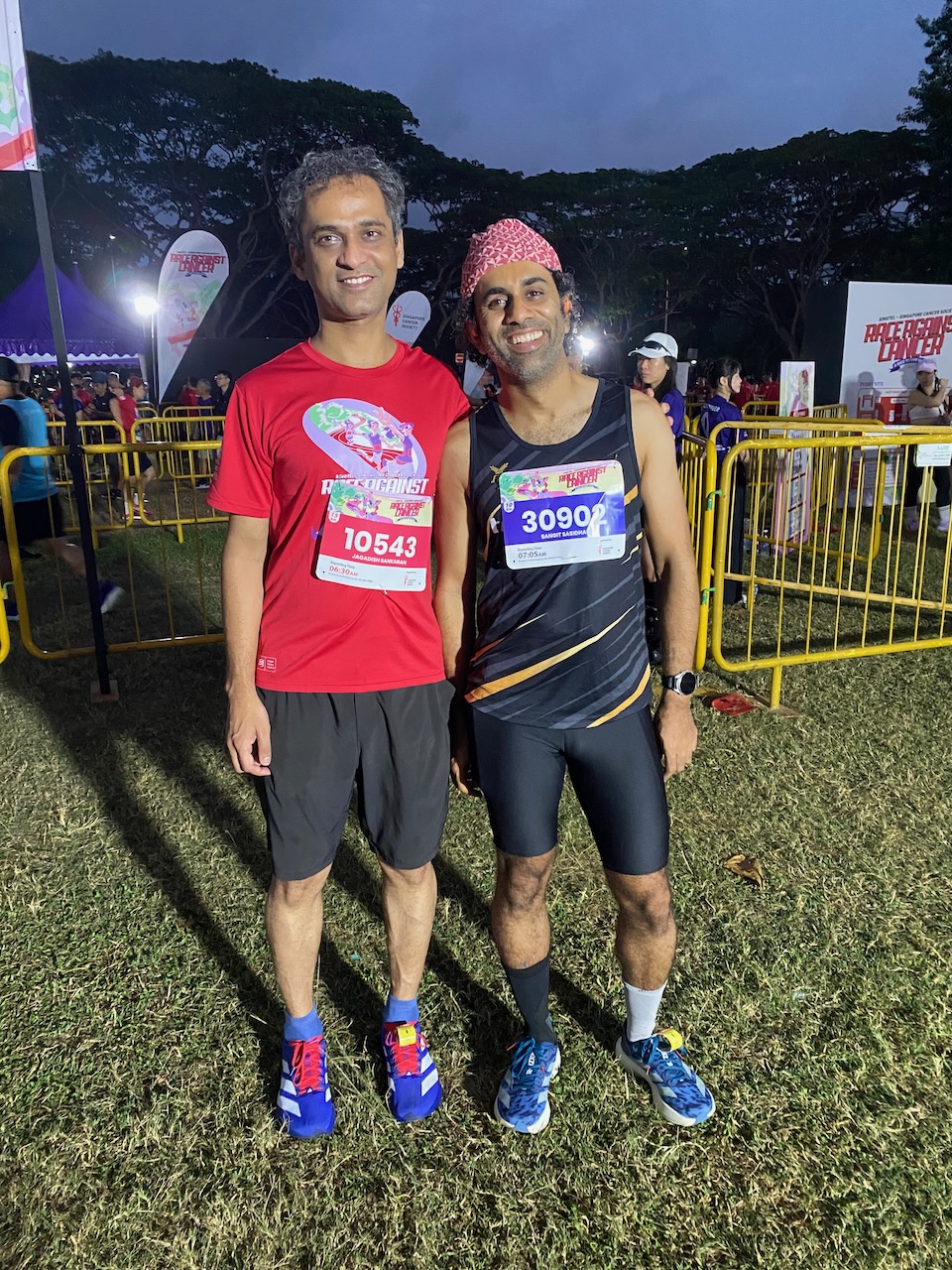
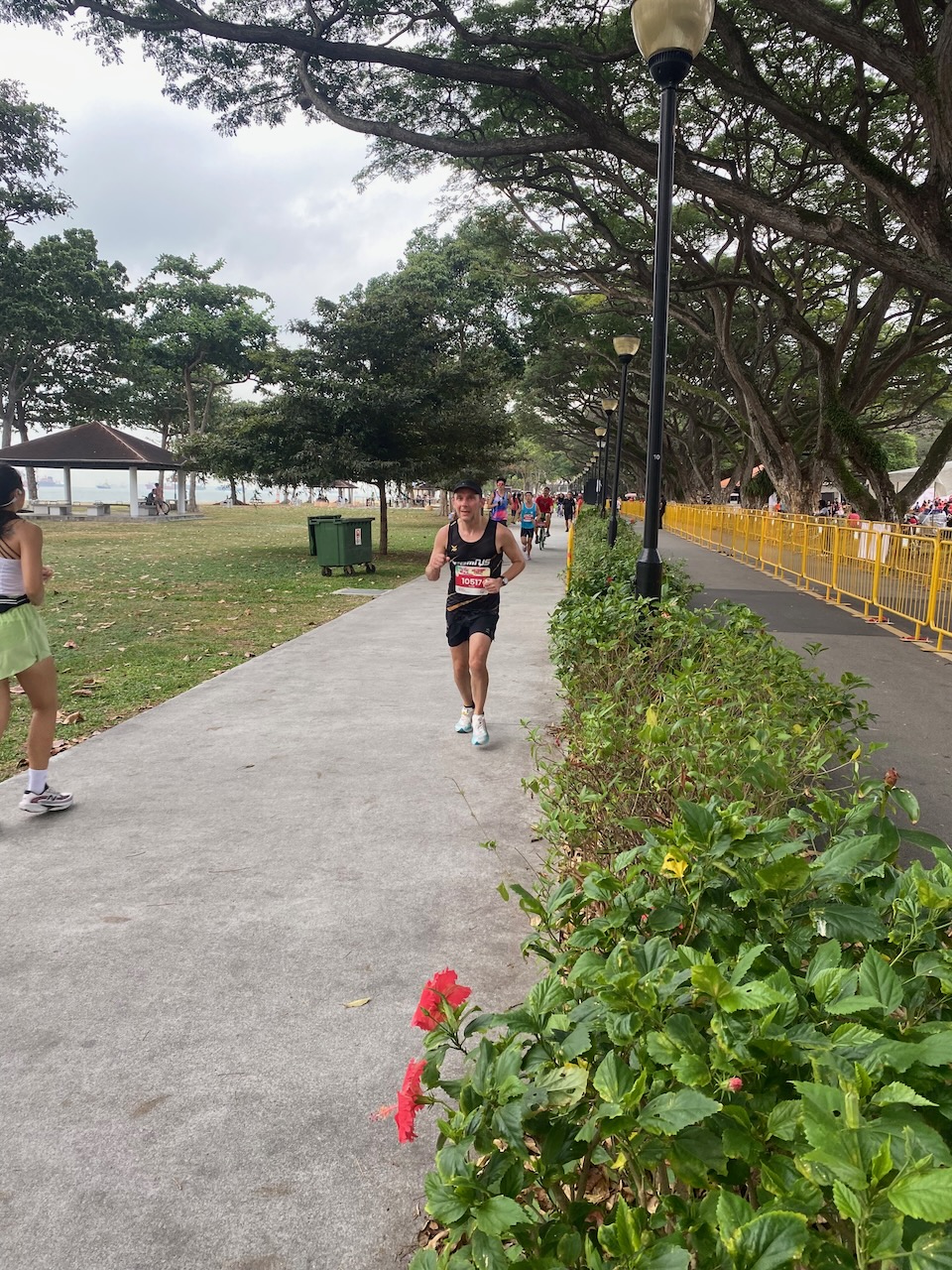
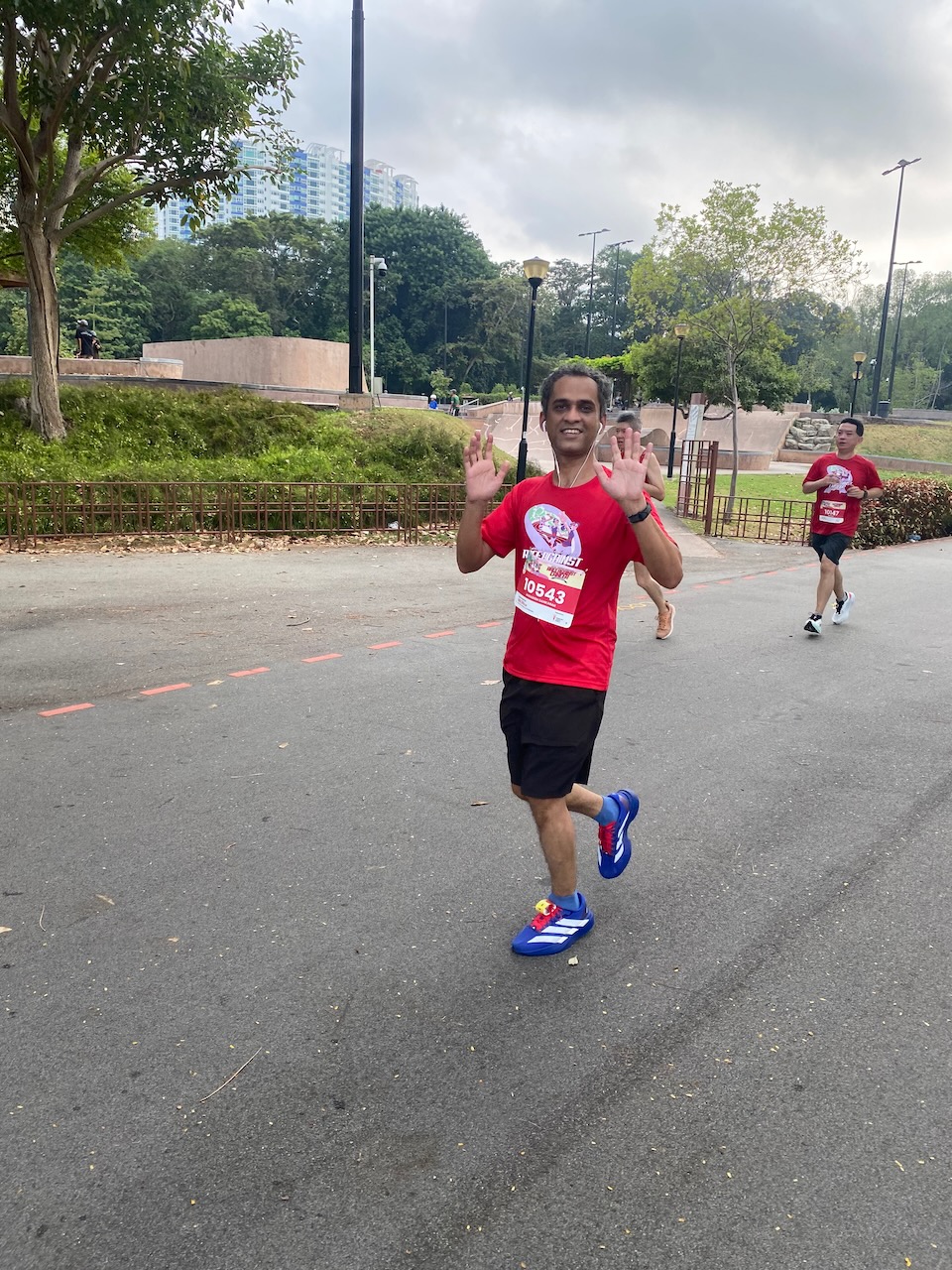
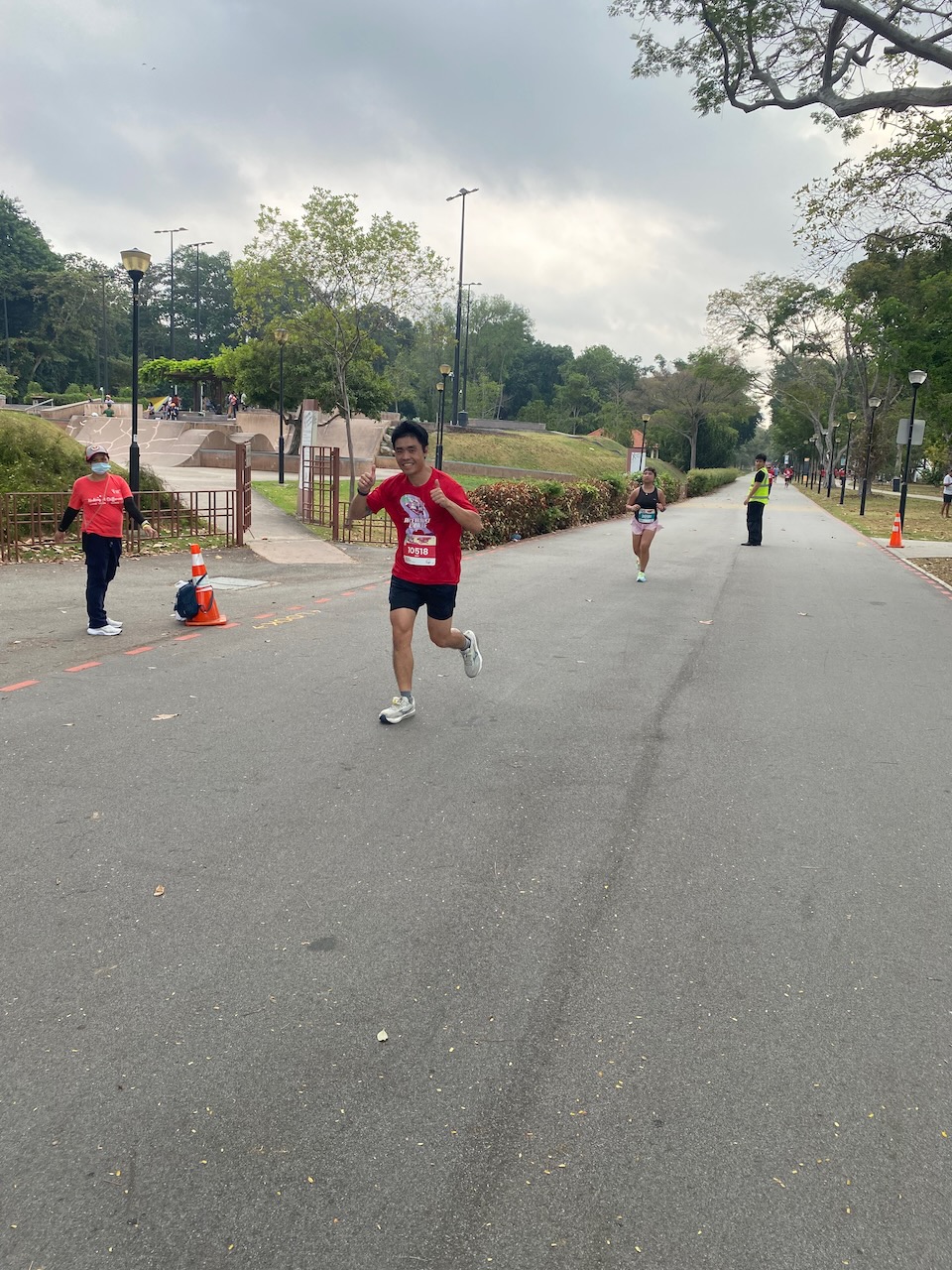
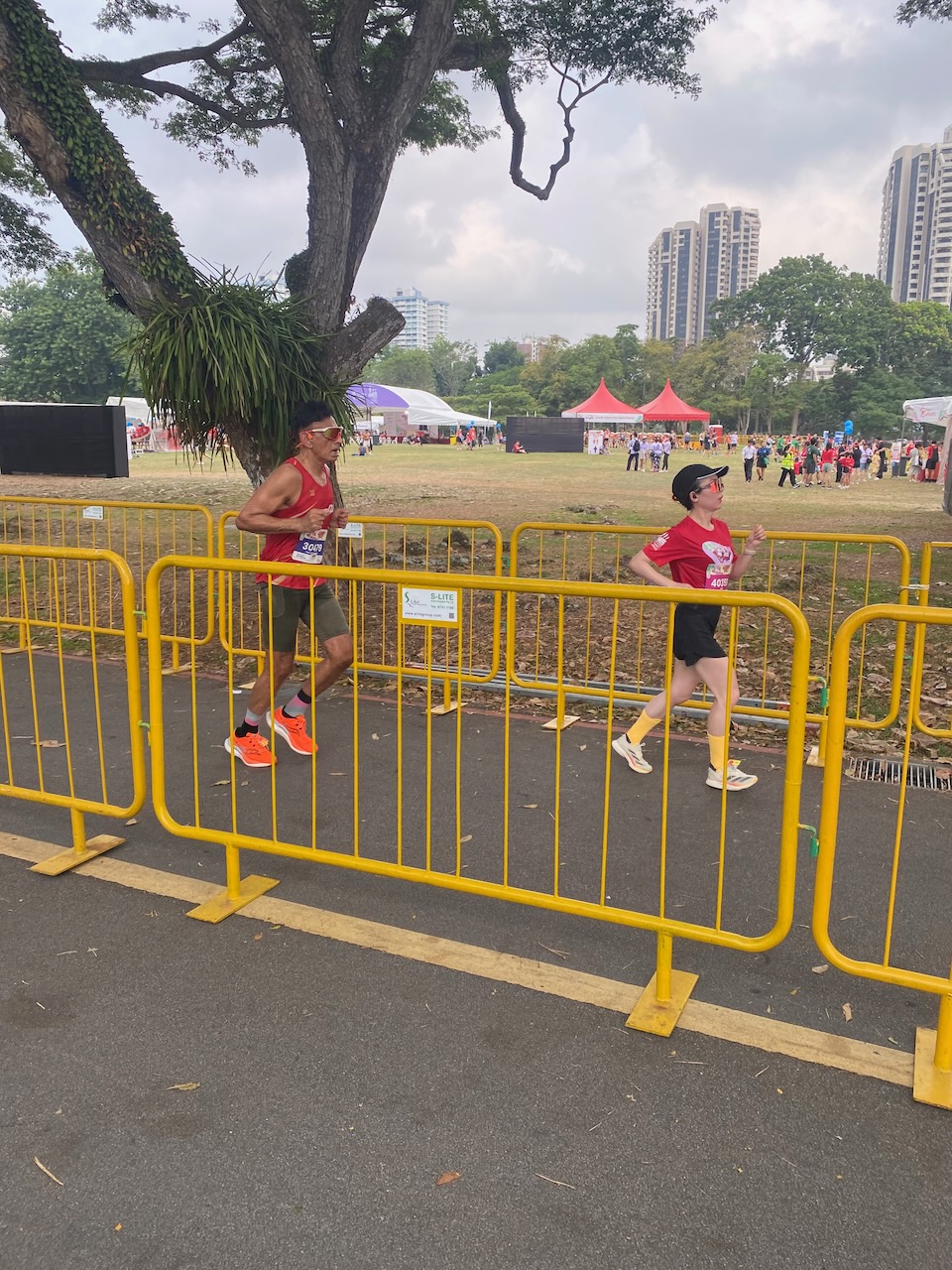
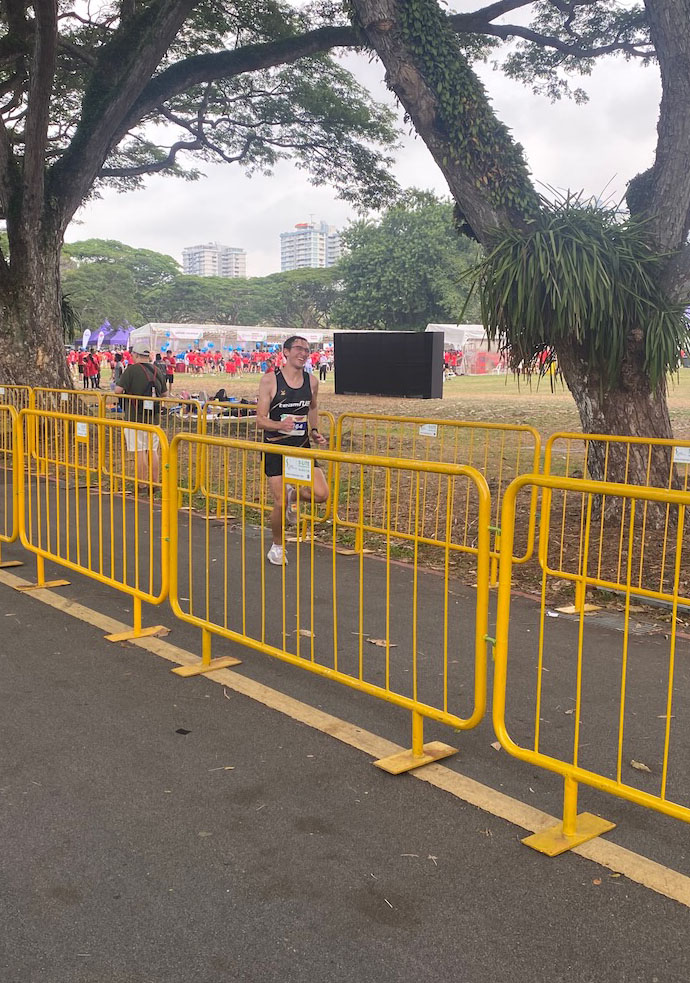
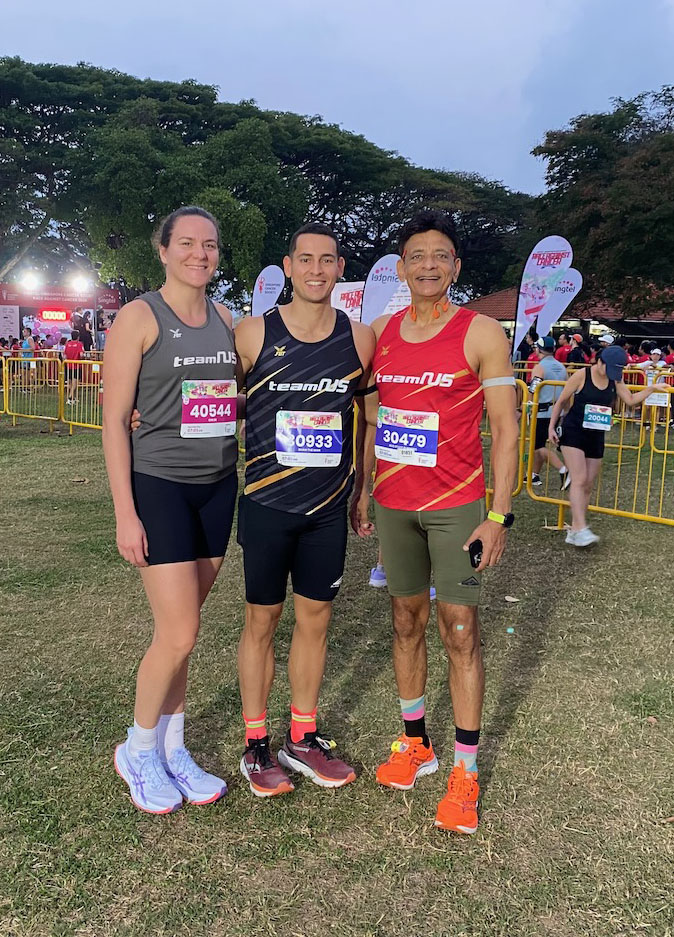
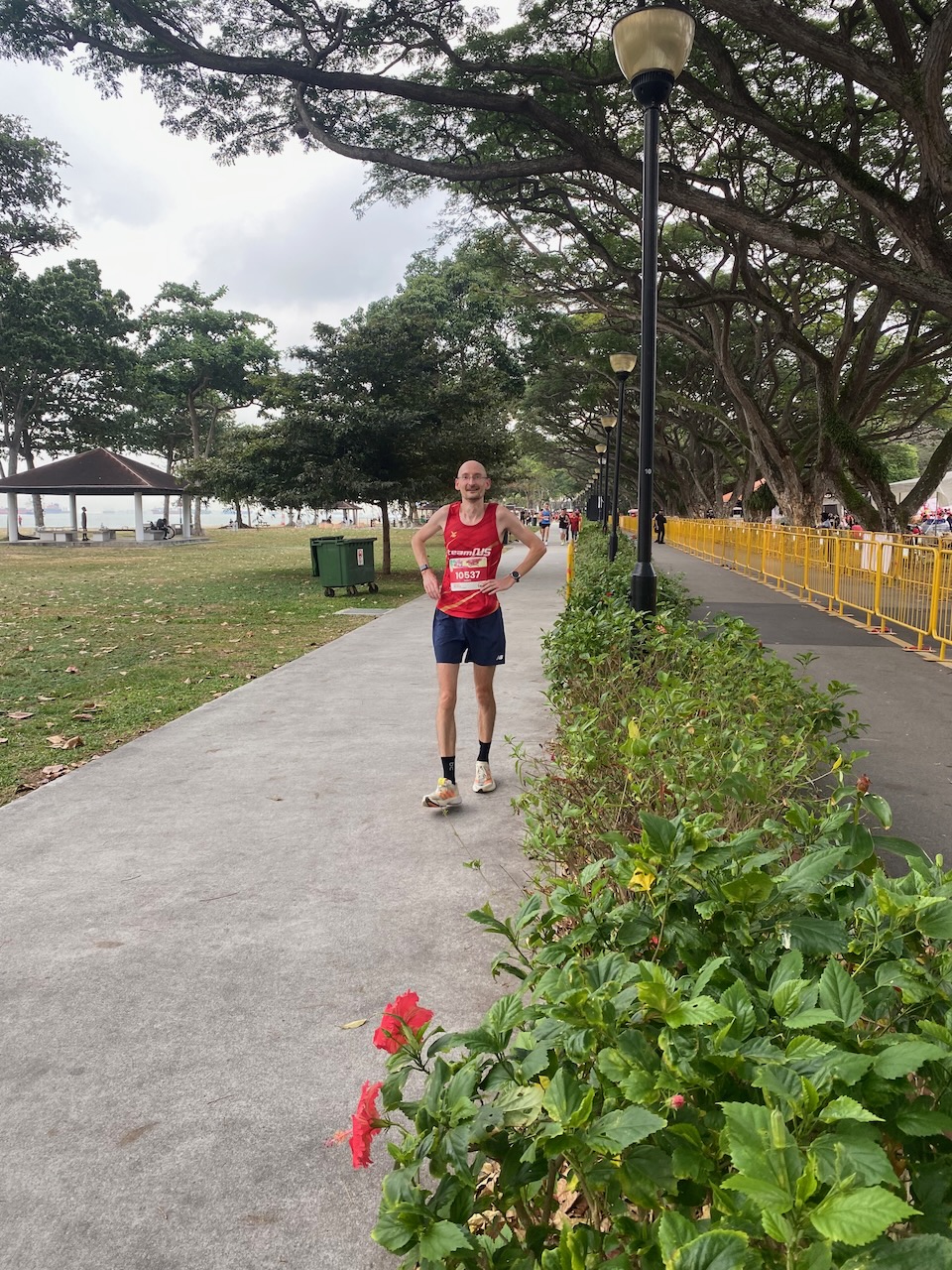
On 20 September 2026, our NUS Staff Runners team participated again in the Race Against Cancer at East Coast Park.
I was a dry morning with mostly cloudy skies. As such, the conditions were much better than the previous year when for the second half of the race, the sun was out and it was very hot.
We had 17 runners participating in the 10 and 15 km categories, and our runners did well, with some great results.
In the 15k category, Wei Siang stayed below 1 hour and came fourth overall. Olivier also did amazingly well and finished 14th in 1:07:17.
Over 10k, we had three runners in the top 20 overall, Alvin (8th), Sangit (9th), and Johnson (15th). And Anton came 21st.
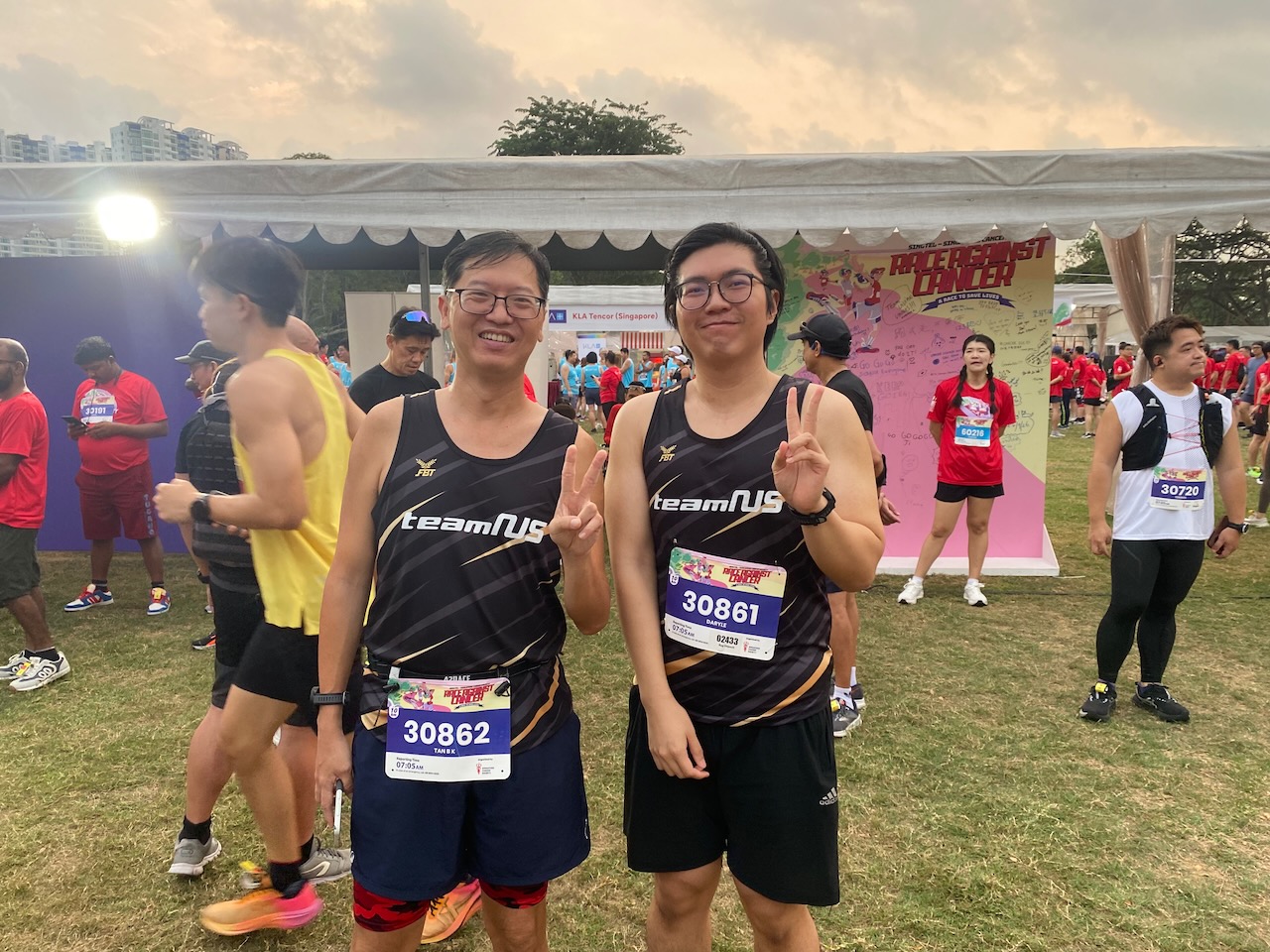
Also over 10k, Daryle showed a great performance in his first ever race, maintaining his pace throughout. Roland came close to his PB, and Meijun ran an impressive negative split.
So all in all, it was a good day for NUS Staff Runners!

HIGHLIGHTS FOR WEEK OF 7 – 13 SEPTEMBER 2026

My triathlon that wasn’t
After training for my 70.3 triathlon for the past three months, making all the complex race preparations and traveling to my parents’ home in Germany for the race, I decided in the end not to participate. I felt not ready.
I fell ill with food poisoning two weeks before the race and based on the workouts I tried after recovering, I felt that I did not have the fitness to complete the race. Running felt very difficult, and on the days leading up to the race, I simply could not imagine that I could actually complete the distances.
I believe I did make the right decision, but it was not easy. This is in part because when I try to make a decision such as this, I often consider how other people may judge me, and I am probably not alone in doing so.
Rationally, I do know that others usually care much less than I think. And if they do, they care much less about my achievements and much more about my well-being and happiness. But even knowing this, there is still a voice inside me telling me I did not live up to the role model that I want to be. Ultimately, however, it is important to remember that while achievements do attract attention from others, it is our actual day-to-day behaviour and care that really makes the difference in how we are perceived by others.
Despite not participating in the event, I did learn some useful lessons.
Firstly, I realised that I did not prepare well in practical terms. I forgot to bring my swimming goggles and realised during a subsequent bike ride that one of my bike petal cleats was loose and probably would have come off during the race.
I also learned that preparing for big events is risky. After spending a lot of time and effort preparing to achieve an athletic goal, there is always the chance that something unexpected happens close to the race. In fact, I have spent the last weeks in constant anxiety about falling ill and taking precautions to prevent it from happening. As such, it is worth considering whether such big goals are really worth my time and effort.
Even more importantly, the training for this event kind of took the joy out of doing exercise. Looking back, the workouts I actually enjoyed were those where I took breaks while cycling around Singapore or stopping at East Coast park to go for a swim, or went for an easy run in a beautiful park.
It is true that goals are important for me to stay motivated. It is also true that achieving milestones that I can look back on and that I am proud of makes me happy and adds meaning to my life.
On the other hand, it is also crucial to find the right balance between pursuing goals and not forgetting the joy that exercising brings. This balance is different for everyone. There is no right or wrong. Everyone needs to find their own balance for themselves. My failed triathlon experience has certainly helped me find mine.
HIGHLIGHTS FOR WEEK OF 31 AUGUST – 6 SEPTEMBER 2026
AI ethics in my work and teaching
These days, there is so much talk about how AI transforms and undermines student learning in higher education. But there is much less attention to how faculty uses AI tools. One Inside Higher Ed commentary that does discuss this topic, entitled, Law Schools Are Asking the Wrong Question About AI, highlights that most institutional AI policy focus primarily on students, “even though professors increasingly are using it to prepare lectures, develop examinations, create grading rubrics, provide written feedback, conduct research and carry out administrative work.”
Indeed, in my own school professors have been using AI tools to generate multiple choice exam questions or write an interactive textbook for medical students. I can only imagine that students would view this as a kind of double standard.
The Inside Higher Ed article sums this up as “Universities generally have treated AI as an academic integrity issue for students while simultaneously embracing it as a productivity tool for faculty.” Instead, the article advocates that “[Students and faculty] should … be guided by common principles of transparency, professional responsibility and accountability.”
I have previously written about how, during the last semester, I used google’s NotebookLM to produce a podcast based on an assay that I had written and then asked the students to listen to the podcast. Although using the AI tool was an eye-opening experience for me, I subsequently conveyed to my class that I view my approach as a mistake.
I recently came across one good criterion for whether using an AI tool for a specific task is ethical (although I cannot remember where I have heard or read it). If we are using AI for a task where asking someone else for help would be considered cheating, then using AI in this circumstance would also be unethical. For instance, asking a friend to do our homework for us would clearly be cheating, while asking someone else to help us study by quizzing us on the study topic would clearly be acceptable. The same is true when using AI.
Judged by these criteria, I would consider using AI to produce a podcast for me as cheating, even if the podcast is based on my original assay and if I declare that I have used an AI tool. I believe that professors should lead by example by only using AI tools for things that humans are unable to do by themselves.
In my personal work, I have never used AI for things that I enjoy doing, such as writing (and thinking), figuring out problems and coming up with ideas. I have a love-hate relationship with the google AI summaries. It does make figuring out things so much easier, but I hate how lazy it makes me and how it prevents me from visiting actual websites. I also feel uncomfortable because the environmental impact of my AI powered searches I did not ask for.
I now usually type “-ai” at the end of a search term in my chrome browser (which prevents the AI summaries most, but not all of the time), or use firefox with the “Hide Google AI overviews” extension enabled, which is very effective. I try to reserve using actual chatbots for really difficult problems that I cannot solve by myself, in particular in my research.
One useful way to think about using AI for things that in theory we can do by ourselves is as a form of plagiarism. After all, when we use AI, we take advantage of a tool that was created through training from knowledge, art and ideas designed by other people.
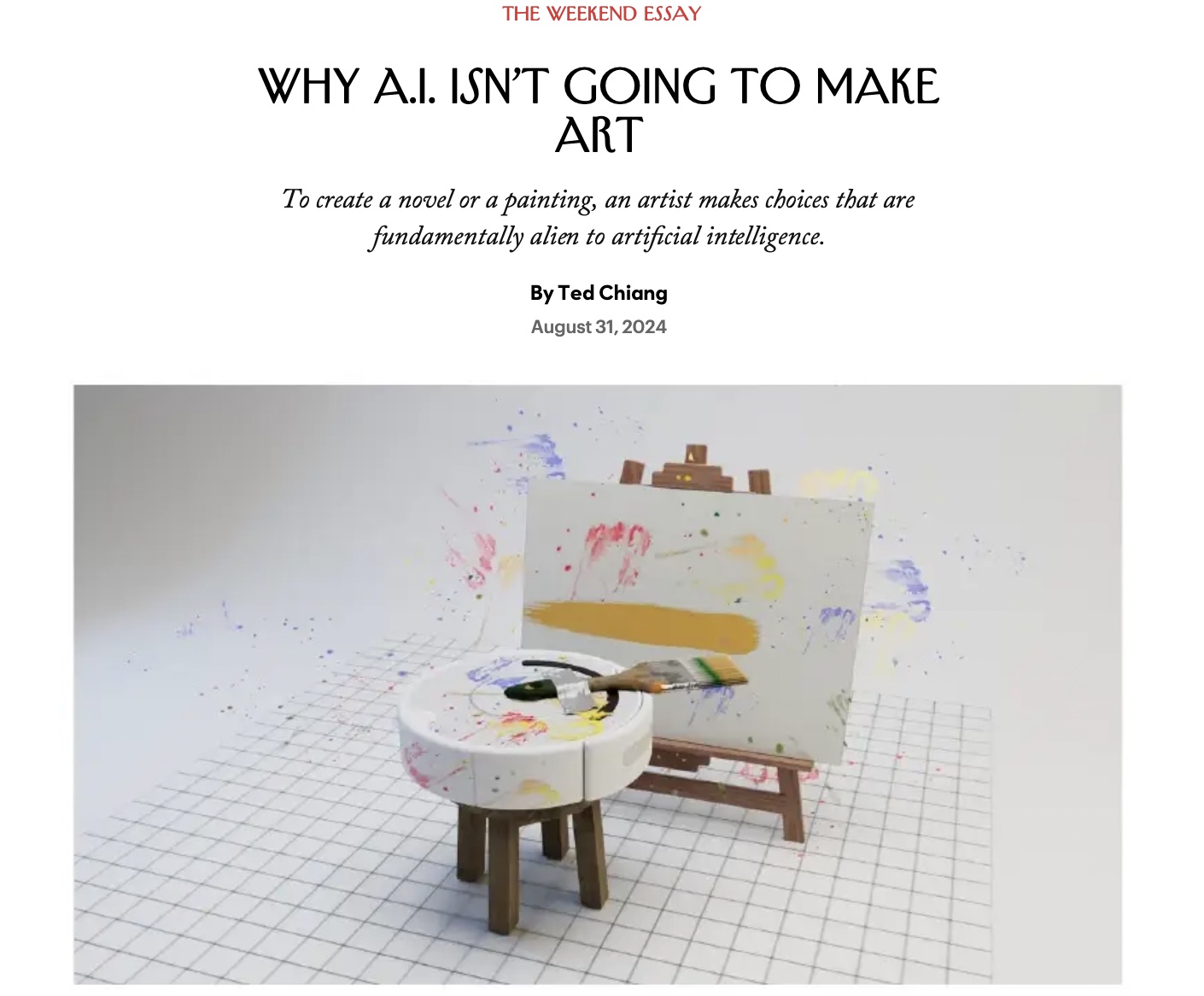
As Ted Chiang, in his article “Why A.I. Isn’t Going to Make Art,” in The New Yorker, puts it, “[AI tools] let you engage in something like plagiarism, but there’s no guilt associated with it because it’s not clear even to you that you’re copying.”
Ted Chiang’s New Yorker article particularly focusses on the arts. He argues that anything created with the help of AI tools cannot be considered art. He points out:
“To create a novel or a painting, an artist makes choices that are fundamentally alien to artificial intelligence.” and “The selling point of generative A.I. is that these programs generate vastly more than you put into them, and that is precisely what prevents them from being effective tools for artists.”
He argues that the same is true for other creative fields, such as writing: “Let me offer another generalization: any writing that deserves your attention as a reader is the result of effort expended by the person who wrote it. Effort during the writing process doesn’t guarantee the end product is worth reading, but worthwhile work cannot be made without it.”
Last year, I received an email from some high school students applying to do a research project (as I often do). Their email sounded extremely enthusiastic and suggested that they had studied my research in great detail.
Subsequently, it turned out, however, that they were not actually that enthusiastic. In fact, it took them five weeks to reply to one of my emails. I figured that they likely sent similar AI-generated emails to various professors (which turned out to be true).
While this was a useful lesson for me and will hopefully help me spot similar AI-generated enquiries in the future, the example highlights that AI-generated text can actually get people to pay attention and deceive someone into believing that the “author” is creative and enthusiastic. Nonetheless, it is likely that the truth will reveal itself sooner or later, as the example of the high school student shows. If someone’s enthusiasm and creative abilities are not genuine, this usually becomes quickly obvious in personal interactions.
As such, Ted Chiang’s call that products that did not afford the creator significant effort are not worthy our attention holds true. Although AI-generated writing can attract someone’s attention, it does not deserve it, because it is not genuine and based on real effort. Ted Chiang’s argument is also true because on the whole, AI generated assays, books, music or art do not truly enrich our lives.
Finally, is there a role for AI chatbots in helping students to learn? As is often discussed, in theory students can use chatbots as a highly effective personalised tutor. I, as a lecturer, can even encourage students to do so.
However, there are two considerations that make me reluctant to do so.
Firstly, I much prefer if students actually interact with their fellow students to work through problems and help each other.
Secondly, when imagining the possibility of AI tutors, what comes immediately to my mind is that students might become too good, creating a grading dilemma. Since our university restricts the number of “A’s” I can award in my course, students becoming “too good” means I either need to give students a lower grade than the one they have achieved based on their overall marks, or I have to make the assessments unreasonably difficult.
As such, it is worth remembering that the main reason why AI is so disruptive to education is that we are grading students. This is what ultimately incentivises students to skip learning and use AI shortcuts.
What if employers and scholarship providers in Singapore would agree to stop using grades to evaluate students, and instead evaluate students by letting them solve difficult problems. This would serve as the best incentive for students to focus on learning. As I have learned in a recent “Inside Higher Ed” article, entitled “MIT AI Report Calls for Alternative Grading, More Social Learning“, there are already many companies that do so. As a result, there would no longer be a need to grade students and students would instead be motivated to learn.
Indeed, the Inside Higher Ed article quotes the recent report on artificial intelligence by an MIT faculty and staff committee: “The committee discussed the idea that if MIT did not have grades, many of the incentives around AI cheating would disappear”. Perhaps grade-free universities are really where the future lies.
Employers and scholarship providers opting not to use grades to evaluate students would be one option to facilitate a grade-free university. Another option, which is particularly suitable for Singapore with its only seven universities, is that all universities would agree to no longer award grades. As a result, employers and scholarship would need to find new evaluation methods, and all parties together could discuss what such methods could look like.
Even more radically, universities could also stop using grades when admitting students.
It goes to show that universities have in fact a lot of power to bring about change if they choose to.
HIGHLIGHTS FOR WEEK OF 24 – 30 AUGUST 2026

My plans for next semester’s Cell Biology course
I have finally made some concrete plans for my Cell Biology course, which starts in January 2026.
When planning a course, we should start with the assessments. Even before considering our assessments, we need to define our overall learning objectives. However, my learning goals remain the same as in previous semesters: training students to interpret and predict research data and understand research papers and improving their ability to work in groups, and of course having fun while learning.
These skills are still relevant in the age of generative AI, or especially because of it, given that interpreting and predicting research data are critical thinking skills, which are essential to make students AI-literate, as I have discussed in a recent post.
One major approach to teach students these skills are my weekly Learning Catalytics team quizzes. In previous semesters, these quizzes have taken the form of formative assessments, i.e., the quizzes are graded, but at the same time the students are learning because immediate feedback in the form of the correct answers and explanations is provided.
Pearson, the company behind Learning Catalytics, was initially planning to phase out the Learning Catalytics courseware. This has puzzled me, given that it is such an amazing platform to implement team-based learning. I suspect, however, that the take-up rate has been relatively low, in part because it does take significant effort on the part of the instructor to prepare the questions. This is especially because to ensure that team-based learning is effective, the question have to be problem-based and should not be about content that can easily be found online.
However, fortunately, Pearson has now decided to extend Learning Catalytics for another year.
While this allows me to continue my team-based learning activities, there remains another problem: AI. Instead of trying to solve the problems in their teams, many students have been reverting to using ChatGPT or other chatbots during the last semester. This is despite the fact that the majority of students likely knows that using AI does not help them learn how to interpret research data.
As I have learned from an episode of the Happiness Lab podcast, the reason why students use chatbots anyway is because AI functions as a so-called “product trap”. As Dr. Cass Sunstein explains in the podcast, “product traps” are products that people would not choose to use if they had free choice, but they are driven to use them because everyone else does.
For instance, if most students in a class are receiving tuition after class, parents may feel that their child also needs to take tuition in order to not be disadvantaged.
The same phenomenon also applies to social media usage, where according to the podcast, studies have shown that people would be very willing to give up certain apps if everyone else among their peers did, too. However, they are much less likely to do so if they are the only ones to abandon an app.
And similarly, the product trap concept applies to AI. Many students would prefer not to use it, but they feel they have to because everyone else uses it.
I hence have come to the conclusion that the only way to discourage students from using chatbots to try to answer the team quiz questions is to not grade the quizzes. If combined with conveying to students that they need the skills they are learning in the quizzes for the formal assessments (i.e. the exams), most students will likely use the quizzes as practice opportunities (although this remains to be seen).
As an alternative to grading the quizzes, I could in theory award participation marks for showing up for the quizzes. However, participation marks have their own problems, including that they force me to make the other assessments (the exams) more difficult, or else I end up with grade inflation, i.e everyone having high overall scores, which our university does not like.
There is, however, one problem with not awarding marks for the quizzes. Some students will not show up, and whether or not they do is impossible to predict. This is problematic because the groups (which given the constraints of the lecture theatre consist of three students) will not be functional if one or two group members are absent. In theory, I could let the students who do attend form their groups spontaneously. But I believe that effective group work requires a consistent group composition where the group members feel accountable to contribute. More importantly, students who do not have friends in the class may feel discouraged to show up for the quizzes.
To overcome this hurdle, I plan to conduct an initial quiz that all students have to attend (for which I will give participation marks). After all students are familiar with the quiz format, they then need to commit to whether they want turn up for all quizzes or if they choose not to. The former students will be assigned to a group and removed from their group if they miss a quiz without having emailed me with a valid excuse. For the latter students, I will after each quiz upload the questions so that they can attempt answering the questions by themselves in their own time.
As I have discussed previously, in a survey I conducted at the end of the last semester, the majority of students (87.5%) recommended that the weekly Learning Catalytics team quizzes should continue to be graded, indicating that students indeed value these practice opportunities. However, because I feel strongly that the only way to discourage AI use is to not grade the quizzes, I also asked the students a second question:
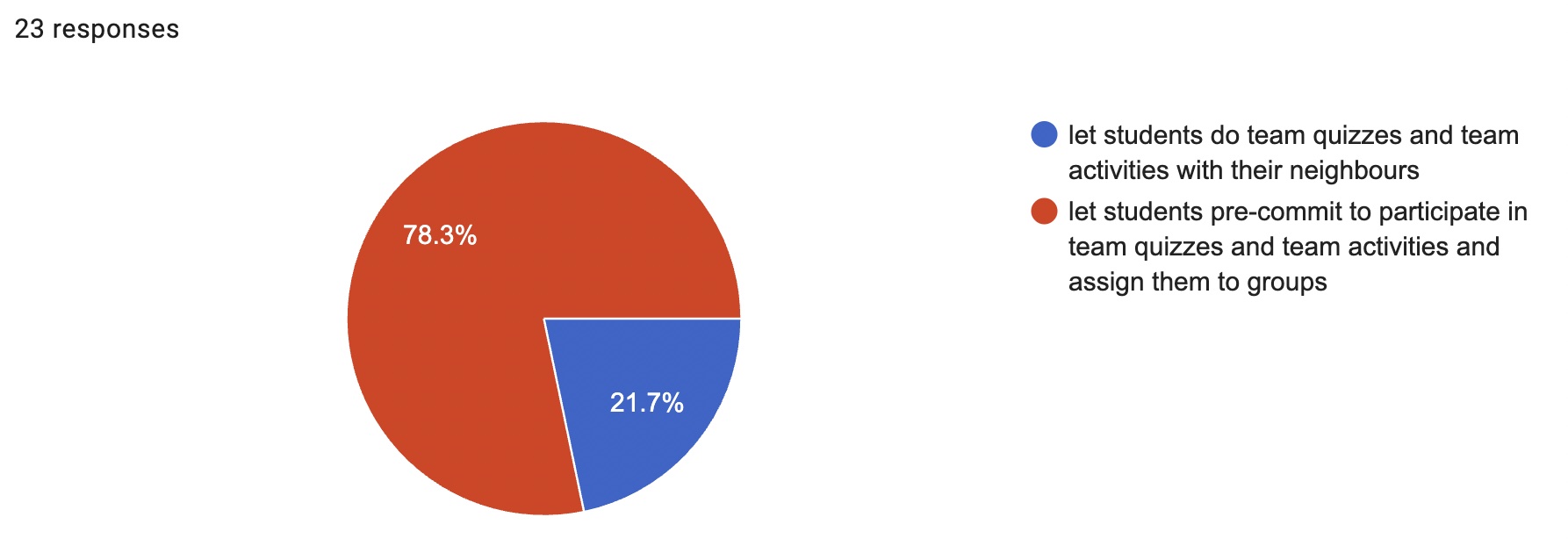
“If the Tuesday team quizzes and team activities were NOT graded, should students be able to choose to do them with their neighbours, or should student be asked at the beginning of the semester (after letting them experience a team quiz) whether they want to commit to attend all Tuesday classes and then be assigned to a group?”
Notably, 78% of students favoured the second option to let students commit to attend all quizzes! As such, the students seem to endorse my plans on how to administer my Learning Catalytics team quizzes.
Having decided on how to conduct the team quizzes, the next question then is how I will make up for the lack of graded assessments contributing to the final student grades?
In past semesters, I used to conduct an open book and open internet mid-term exam and final exam. Each of these exams is based on a research paper related to the course content. In the coming semester, I plan to conduct three somewhat shorter continuous assessments, each worth 16%. These assessments will also include questions about the figures of research papers (the first and second CA will be about the first and second part of one research paper, while the third CA will be about a second research paper).
These assessments will still be open book (i.e. students can access files on their laptop and any hard copy notes). But I will no longer allow use of the internet and AI. I believe that ultimately this will be in students’ interest because it promotes true learning.
As in past semesters, I will also give students the opportunity to improve upon past performances, with the goal of keeping students motivated even if they do poorly in assessments early on in the semester.
Traditionally, I set the rule that if students achieve a higher score in the final exam compared to the midterm, I will count the final exam score for both the midterm and the final exam. In contrast, if students do not improve in the final, I will count the actual results of both assessments. This generally worked well in sending students the signal that nothing is lost if they flunked their midterm test.
Last semester, however, I tried a different approach, whereby I assessed the students on one research paper in the midterm and on two different papers in the final (part A and part B). I then counted the best two scores of the midterm and parts A and part B of the final. This also motivated students who did poorly in the midterm to try hard and make up for it in the final. However, a number of the students who did well in the midterm only focussed on the first part of the final exam, knowing that the second part would not affect their grades. This was definitely not my intended outcome.
In the coming semester, I will thus return to the initial grading scheme, where students can improve their first assessment performance if they do better in the second test, and improve their second assessment if they do better in the third.
For the final exam, I will try a completely new format.
To quote a recent Inside Higher Ed article, entitled “Law Schools Are Asking the Wrong Question About AI“:
“The most effective assessments will focus less on the documents students submit and more on their ability to explain, defend and apply their reasoning. With such assessments, it will quickly become apparent which students have relied on AI without understanding their work. Students who used AI appropriately while exercising sound legal judgment also would distinguish themselves.”
This indeed reflects my own experience. For instance, in the past I have conducted my make-up mid-term exams as oral assessments, in which the students had to answer questions related to the figures of the research paper that was the subject of the test. This approach revealed much better than any written test how well the students actually understood the paper in all its details.
As such, it is no surprise that many view oral assessments as the gold standard, and it is for a good reason that all over the world, the PhD defence viva is in an oral format.
Hence, for the final exam next semester, I plan to conduct individual oral exams, in which students have to answer questions related to the figures of the final exam research paper. They will have to explain figures, interpret the findings and predict results if some experimental variables are changed.
I plan to spend around 20 minutes per student, which will result in a significant time investment on my part.
On the other hand, if I consider how much time I normally spend on preparing the exam question document and on marking the papers (on average 15 min per exam), the overall increase in time I spend on the final exam may not be that much.
I anticipate that some students will consider the oral exam as stressful, especially because students are not used to this type of assessment. In fact, I remember that when I was a student, I felt incredibly nervous before an oral exam, even though this was the typical format of all our exams. On the other hand, I also felt that much better than any written exam, the oral format really revealed how much I actually understood. Most importantly, I believe that the exam format provides a good incentive for students to try to truly understand the course content.
What will I do to reduce the stress level of students? Firstly, I will minimise the weighting of the final exam to just 22% of the overall grade. This will limit the impact of the exam on the students’ final grade.
Secondly, I will ensure that students are well aware of what they will be tested on.
The exam will be exclusively about the figures of a research paper, which the students study beforehand. Through in-class practice exercises and in the continuous assessments, I will also ensure that the students are familiar with the type of questions that I will ask them about.
Apart from the continuous assessments and the final exam, I will, as usual, include my introductory video assignment and my one-to-one conversation with each student, for which I will award a small amount of participation marks.
In addition, there will be a number of in-class group assignments, each worth around 5% of the final grade. Here, I will include activities that are similar to assignments from the last semester, e.g. research data interpretation and prediction, testing of hypotheses, answering cell biology related research questions using AlphaFold-based structural prediction and visualisation using ChimeraX, and evaluation of research questions.
I will also try some new activities, for instance letting students challenge chatbots by coming up with questions based on provided research data that the chatbots are unable to answer correctly (as described in my post from a couple of weeks ago), and perhaps an activity based on building an agentic AI to help answer a research question (provided I manage to first learn how to do it myself).
This all seems very exciting and I must say that I already look forward to the next semester. The only downside is that it will be a lot of work and I won’t have much (if any) time for my own research and experiments!
HIGHLIGHTS FOR WEEK OF 17 – 23 AUGUST 2026
Supervising new students
Supervising new students and seeing them improve and develop can be a lot of fun. But there are also things that can make it difficult.
The first difficulty relates to coming up with good projects that are interesting to students and feasible to do. I believe I did manage to come up with good projects this year, although there is never a guarantee that they will work out. (So far, things are going okay, though).
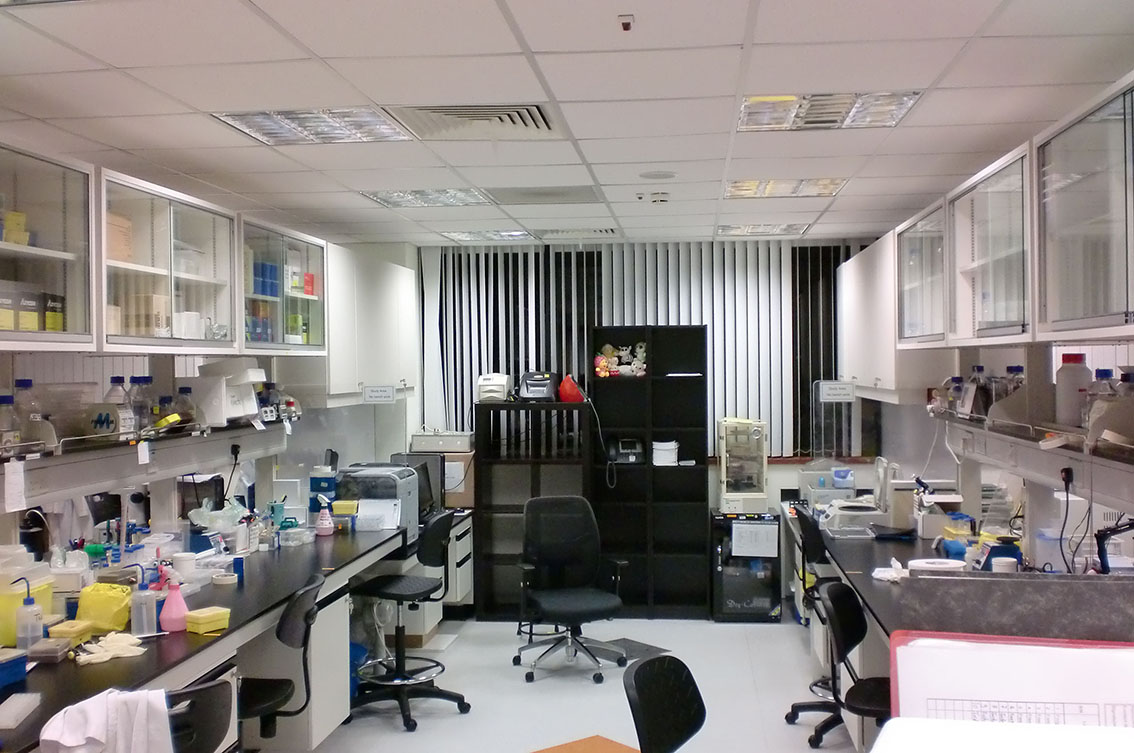
Secondly, the first couple of weeks tend to be somewhat painful, because I usually have to teach students the very basics of lab work. This process is tedious and not exciting, mainly because there is little intellectual challenge and engagement.
After some time, though, students typically master the basic techniques. This is when things typically start becoming more fun. The students are getting more independent and begin making some decisions on their own. Most importantly, I can challenge them and engage in conversations about their experimental results, interpretations and plans.
But as I have been learning this year, students do not always progress in this way.
Some students are slow at becoming independent or have difficulties remembering things, leading to mistakes and sometimes frustration on my side. Potential reasons include that students do not keep good records and do not carefully think about their results, that they are not truly present, that they do not truly understand the experiment they are trying to conduct, or that they lack specific knowledge or an intellectual framework into which they can place the work they are doing. I have also noticed that some students do not seem to process conversations we have, and hence do not remember what we discussed previously.
As a consequence of all these, students may be unable to make correct decisions and solve problems they encounter.
There are other potential problems. Some students start out being messy, unorganised, or careless. And some are not observant and do not notice things that are unusual (such as if there are extra bands in their gel or bacteria contamination in their cell culture), or fail to recognise results that are contrary to expectations. This is often because students have no expectations, i.e., because they do not think about the expected results before doing an experiment.
We can express our expectations about all of these issues, as I usually try to do. But ultimately, a lot depends on the students’ character, their upbringing and prior experience. None of these are easy to predict at the start of a project.
How can I still make the experience of students who are failing in one way or another meaningful for the students?
Firstly, repeatedly pointing out mistakes students make or deficiencies they have can make a difference, as I have been noticing this semester. Even if the students do not improve, realising their difficulties can be a useful insight that may help them to decide their future path. After all, finding out what we are not good at or do not enjoy doing is just as important as identifying things that we excel in and that we feel passionate about. It is also important to talk about the students’ difficulties. In these conversations, we will almost always discover interesting perspectives the students hold.
The most difficult problem to address is a lack of interest students exhibit in their project and a general lack in curiosity. This is perhaps one of the two biggest differences I see between past student generations, like those I encountered in my early years as a Prof, and more recent ones. It often feels as though students consider their projects as just another box they need to tick. I find it difficult to change this mindset.
Perhaps related to this is that students seem less able to express interesting opinions or ask questions. I am not sure if this is because my memory deceives me, or whether this is because students these days spend less time really observing the world and engaging in independent thinking and reflection, while constantly consuming online content that does not require critical engagement or considering one’s own position, not to mention enlisting chatbots to do the research and thinking for them. It sometimes feels depressing to me that so few people in Singapore appear to be able to enjoy merely being with themselves without immediately diverting their attention to their phone. Without ever being truly present with ourselves, it seems impossible to truly live and experience happiness. I totally resonated with a comment writer Tom Hodgkinson made in a recent episode of the “The Happiness Lab” podcast, that gazing out the window while commuting on a bus or having a friend be late for an appointment is a gift that allows us to reflect and enjoy being alive. Sadly though, the peace and quiet required for these pursuits is often disrupted by others listening to their phones on loudspeaker.
But even more depressing than this is the recent trend that students, even in my lab environment, opt for asking chatbots or AI summaries about their research rather than making the effort to try to think for themselves or deriving information and ideas from actual research papers. This is no way to learn to become a good researcher. It is also no way to enjoy doing research because it is the things we figure out by ourselves that make us excited and content. As such, I do feel some sympathy with professors quoted in a recent article in the Chronicle of Higher Education, entitled “These Professors Are Retiring Early – AI Was the Last Straw. What is the point of teaching, if students are just pretending to learn?“
Enjoying working in the lab requires the ability to talk to others, having opinions and questions about one’s own research and that of other students as well as about other topics. While I miss the days when it was more fun to be around students in the lab, no matter the current difficulties, the effort to help students succeed is still worthwhile because in the end, every student will gain something to move them forward.
HIGHLIGHTS FOR WEEK OF 10 – 16 AUGUST 2026
A new type of AI-based student assignment
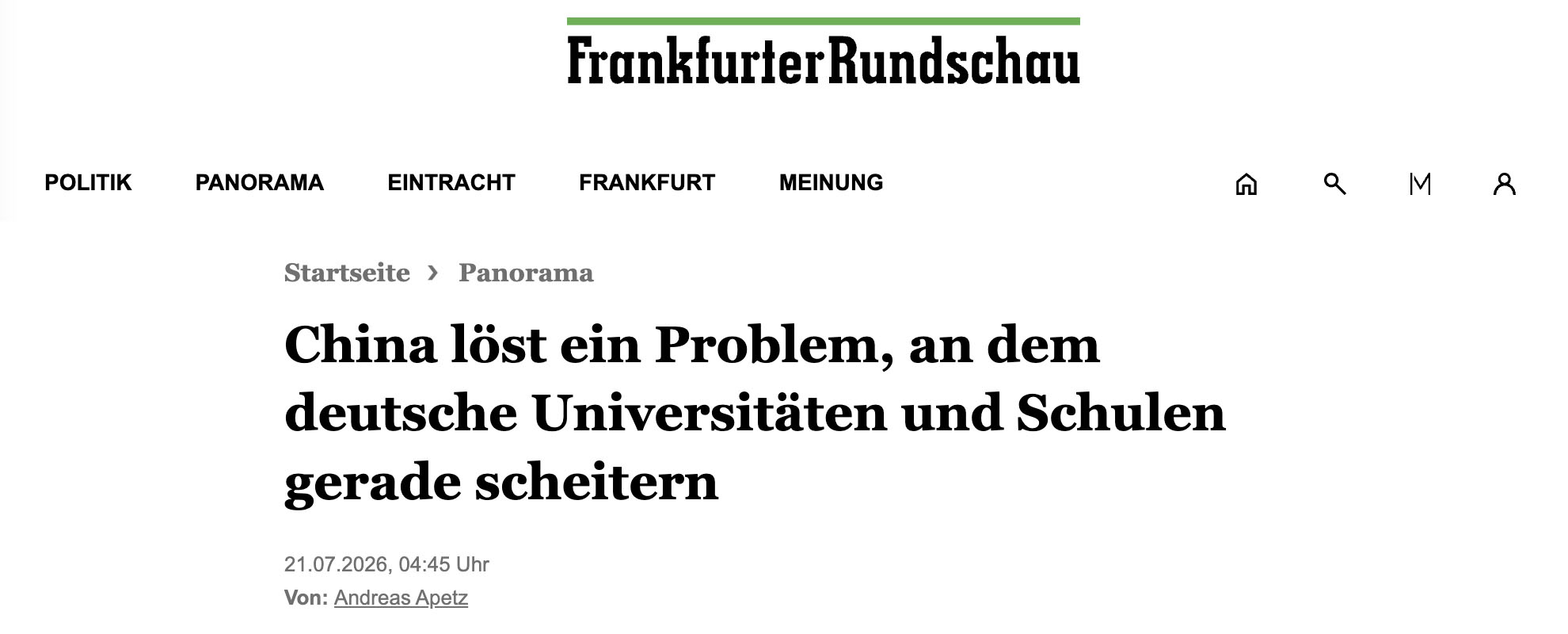
Recently, my dad sent me the link to an amazing article about AI in education, or more precisely about utilising AI in assessments. The article could not be more relevant to me while I am planning next year’s Cell Biology course and struggle with the question of how I could incorporate AI in ways that benefit student learning.
The article describes recent approaches taken by Chinese universities to assess students using AI chabots. Students are tasked to test the knowledge of three LLM’s, by coming up with questions within a given topic area that are so difficult that the chatbots are unable to answer them correctly. Their marks are in part dependent on whether they can design questions that produce wrong chatbot answers. Before evaluating the chatbots, the students need to answer their own questions correctly, which is also part of the student evaluation.
The article points out that this tasks requires that students have “a high level of expertise and a deep understanding of AI models to identify and formulate suitable test questions and evaluate the AI’s results”. However, beyond helping students learn how to use chatbots and evaluating what their capabilities and limitations are, students also practice critical thinking and applying learned concepts.
Feeling very excited about this idea, I have asked myself how I could implement the approach in my own course, in which I primarily assess students based on interpreting and predicting research data and understanding research papers. One way to apply the idea could be to provide students with a set of complex research data and then let them design questions to interpret the data or predict results if some of the variables are changed. The students would first need to give the correct answer to their questions by themselves. They could then challenge chatbots with their questions and provide screenshots with wrong (or at least partially wrong) answers, pointing out which parts of the answer are wrong and why.
In this assignment, I could evaluate and mark the quality of the question that the students designed, whether the students themselves gave the correct answer, and whether they found one or more chatbot models unable to answer the question.
One downside is that it will take more time to mark the assignment because each student would likely come up with different question. But doing the exercise in groups would somewhat minimise my workload (and also increase student engagement).
What do students learn?
Asking questions requires that the students themselves first understand the data. Changing variables requires applying what the students have learned. Importantly, students also learn evaluating LLM output and get a sense of how reliable different models are, and what type of questions LLM’s excel at and which they are struggling with.
All these potential outcomes make it definitely worthwhile for me to try the exercise next semester!
HIGHLIGHTS FOR WEEK OF 3 – 9 AUGUST 2026
Teaching AI literacy
What actually is AI literacy? Common answers include teaching students how to design good prompts or how to improve and evaluate generative AI output. However, I believe that these skills are not really that difficult to master and most students are probably better at them than their professors.
A much better approach to promote AI literacy is to let students solve complex problems by applying AI tools, something I would like to incorporate more into my own courses.
On the other hand, a recent article in the Chronicle of Higher Education, entitled “Can Colleges AI-Proof their students?”, suggest that teaching AI literacy primarily means enabling students to think critically.
What is critically thinking? The article asserts that critical thinking is a process consisting of a number of elements, including (i) exploring the content, (ii) considering alternative answers or explanations, and (iii) weighing the evidence. Indeed, these three elements are also required to evaluate AI output. There is a fourth element of critical thinking: finding implications and new applications. In the context of AI, this involves being able to make use of information gathered or generated by AI tools.
The article asks the important question of whether universities normally teach these critical thinking skills, and comes to the conclusion that more often than not, teaching critical thinking only amounts to rhetoric.
The article prompted me to ask myself whether I truly teach critical thinking, and as such AI literacy? By focussing on teaching students skills to analyse, interpret and predict research data, I believe I do.
Analysing, interpreting and predicting research data firstly involves “exploring content”. It also involves the second element of critical thinking, “considering alternative answers or explanations”. This, many students tend to do naturally, sometimes driven by trying to convince the lecturer that their answer can also be considered possible. This highlights the importance of the third element, “weighing the evidence”, which is much harder for students to master.
Weighing the evidence essentially amounts to telling the difference between “possible” and “probable”. This is a key skill that often distinguishes scientists from laypersons, as for instance highlighted in a recent BBC news article about Anthony Fauci’s US Senate hearing about Covid origins. When being pressed by Republican Senator Rand Paul about the origin of the Covid virus natural origins and a lab leak, he replied “[J]ust because two alternatives are possible … does not mean that they are equally probable”.
The skills to explore the content, consider alternative answers or explanations, and weigh the evidence, are required to evaluate AI-generated as well as human output, be it in the form of academic writing, diagnosing diseases, or evaluating scientific research.
This raises the question of whether teaching students how to critically assess research data will automatically lead students to also apply critical thinking approaches to tasks and problems they encounter in other areas of their lives.
My own experience tells me that this is not always the case. For instance, some of my undergraduate students who previously did very well in my course seems to be unable to apply critical thinking skills to their research project, even though the tasks and problems are actually very similar. One may argue that the students are simply not in the habit of using critical thinking approaches, which is probably true. Moreover, being a critical thinker requires in my opinion not only having the skills, but also a certain mindset of curiosity.
Interestingly, the article quotes Prof. Daniel T. Willingham from the University of Virginia, who points out that critically thinking is domain-specific and that teaching critical thinking as a general skill has had limited success. This likely is partly due to the fact that critical thinking requires some knowledge of relevant content and concepts (and in my case also experimental techniques). Therefore, it is likely not sufficient if students learn critical thinking in one specific course.
Finally, the fourth element of critical thinking, finding implications and new applications, highlights that critical thinking should ultimately serve to produce something that is useful. This seems much more difficult to teach, especially in a large class setting.
The skills to “explore content, consider alternative answers or explanations, and weigh evidence” can be practised using problems that have already been solved, which are available in abundance. We merely need to identify suitable examples. In contrast, “finding implications and new applications” involves finding things that do not already exist, which requires creative thinking skills.
During the last semester, I did try to introduce into my course some creative thinking exercises by teaching students how to ask research questions and then letting them evaluate the quality of research questions that I came up with. This type of activity seemed more feasible than letting students find research questions on their own.
Although the effectiveness of the exercise was limited, I believe it was better than not exposing students to practising creative thinking at all, especially given that so few science courses, including lab-based courses and lab attachments, cover creative thinking-related skills.
However, it is important to recognise that the ability to think creatively also requires the right mindset, i.e. a sense of curiosity and openness, a joy in learning and a willingness to ask questions. Although it is difficult to “teach” this mindset, I can (and do) try to create a class atmosphere and develop exercises and activities that promote these qualities.
HIGHLIGHTS FOR WEEK OF 27 JULY – 2 AUGUST 2026
2nd Department of Biochemistry Student Symposium 2009
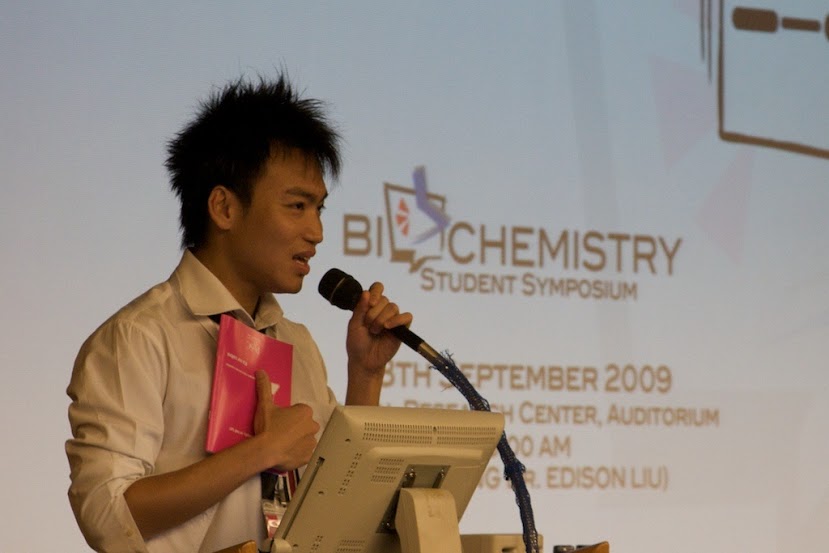
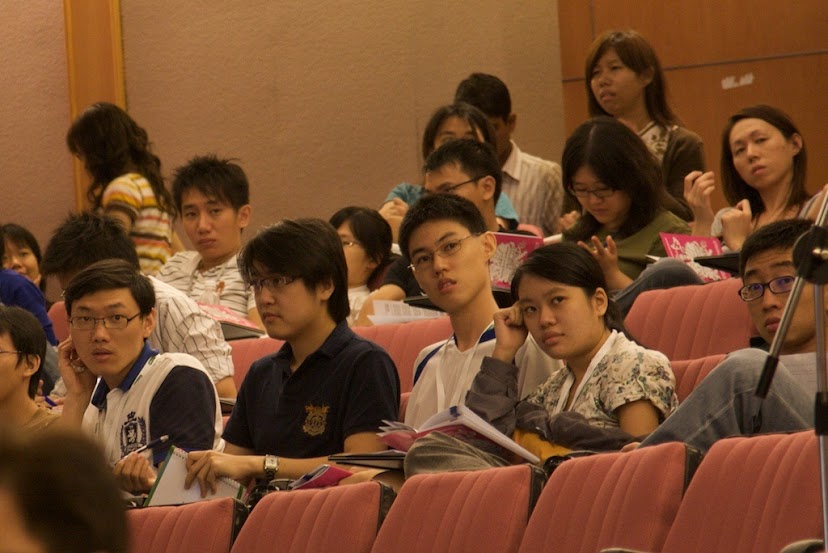
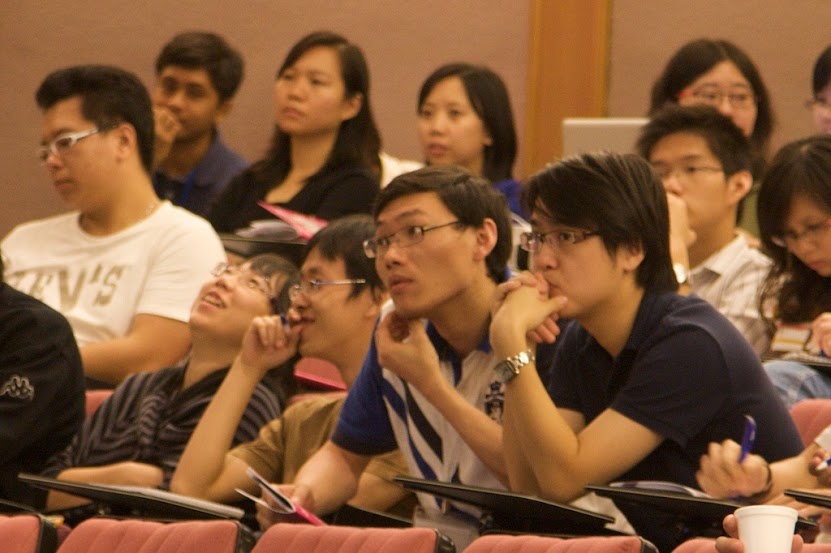
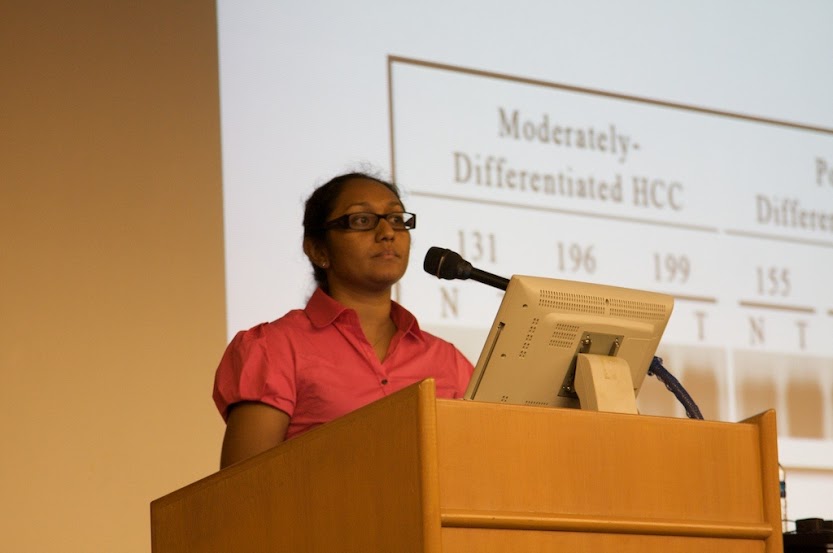
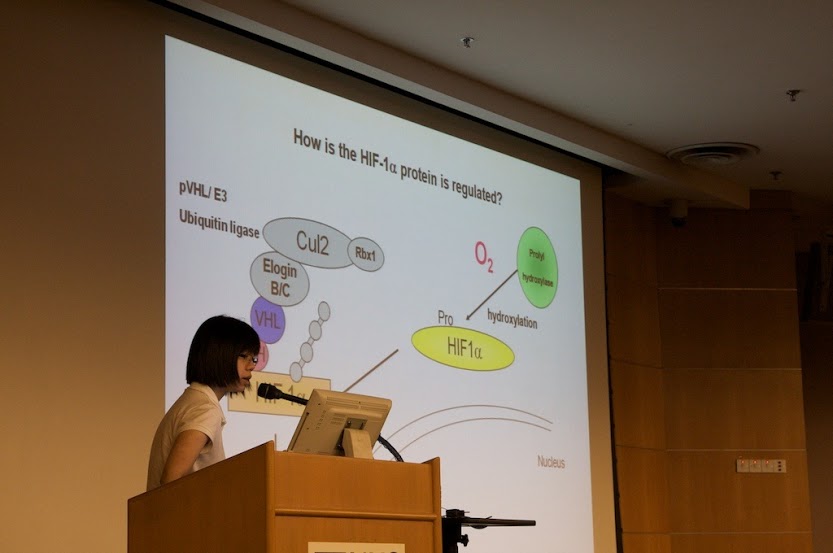
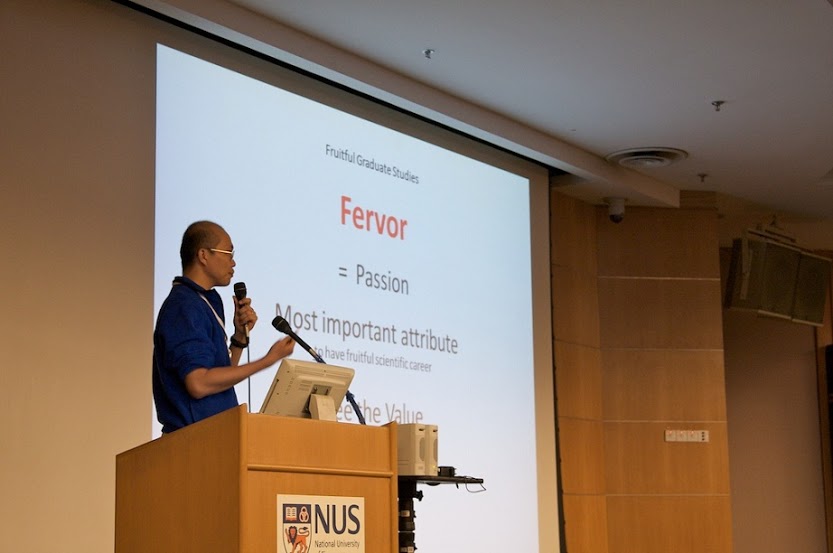
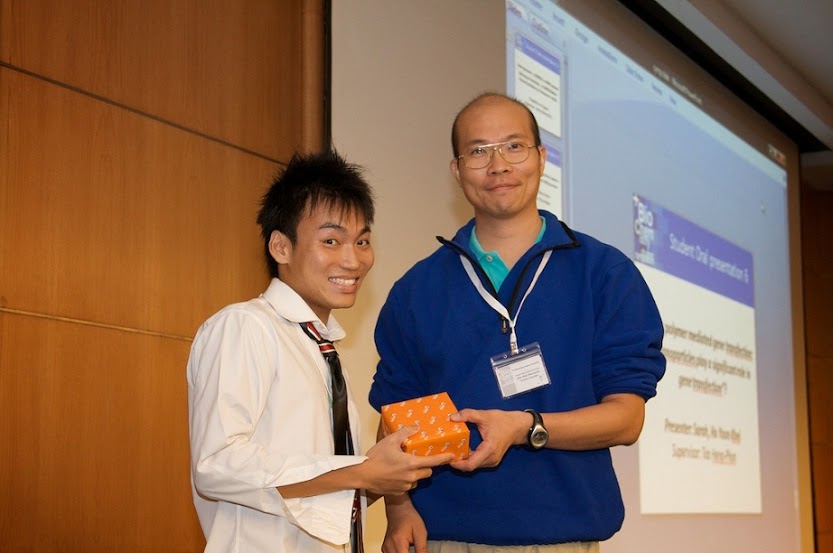
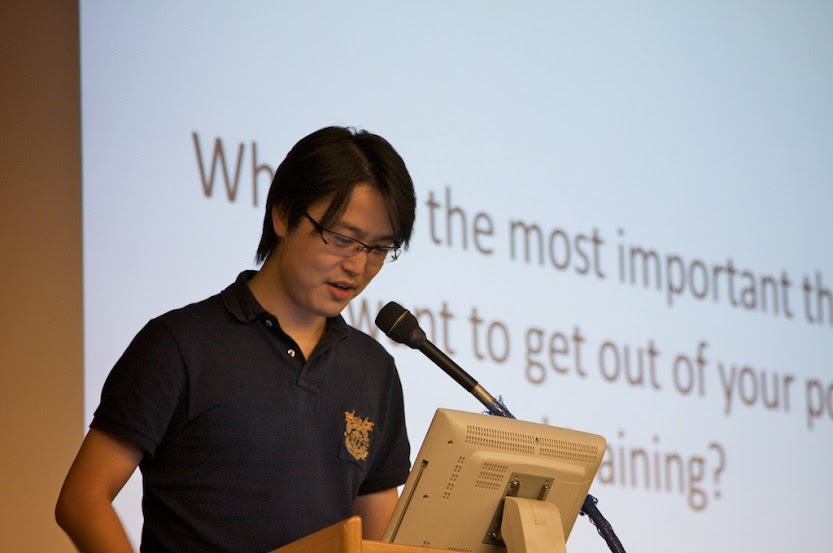
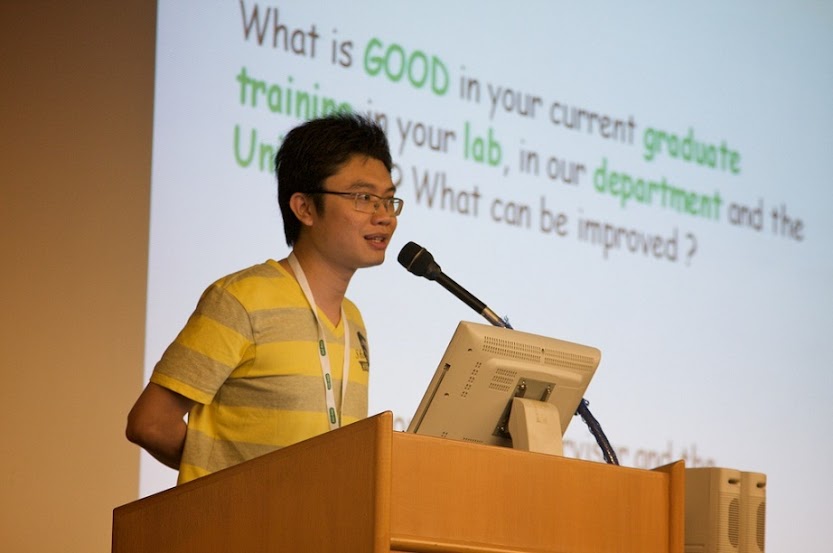
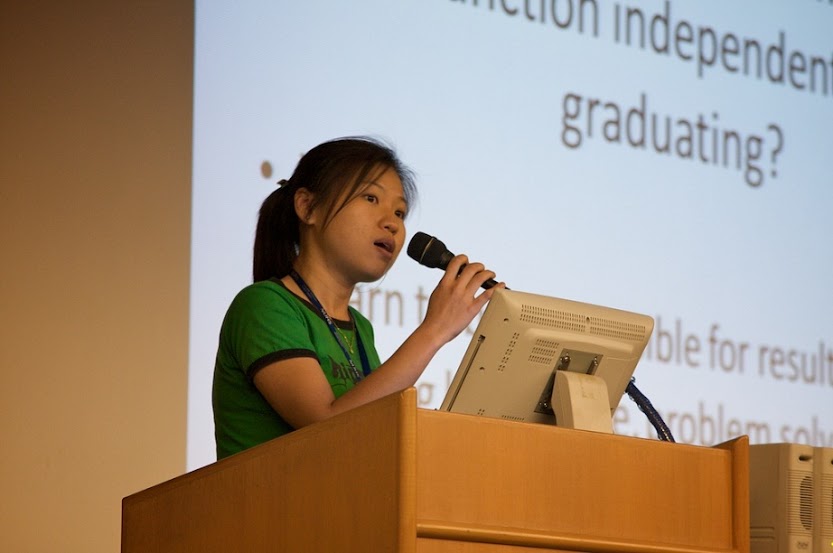
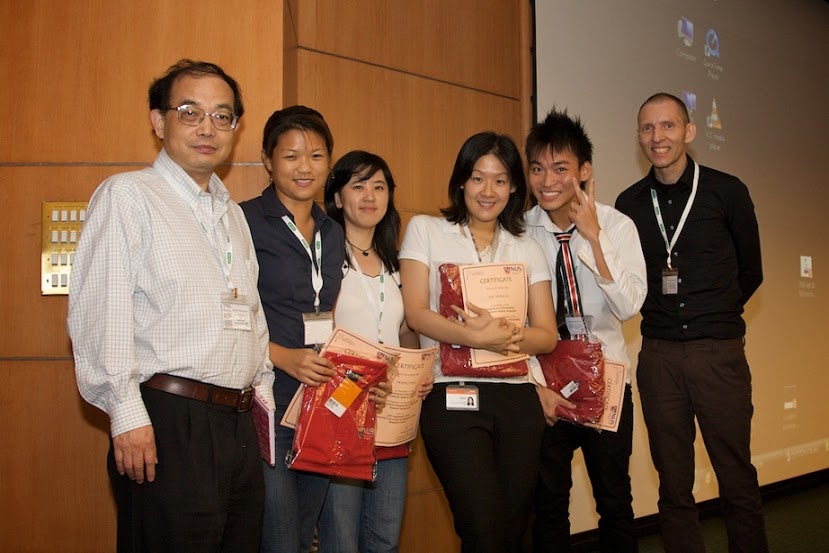
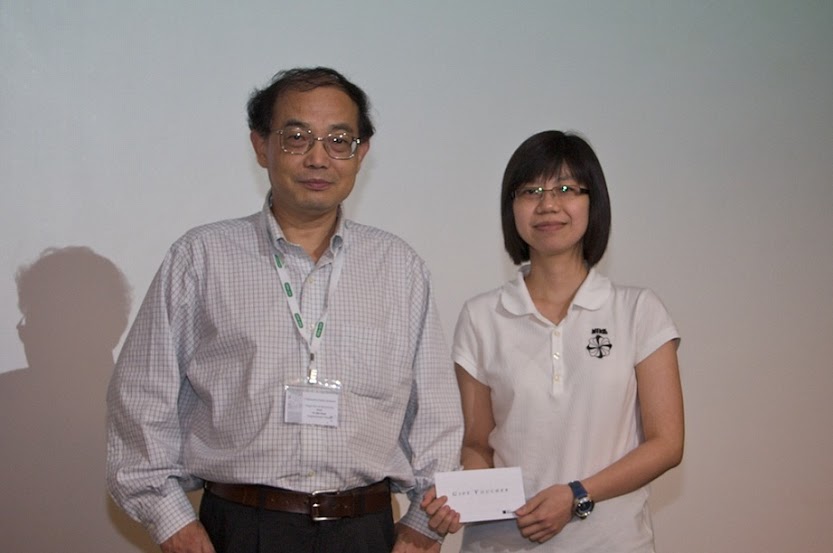
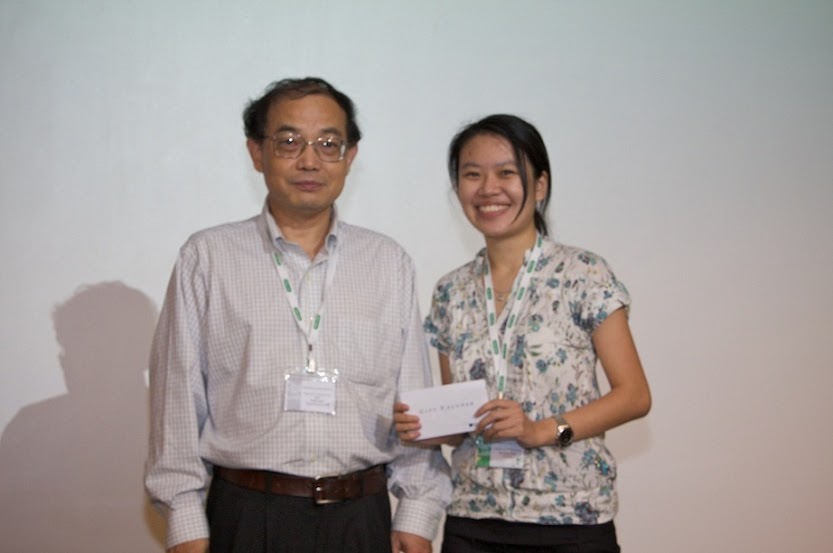
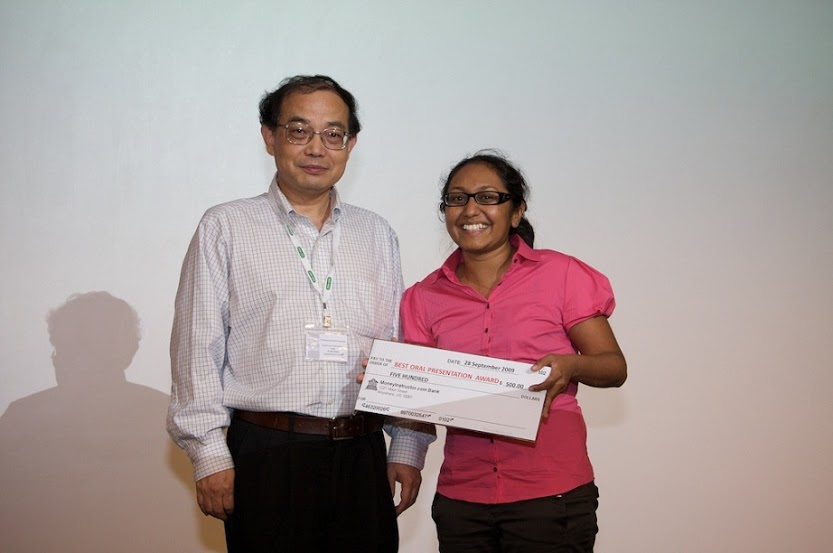
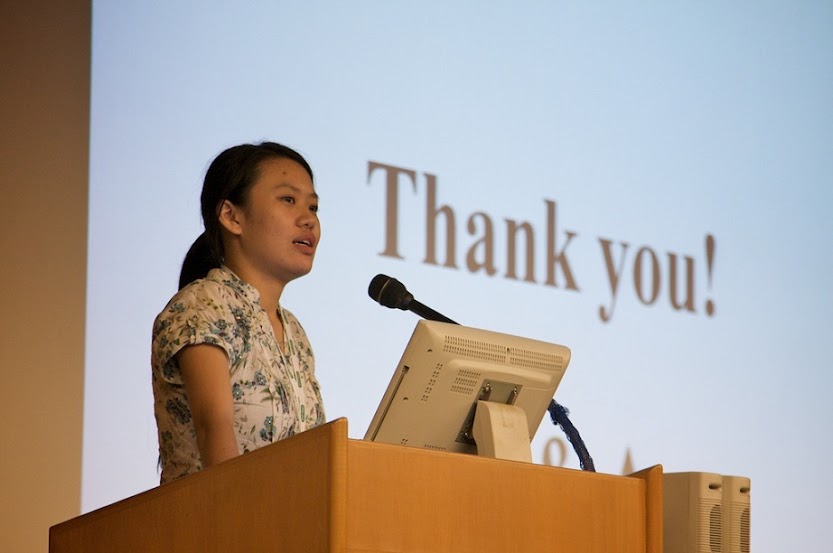
Reflections on an era of vibrant postgraduate life in our department – Part 2
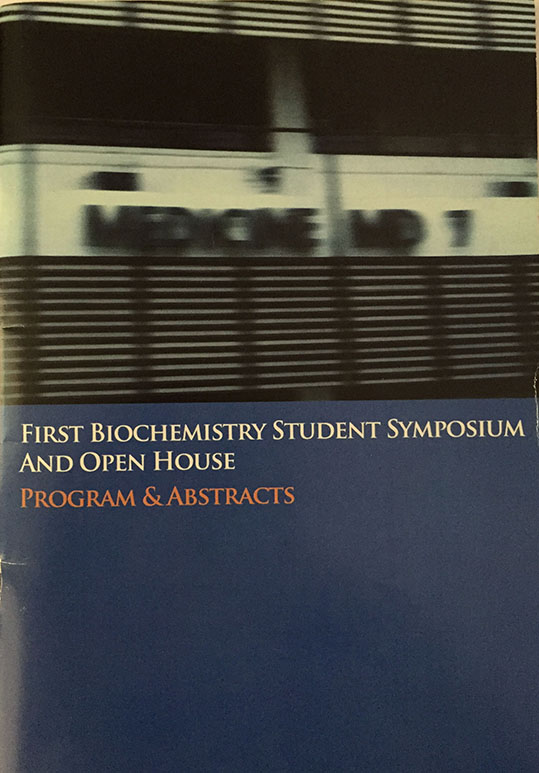
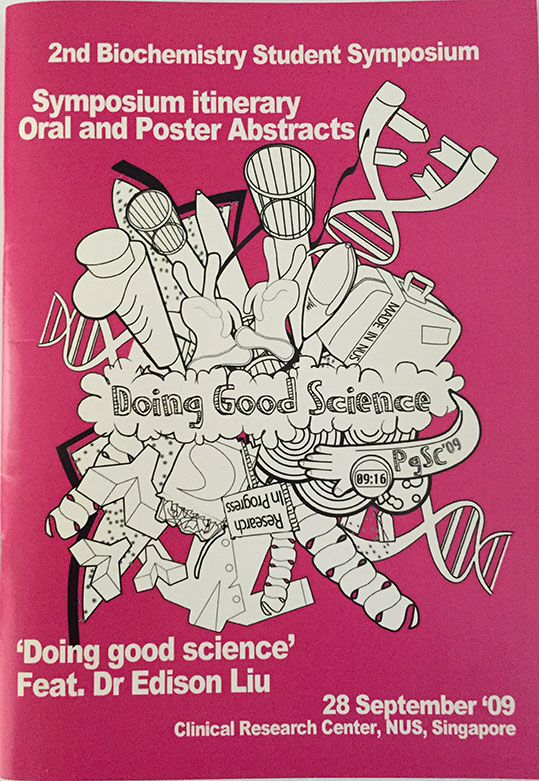
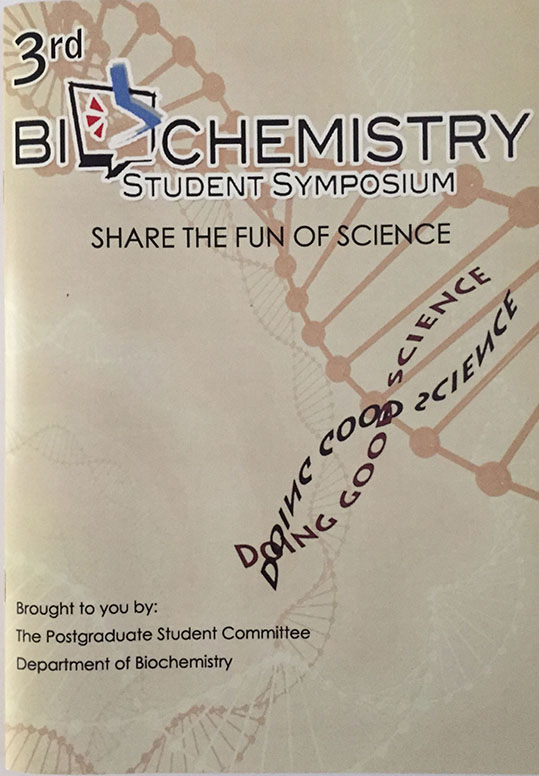
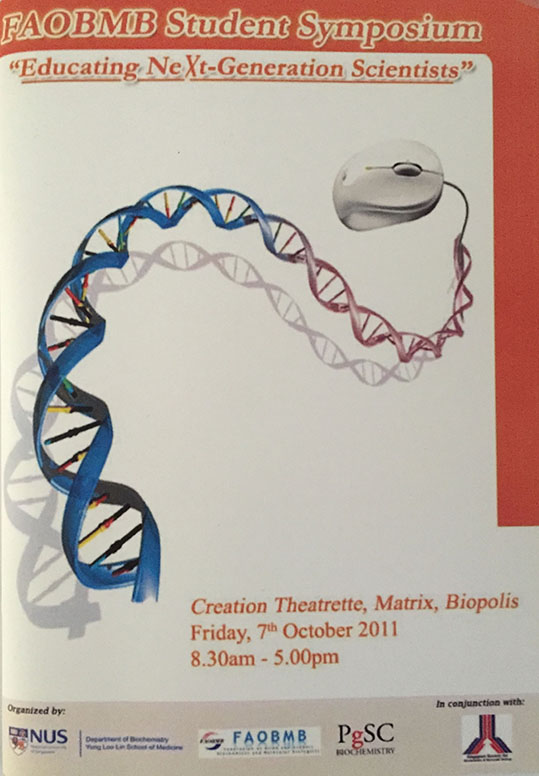
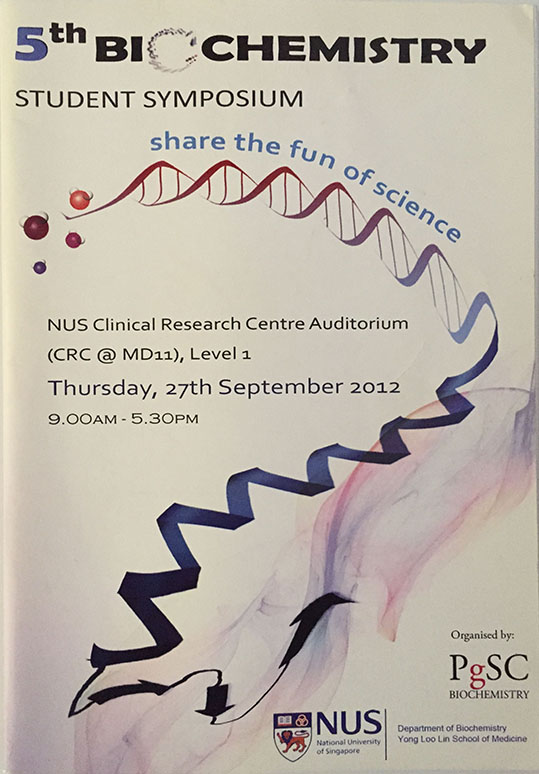
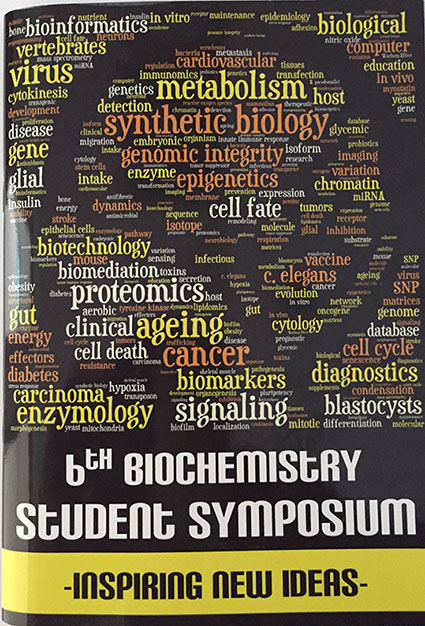
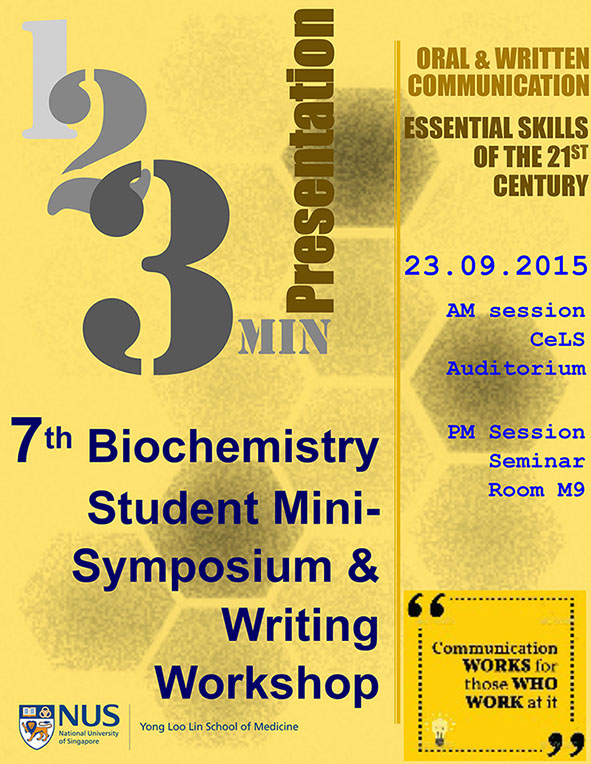
In last week’s post, I discussed the Department of Biochemistry Research in Progress seminars, which I organised for our postgraduate students from 2008 until 2015. However, organising these meetings was not my only contribution to our postgraduate and departmental life.
Apart from promoting scientific exchange, I felt that there were few opportunities for students to realise that doing a PhD is about more than just research. I hence initiated, and to a large extent also organised, various events for students to enjoy their time as PhD students, build connections and improve mental well-being.
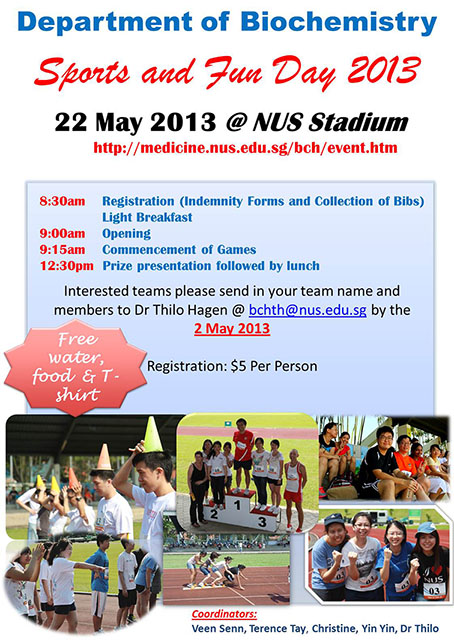
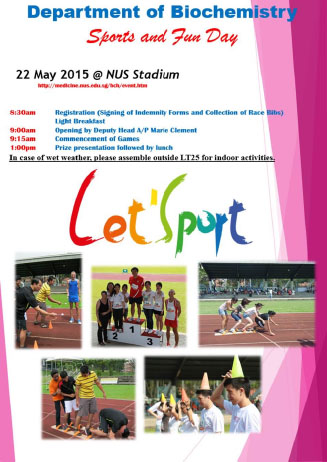
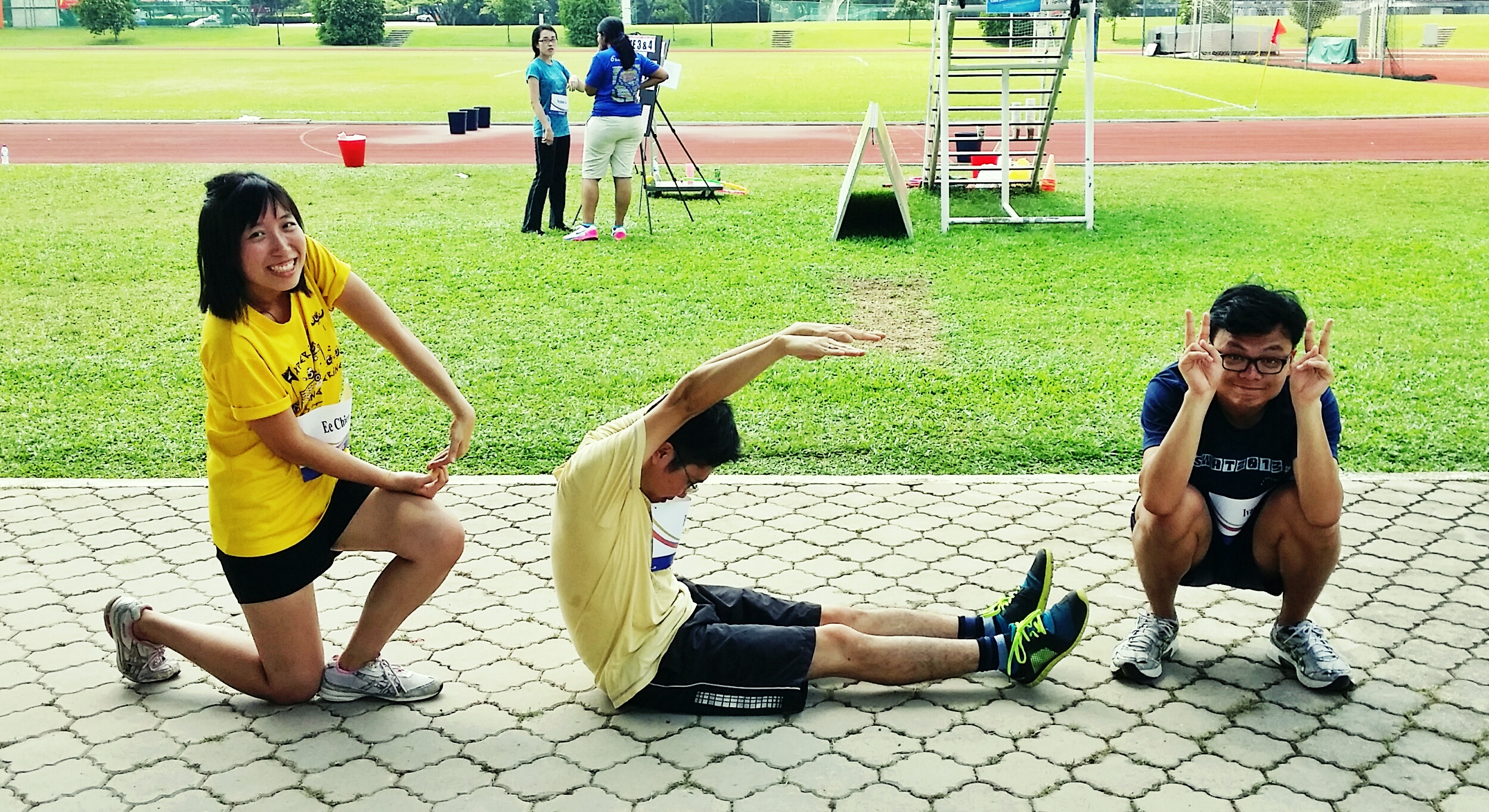
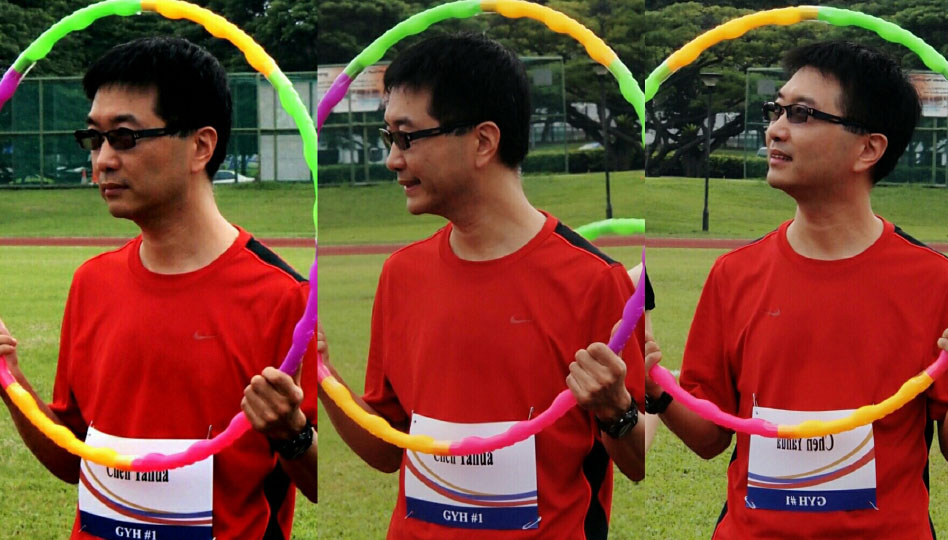
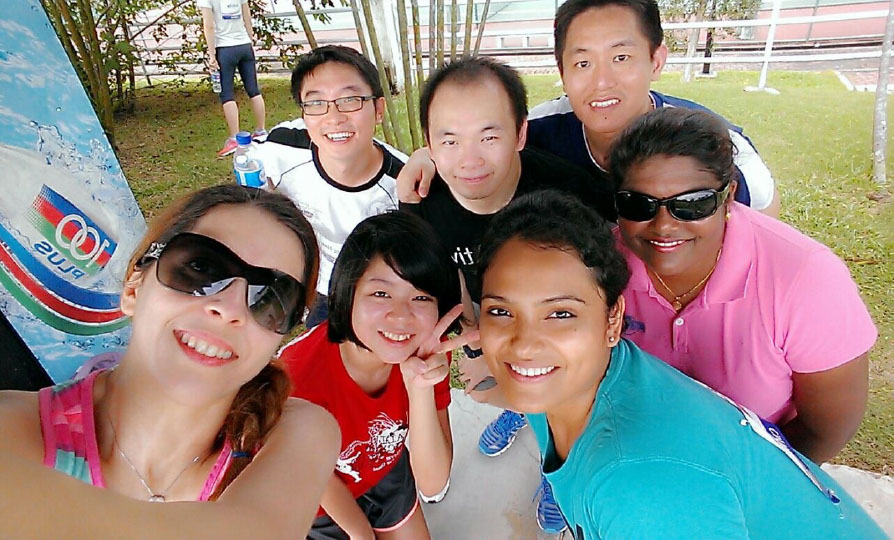
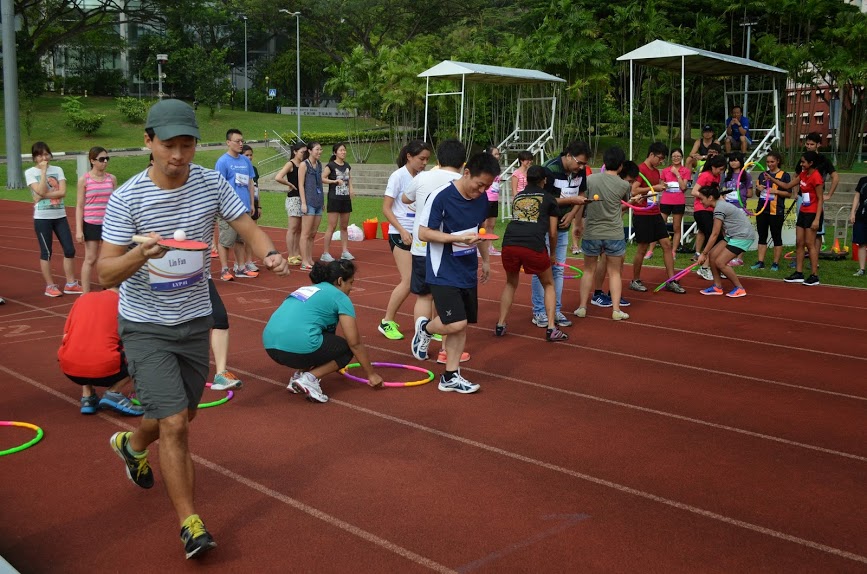
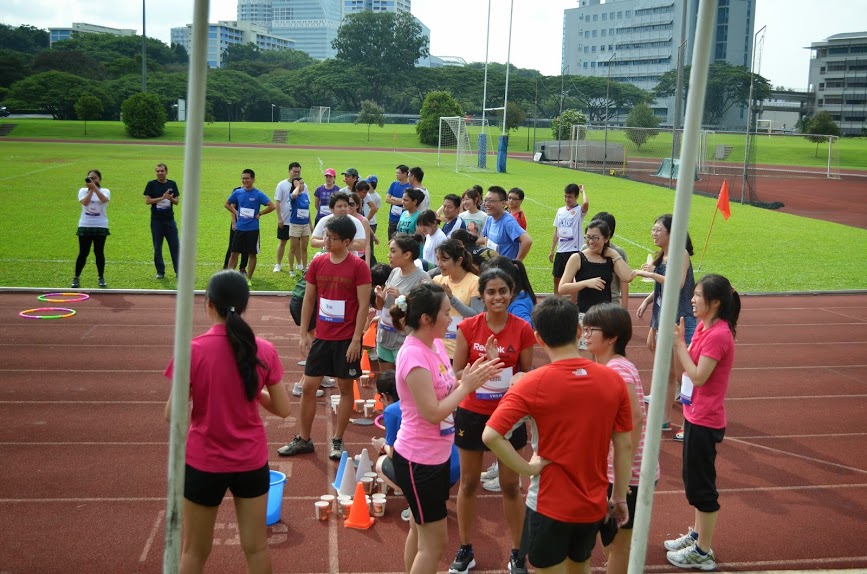
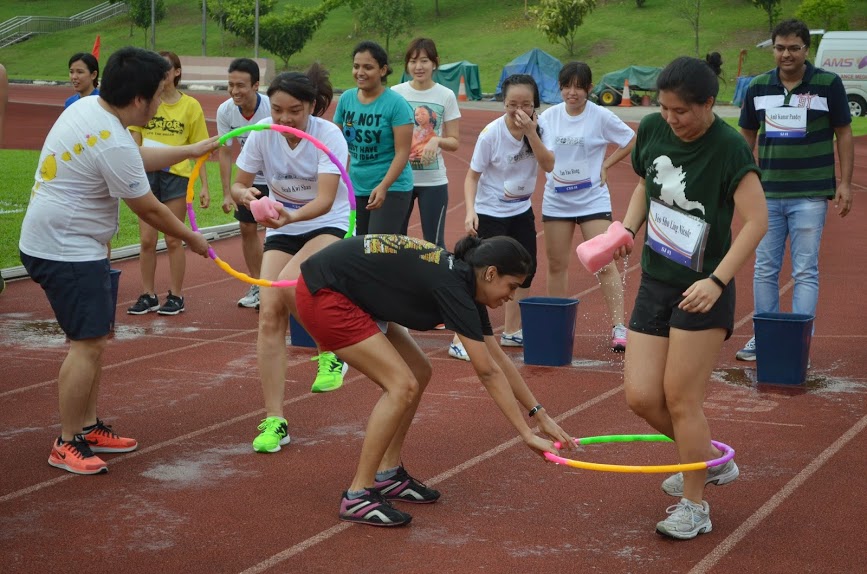
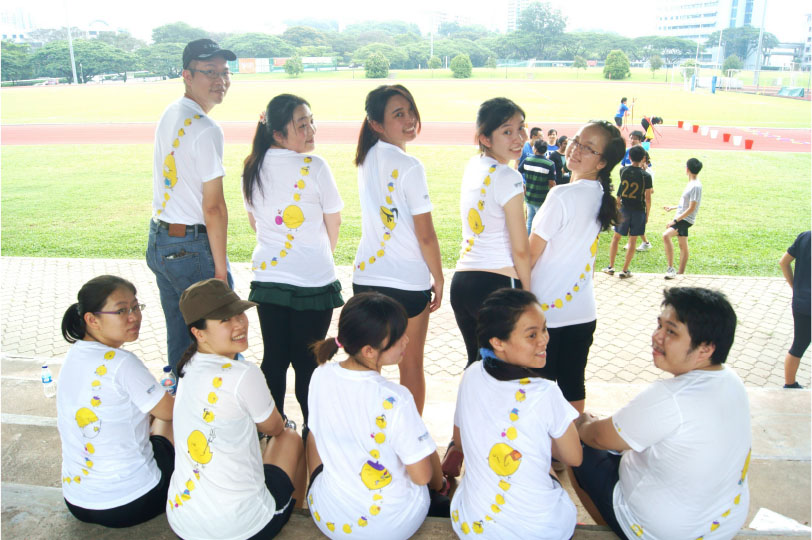
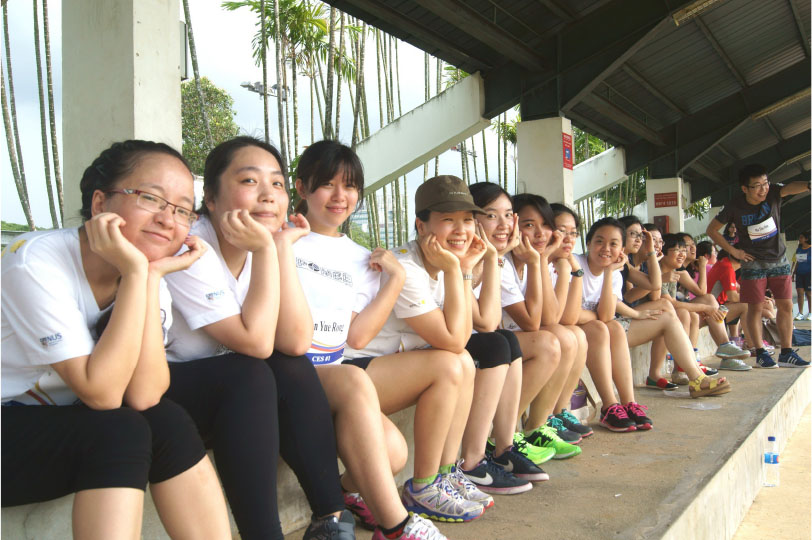
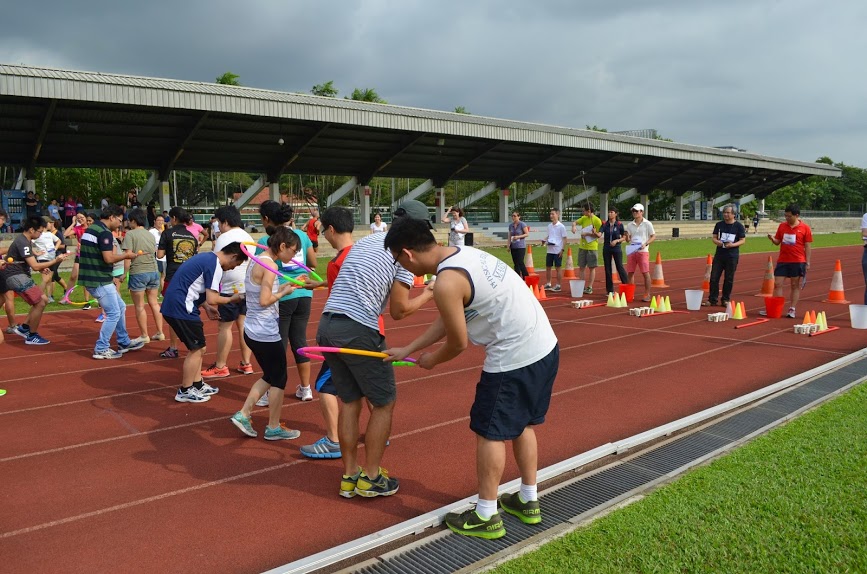
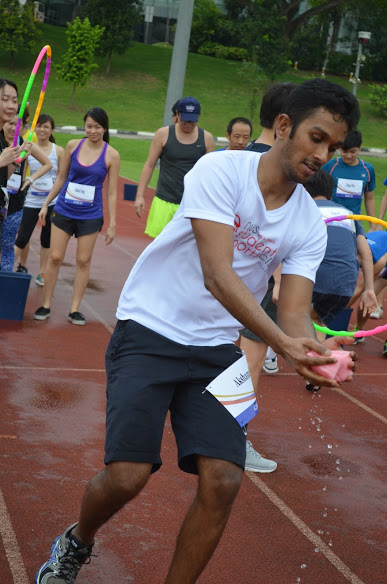
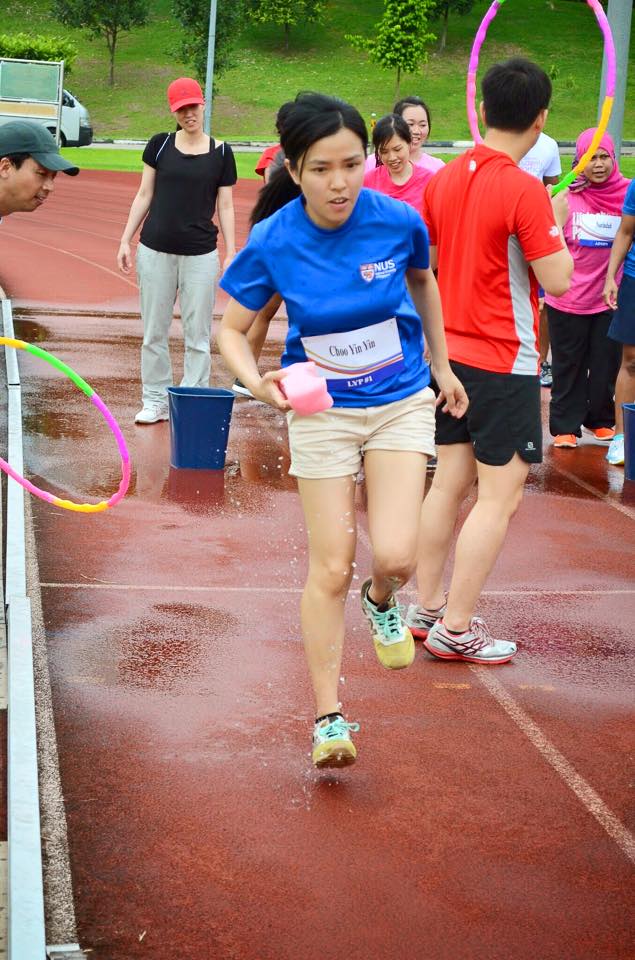
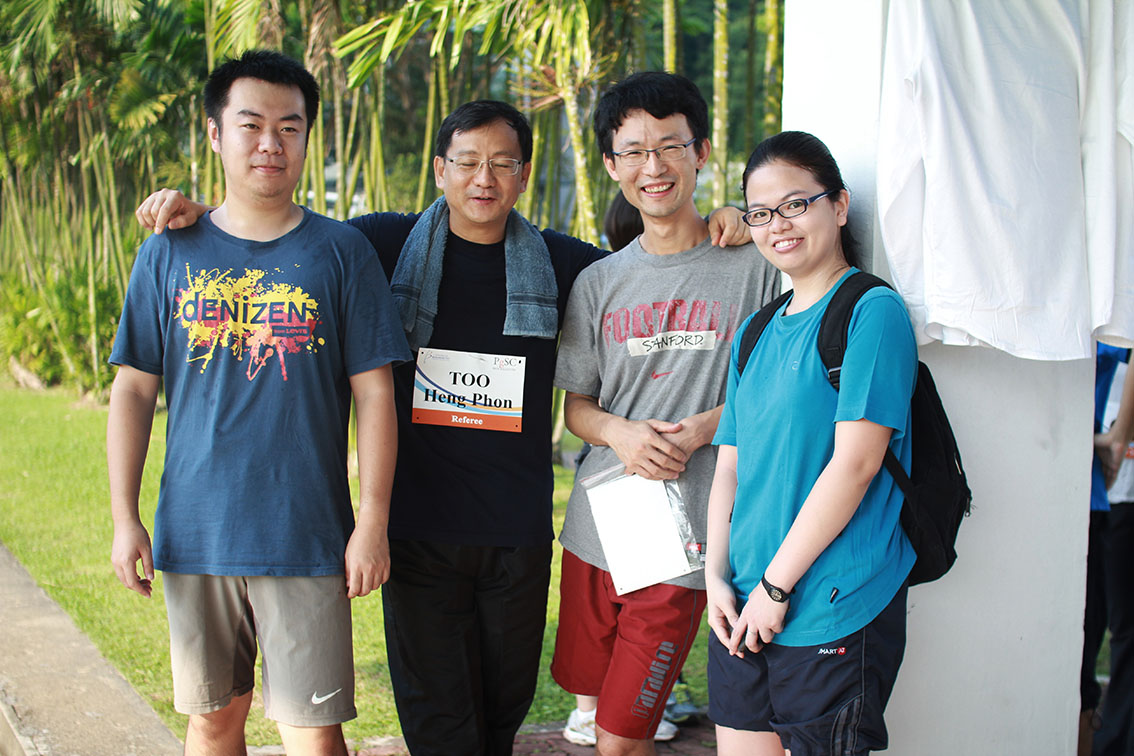
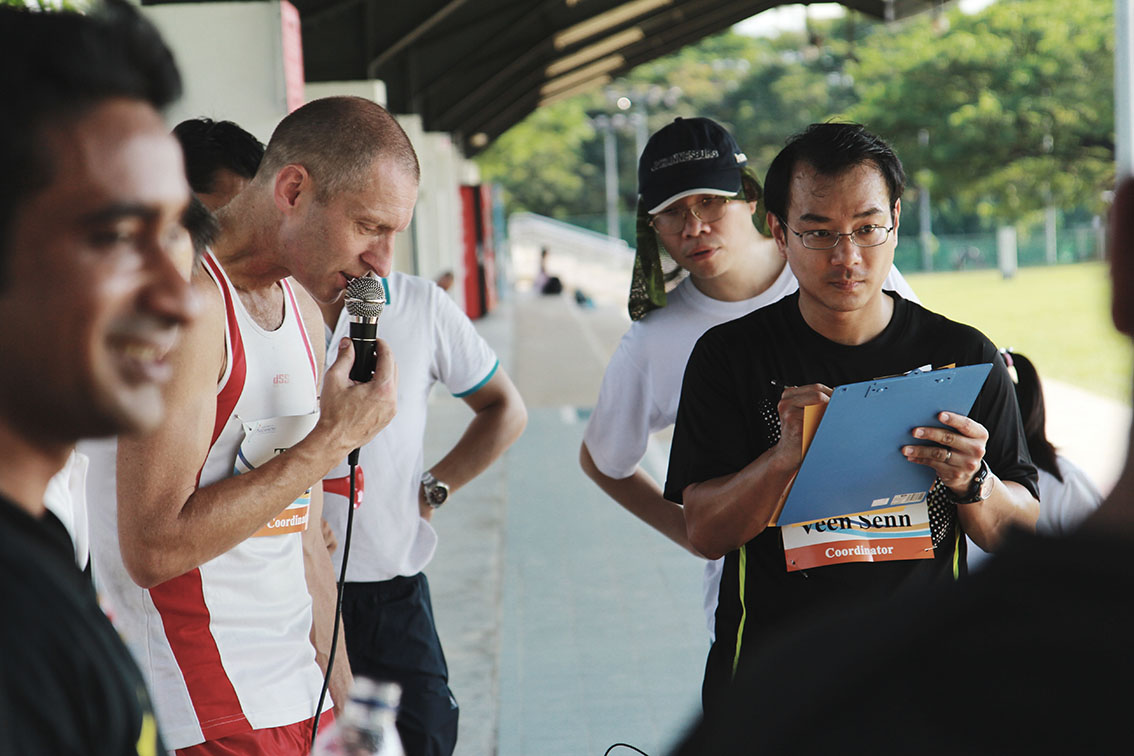
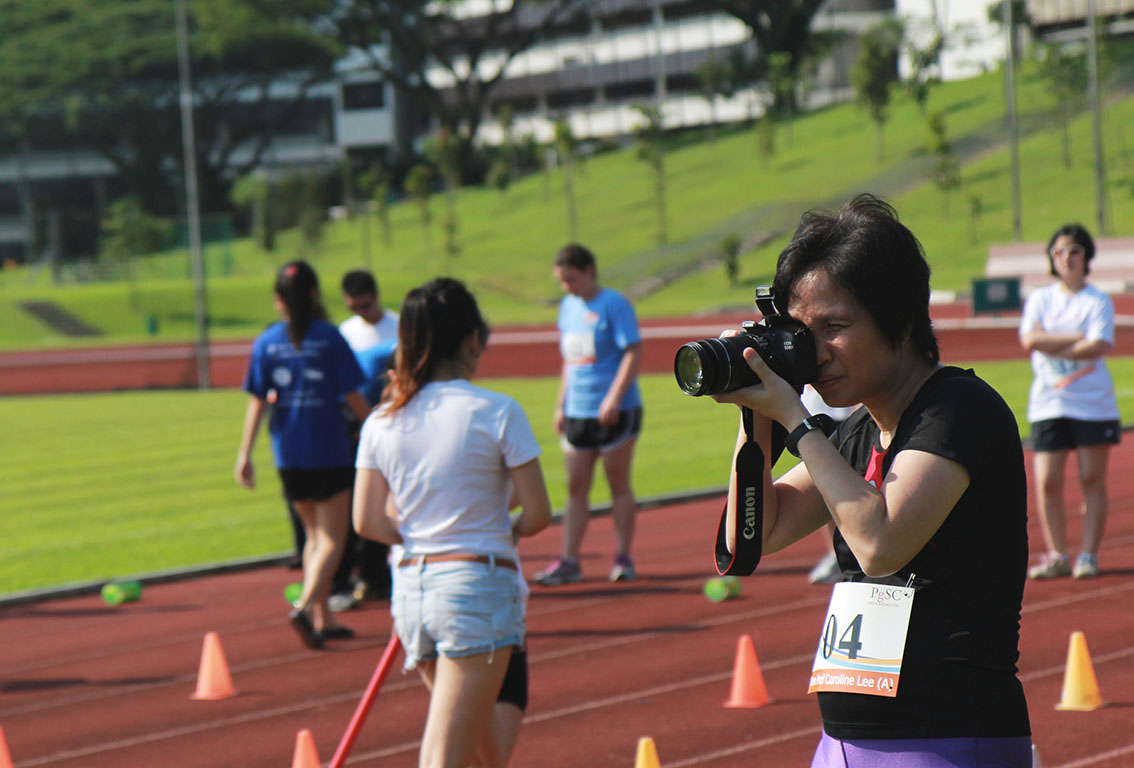
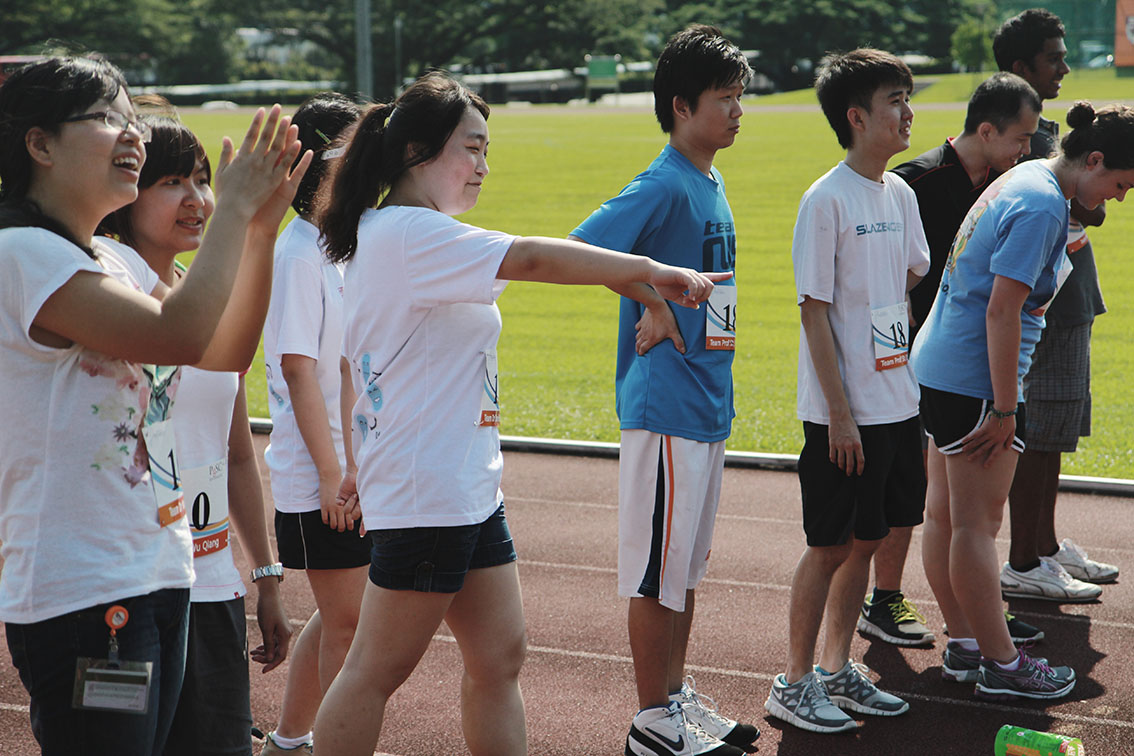
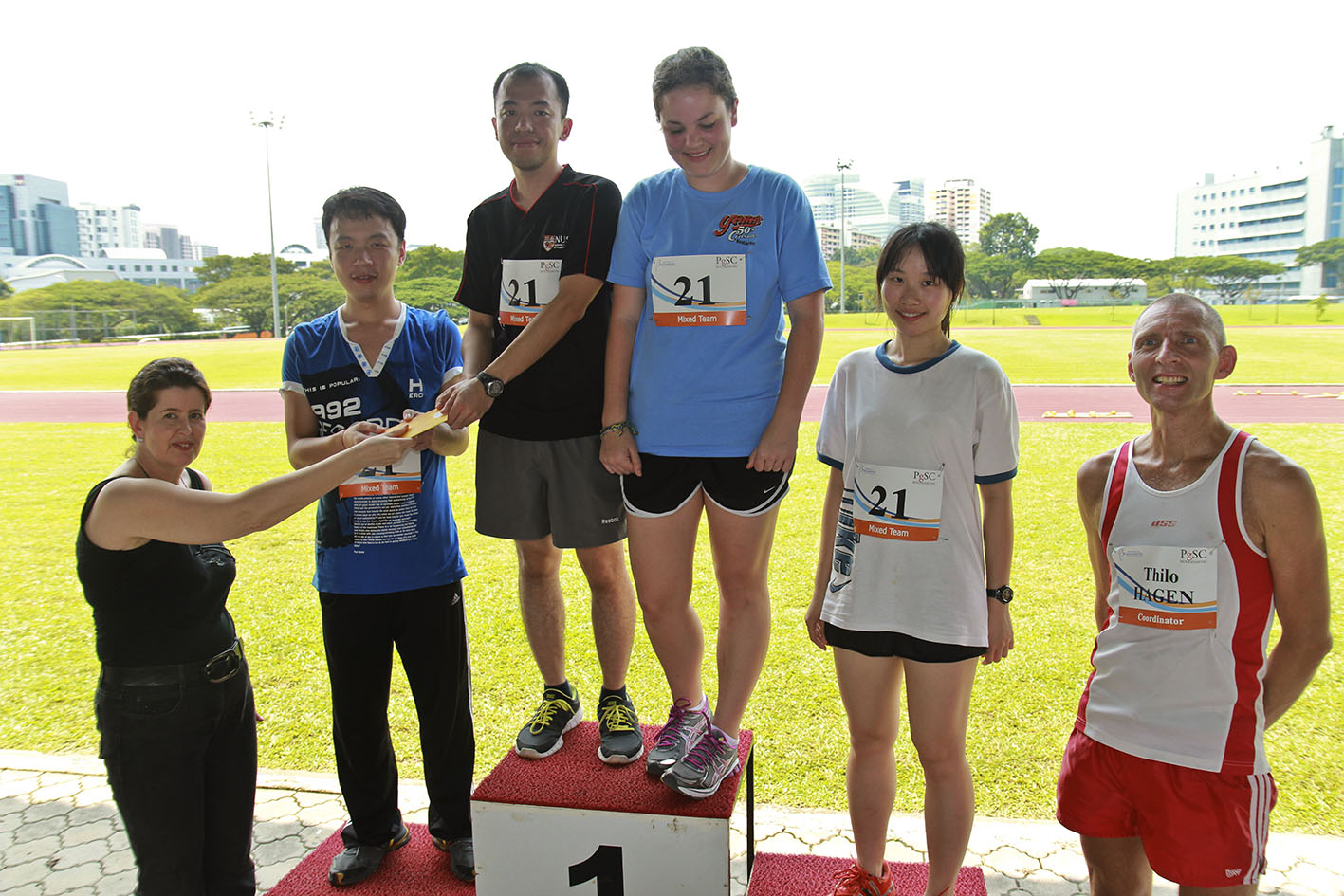
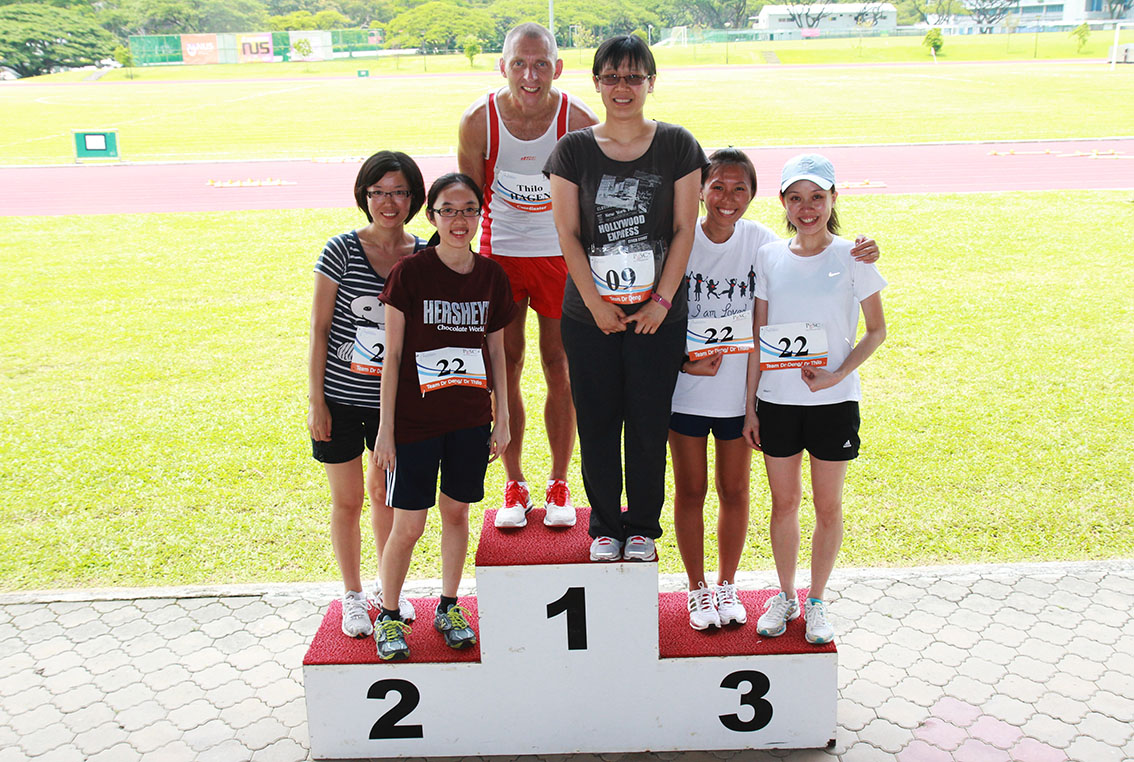
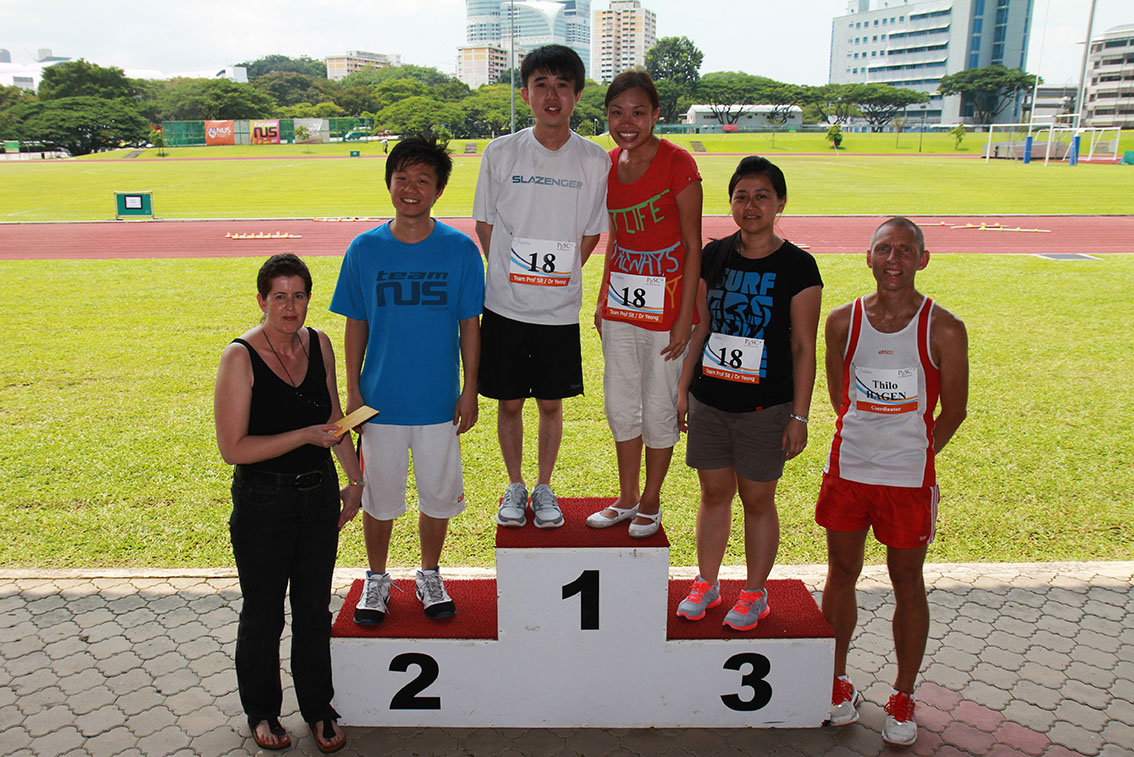
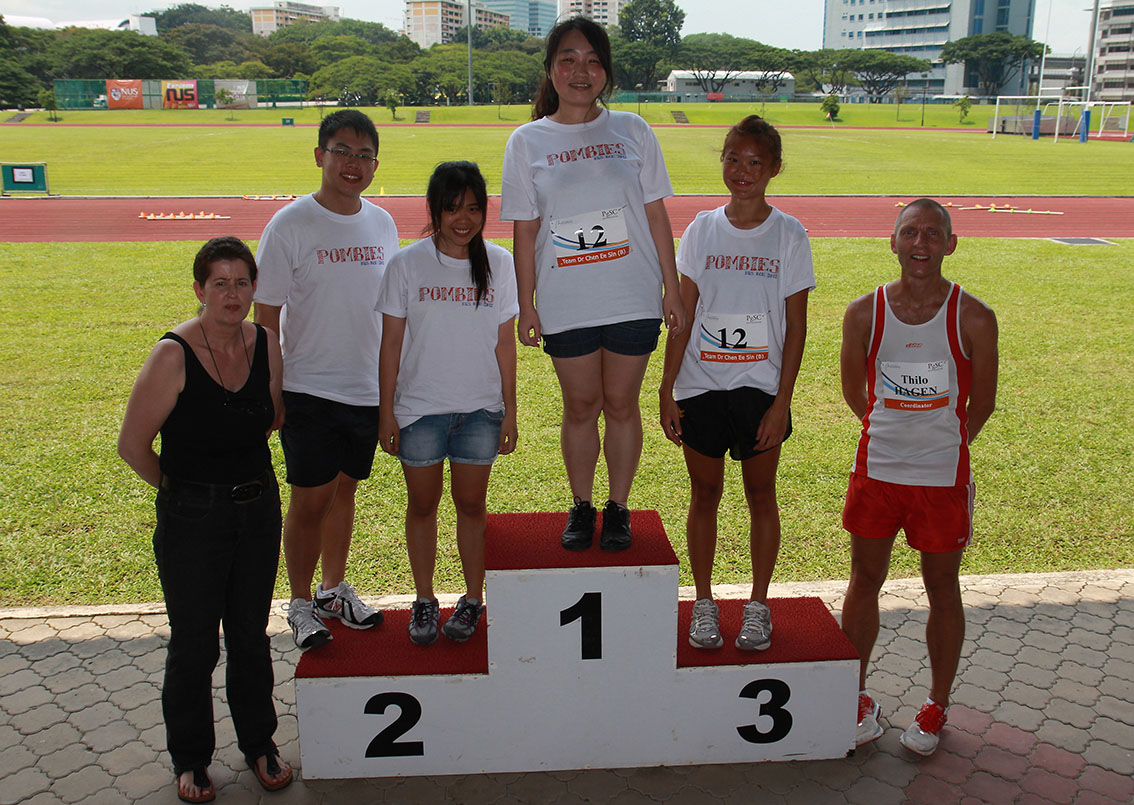
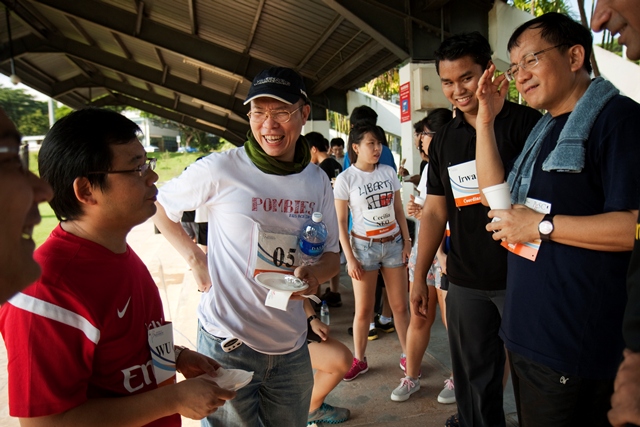
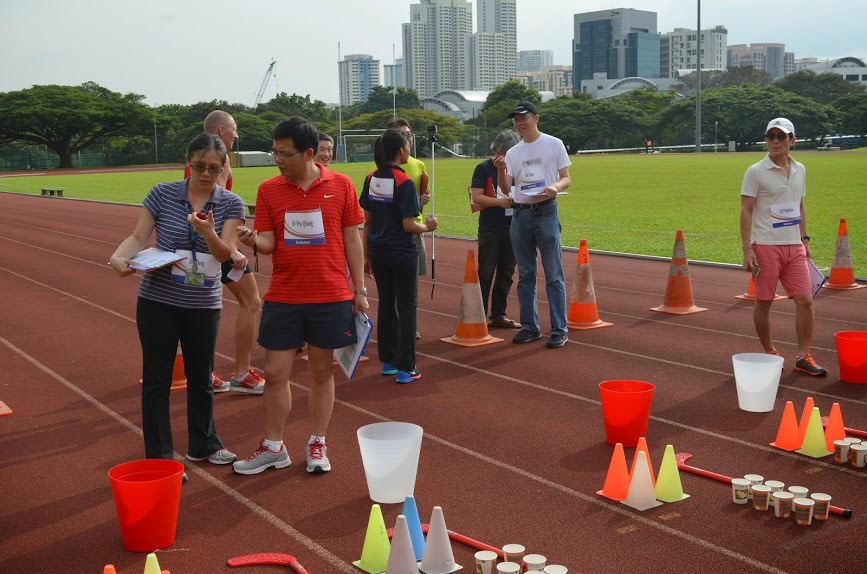
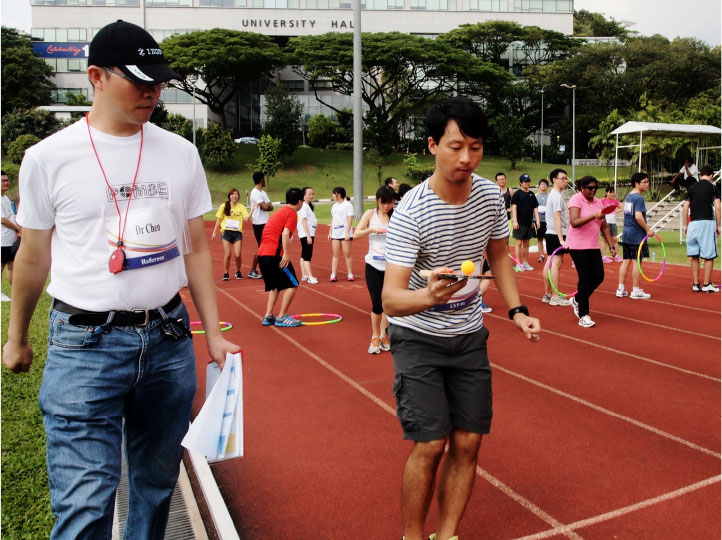
Firstly, there were outdoor activities such as our “sports and fun” days and an amazing race. In these events, lab teams from our department competed against each other.
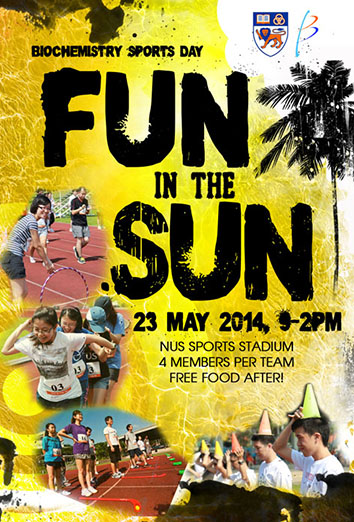
Department of Biochemistry Sports and Fun Day 2015
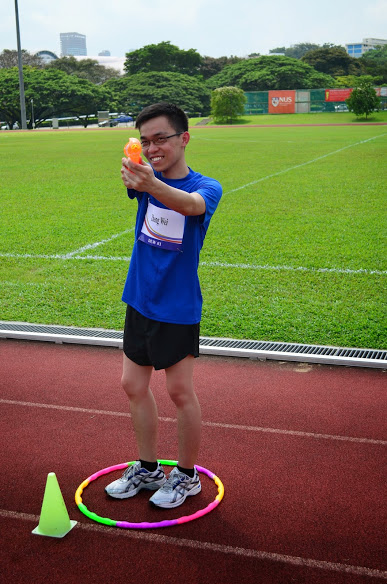
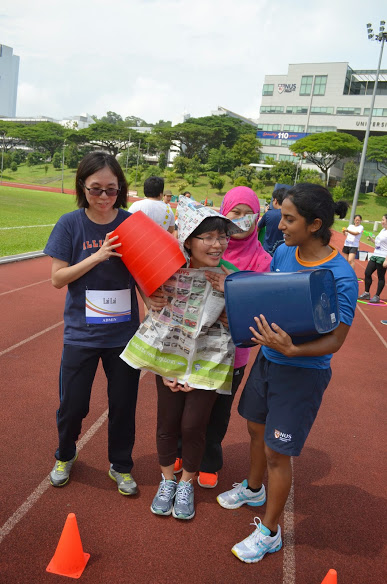
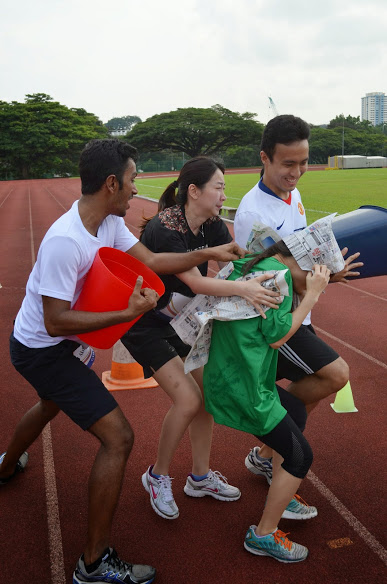
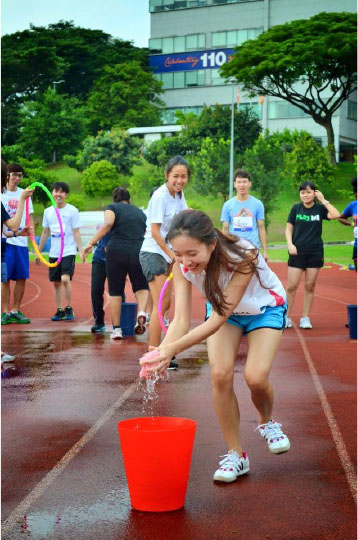

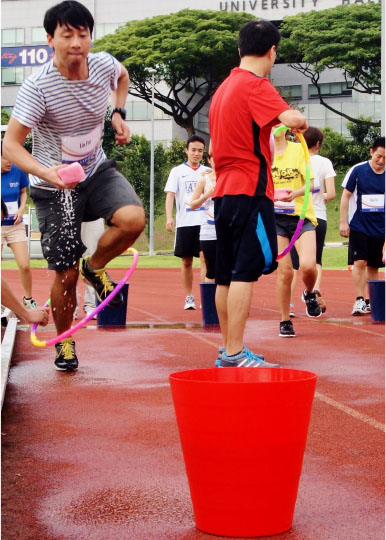
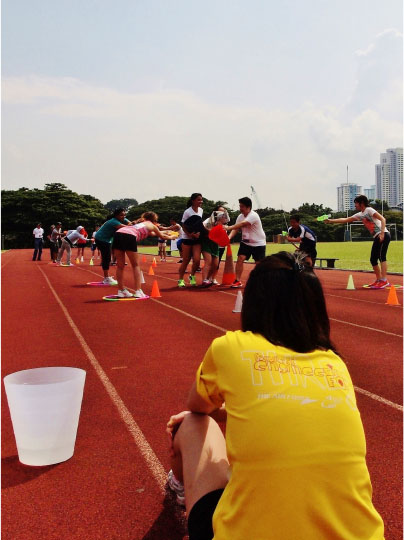
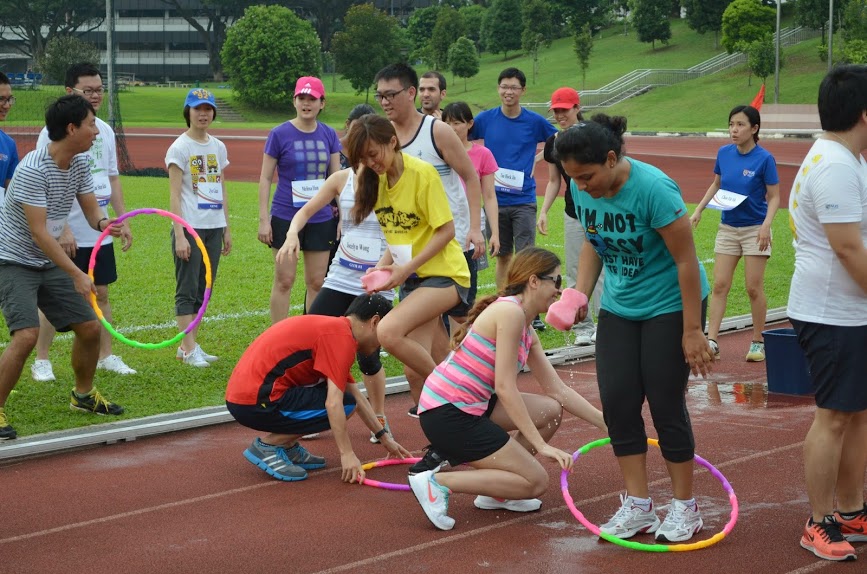
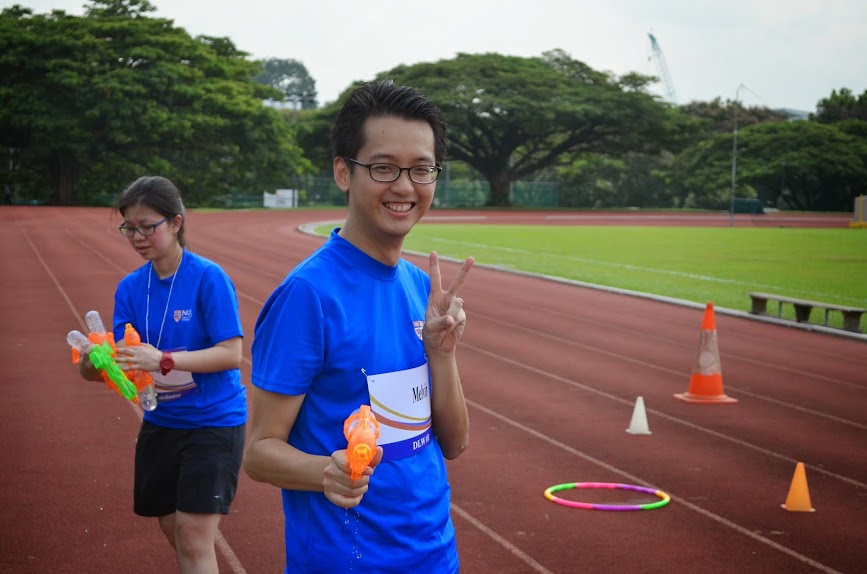
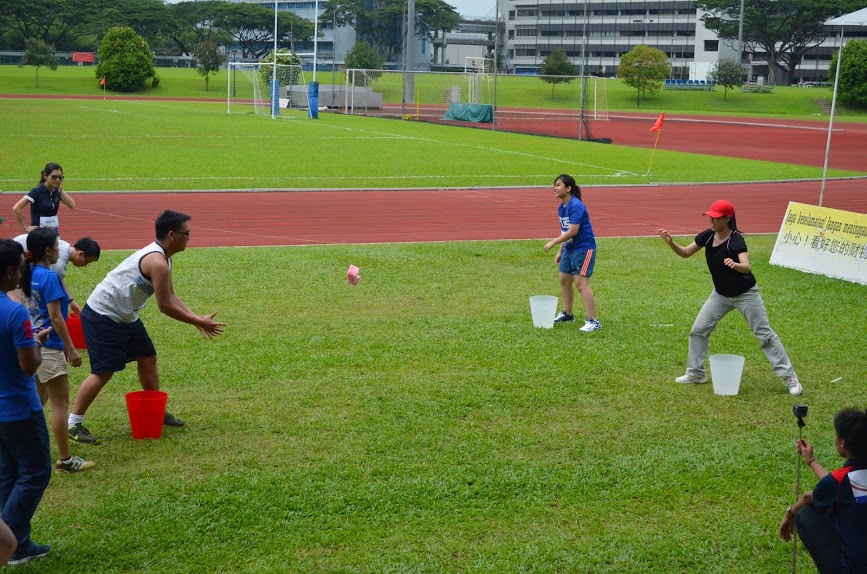
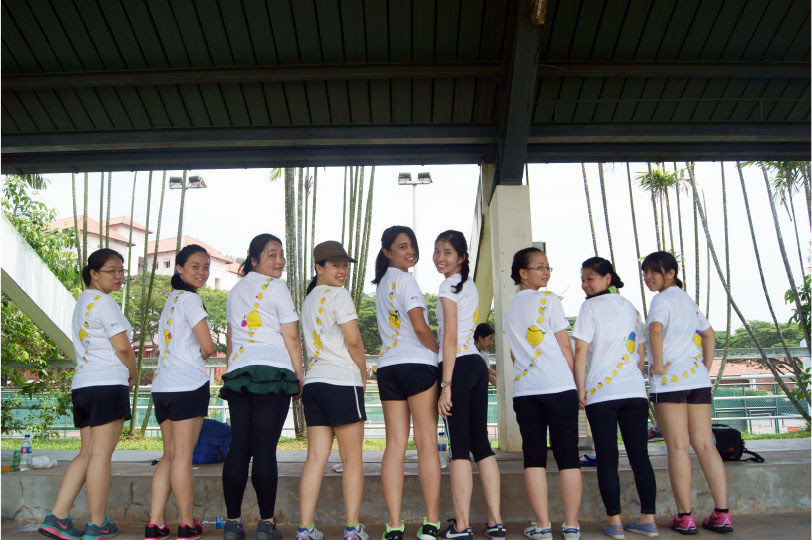
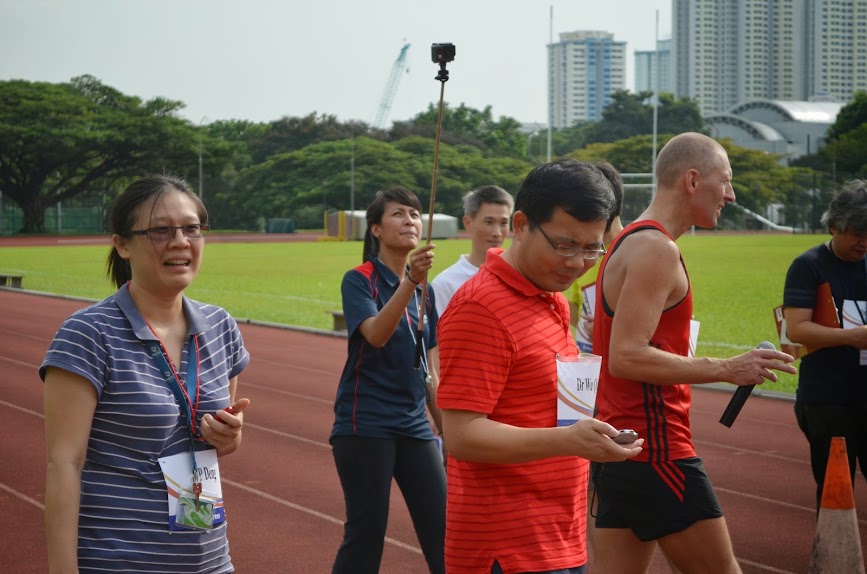
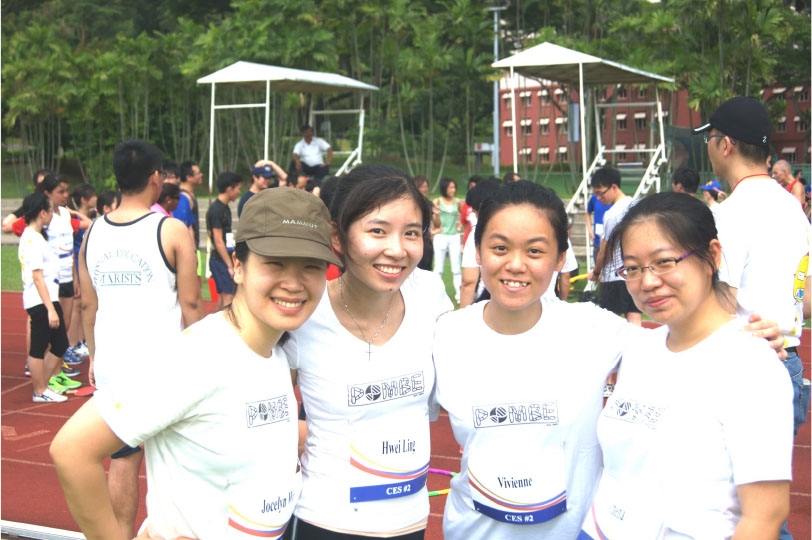
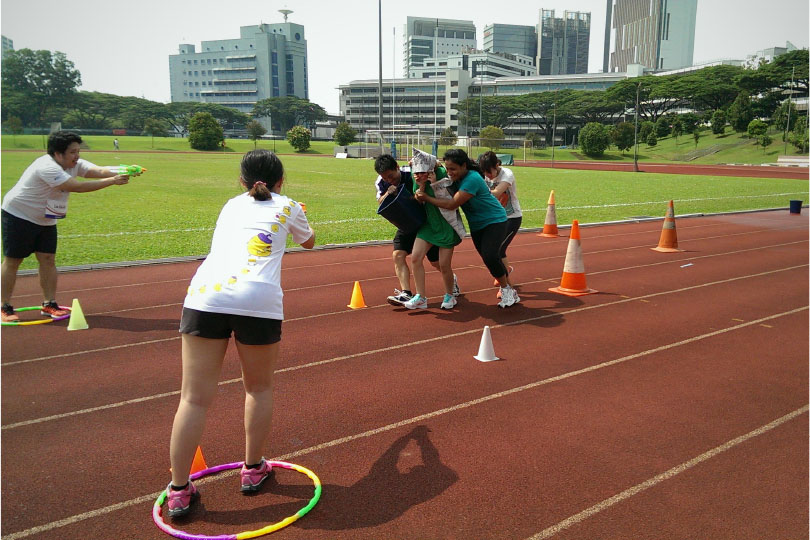
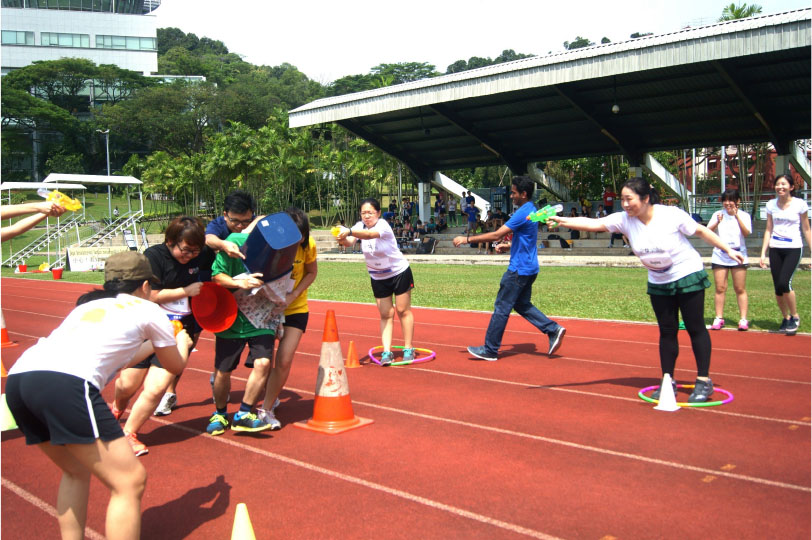
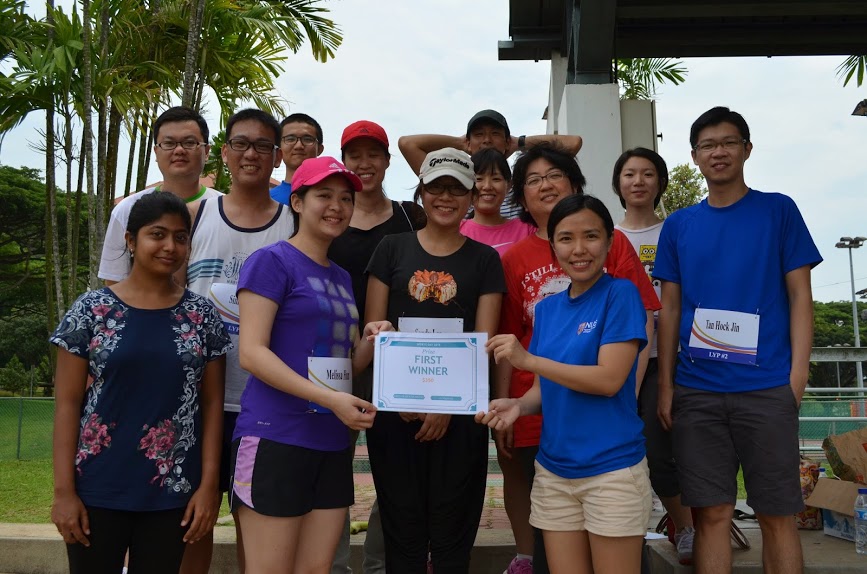
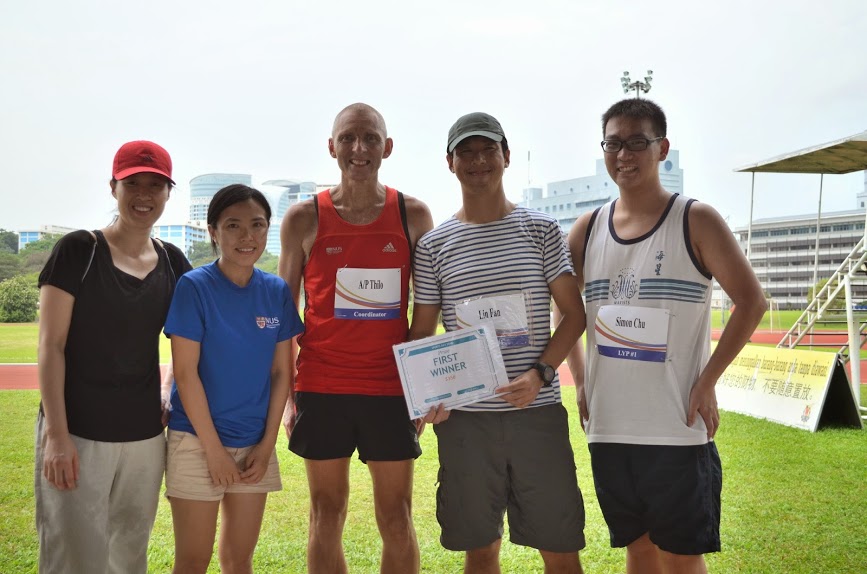
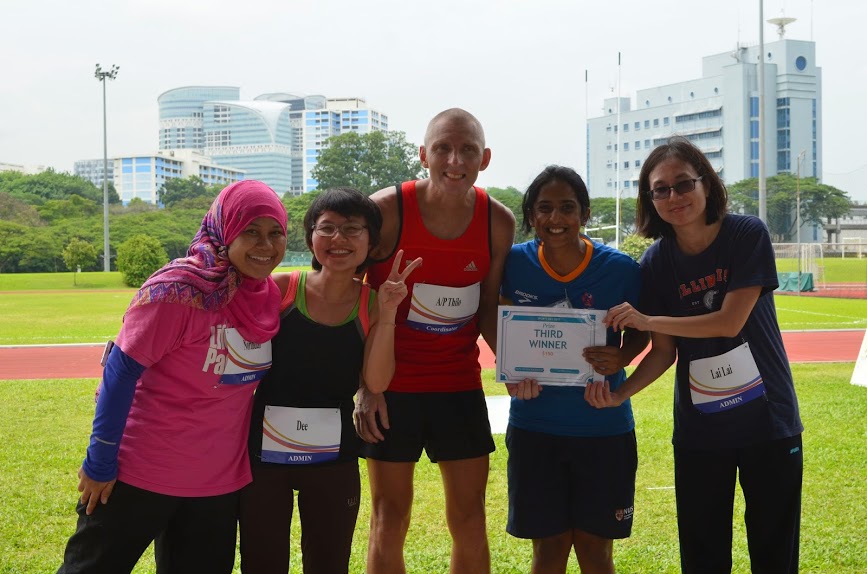
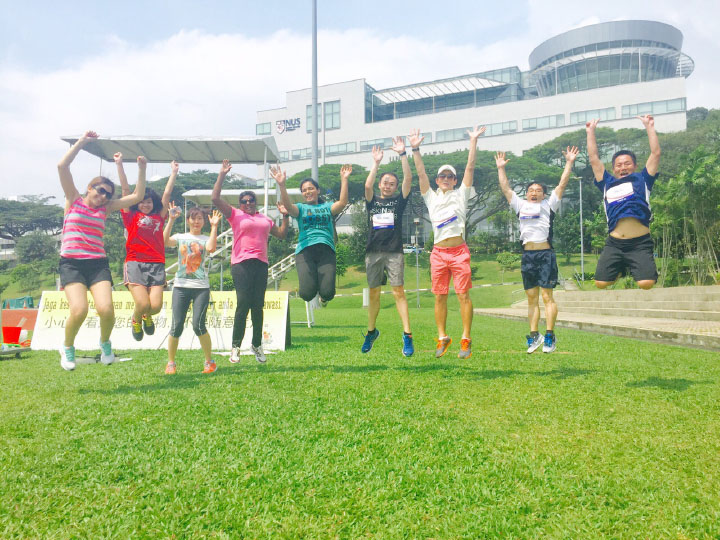
Department of Biochemistry Amazing Race 2013
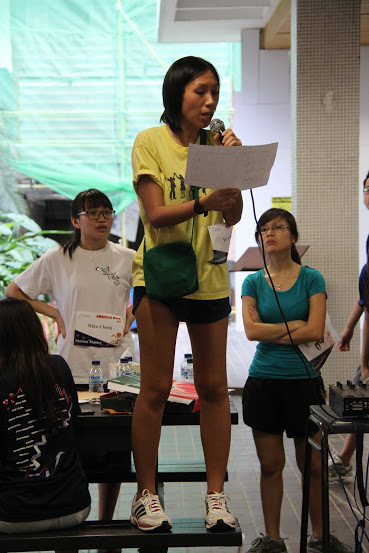
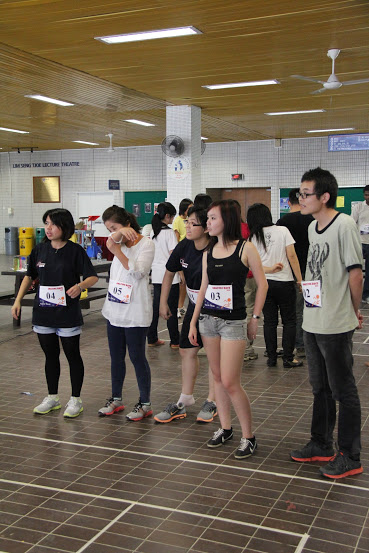
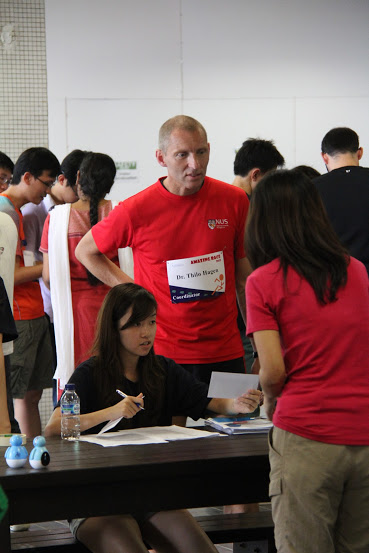
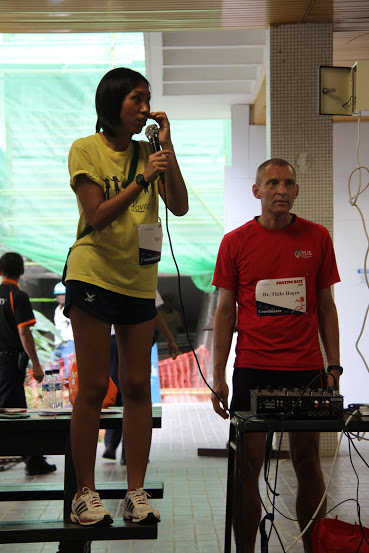
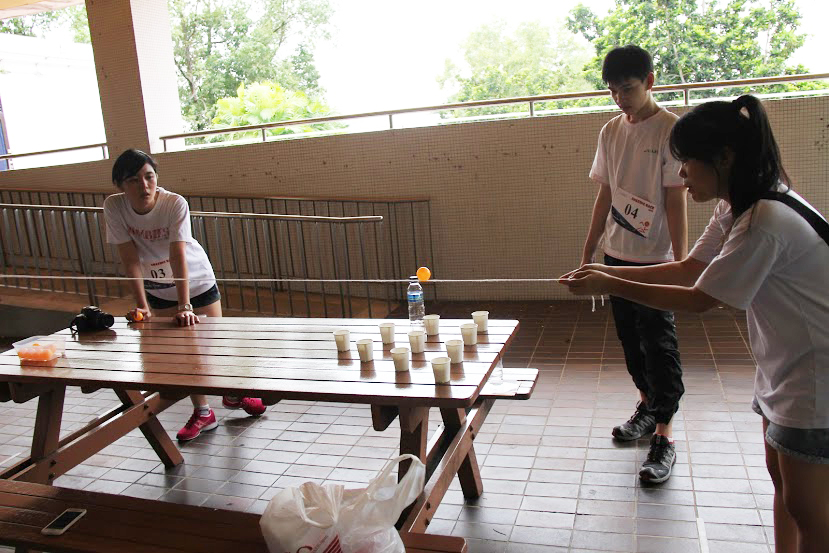
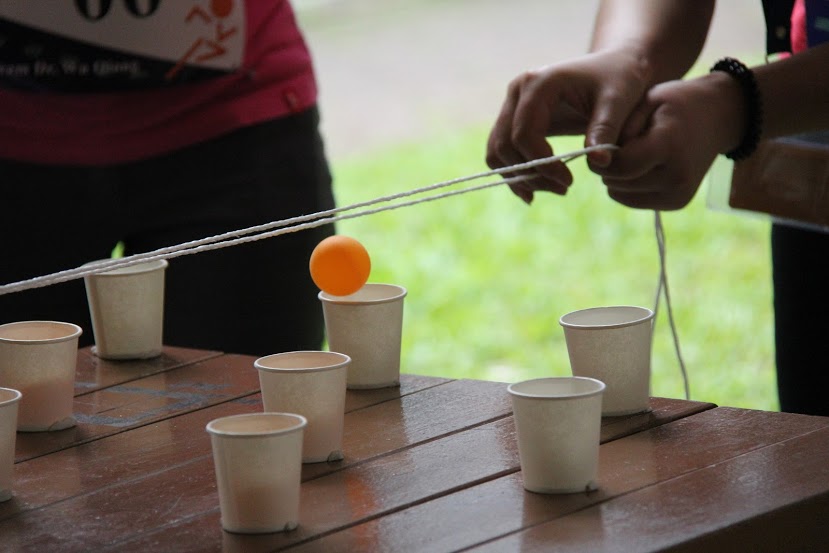
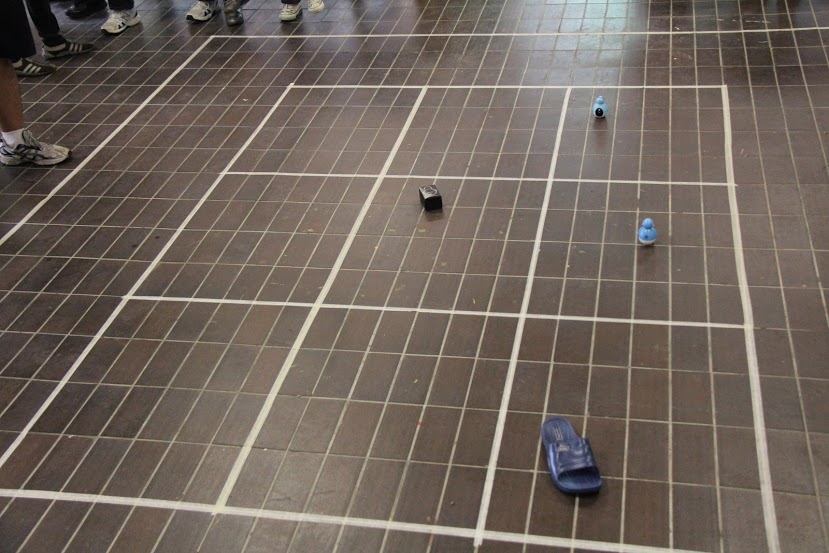
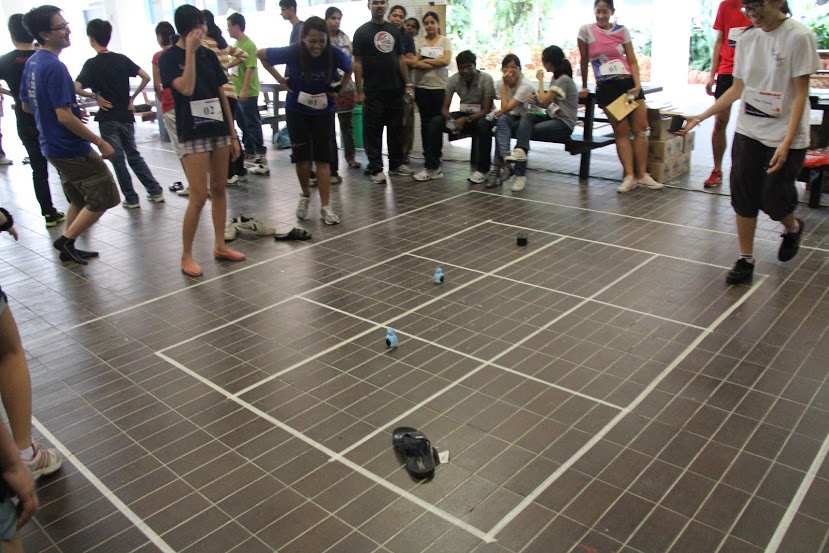
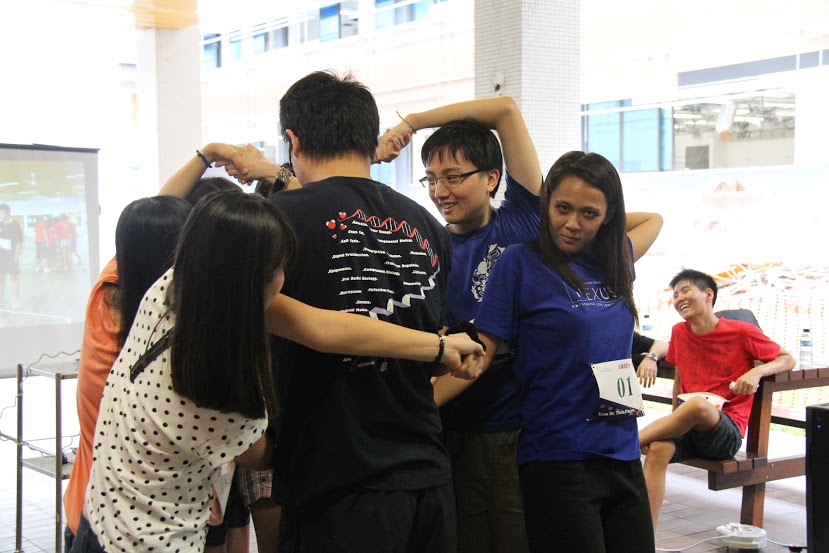
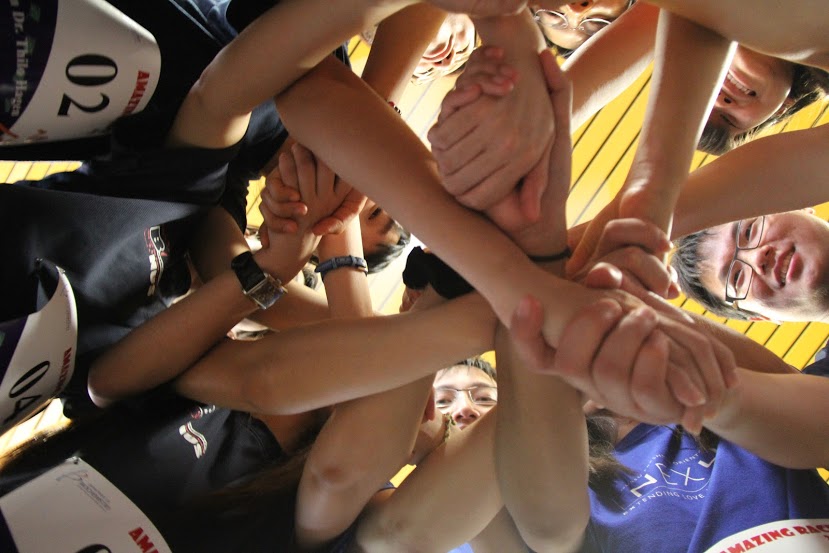
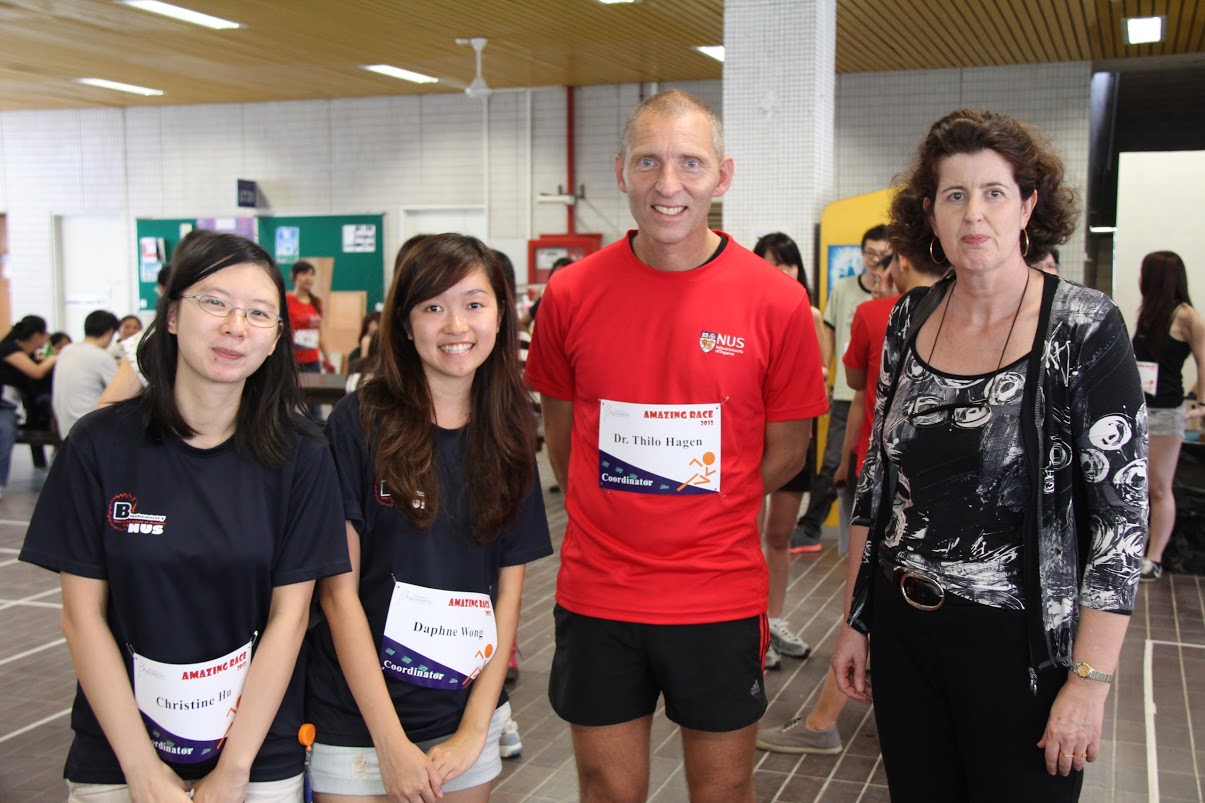
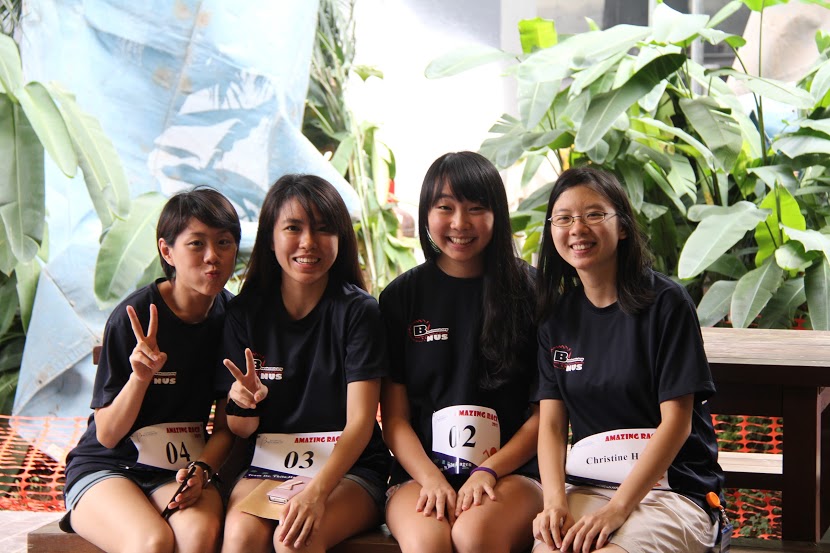
I personally felt super excited about giving our students and staff the chance to enjoy a day together with their fellow-student and colleagues in the department. It turned out, though, that many of our students and staff members were less excited about spending a day outdoors in the Singapore sun and away from their lab benches. As such, it took great effort to get students and departmental staff to sign up for these events, and I used to literally go from lab to lab to recruit lab teams to join. It goes to show that success requires not only taking the initiative, but also persistence and persuasion.
In the end, the events turned out to be a lot of fun, and they were likely memorable for many students and departmental staff. They certainly were for me.
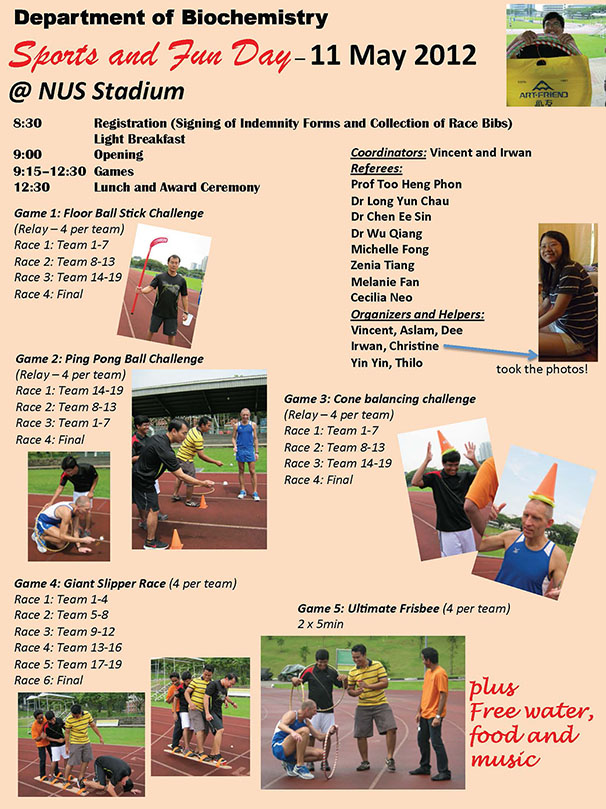
Department of Biochemistry Sports and Fun Day 2012
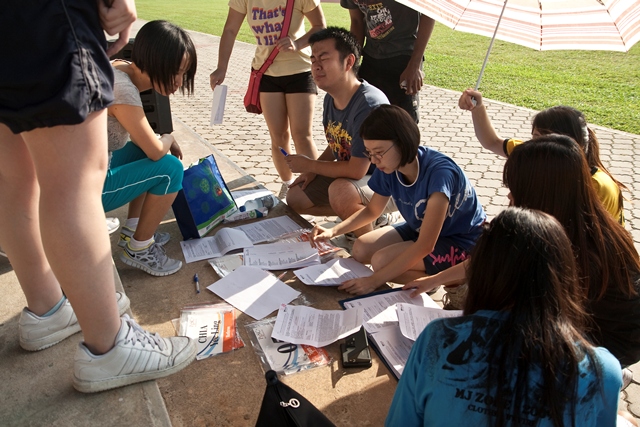
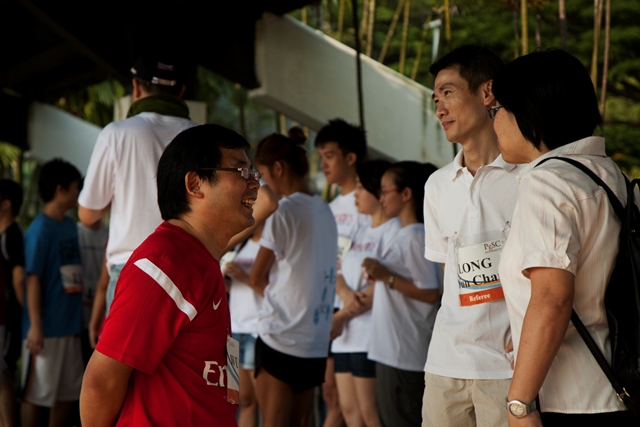
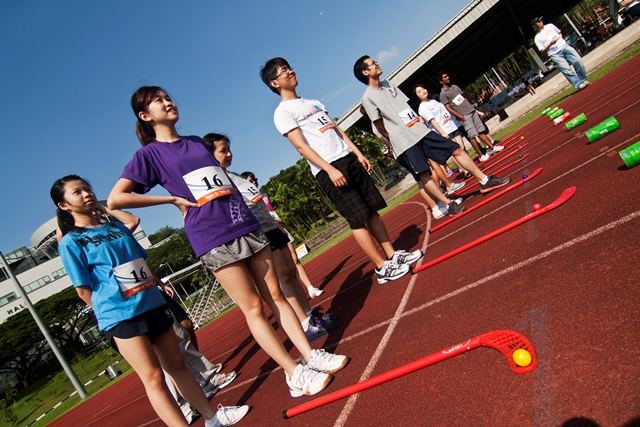
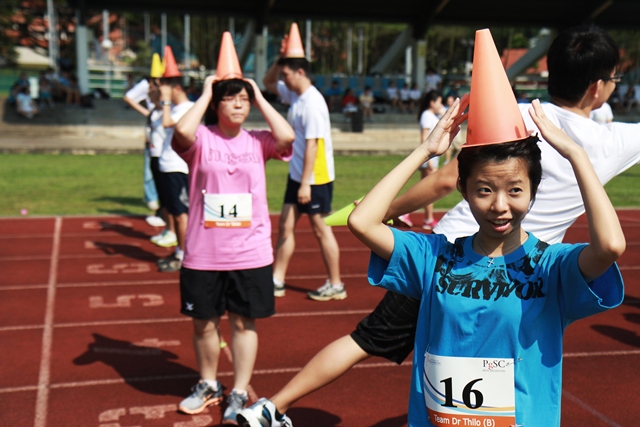
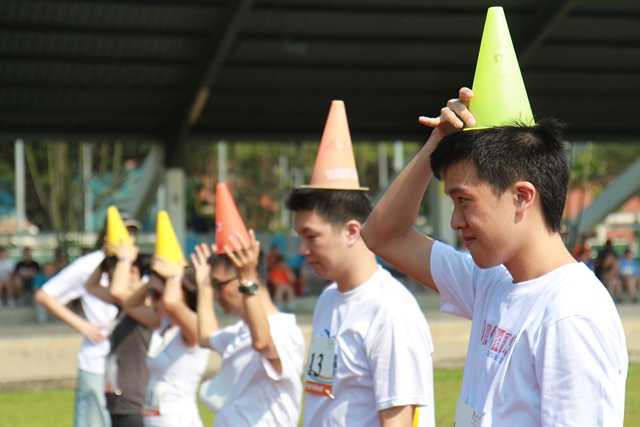
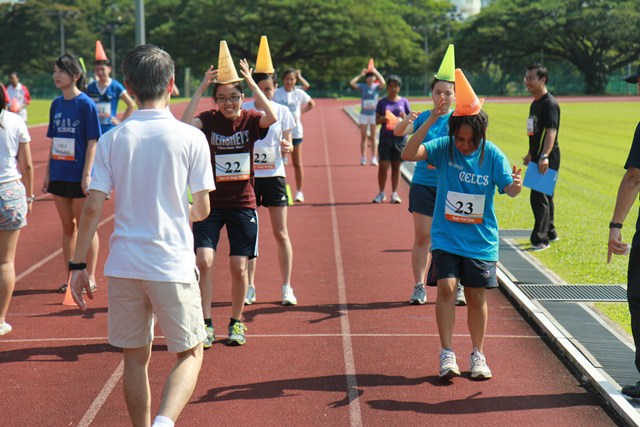
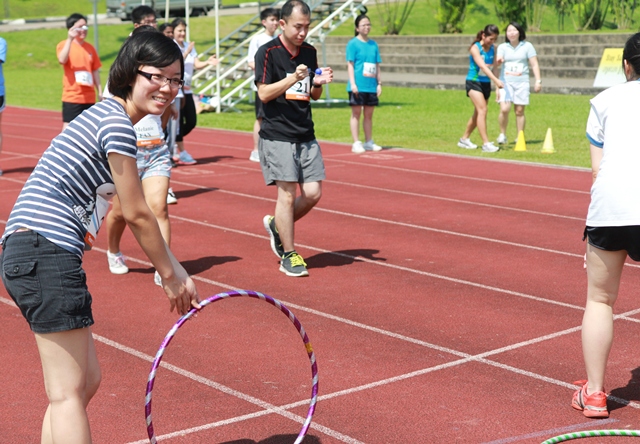
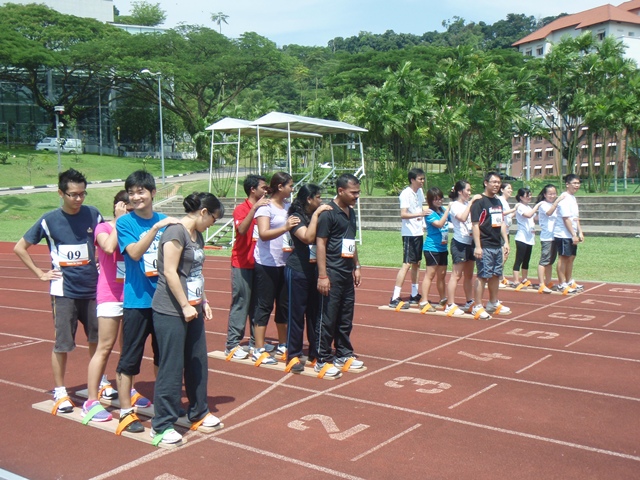
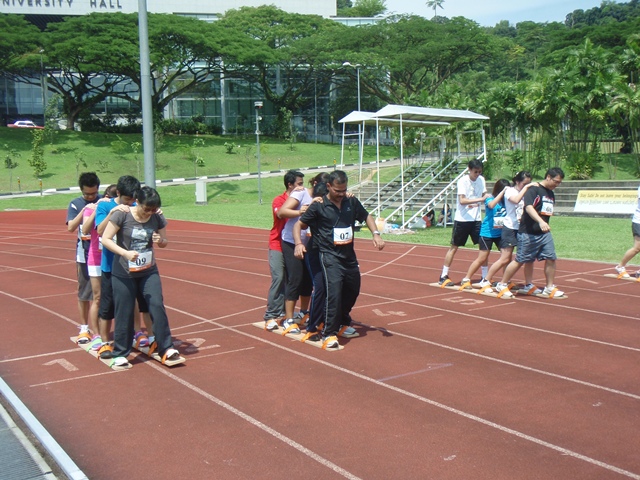
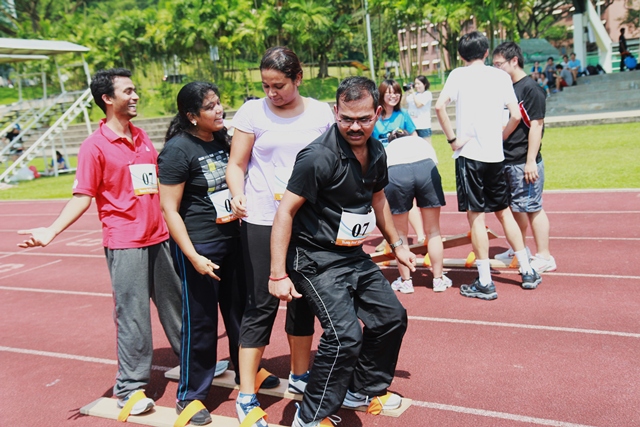
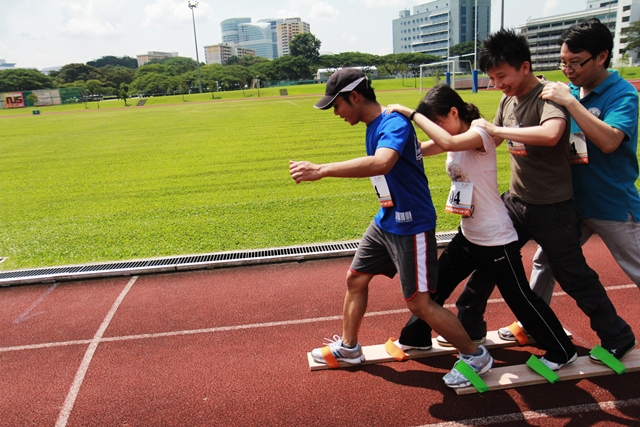
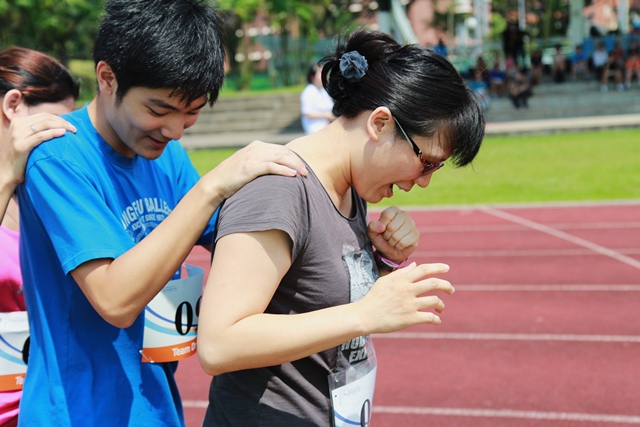
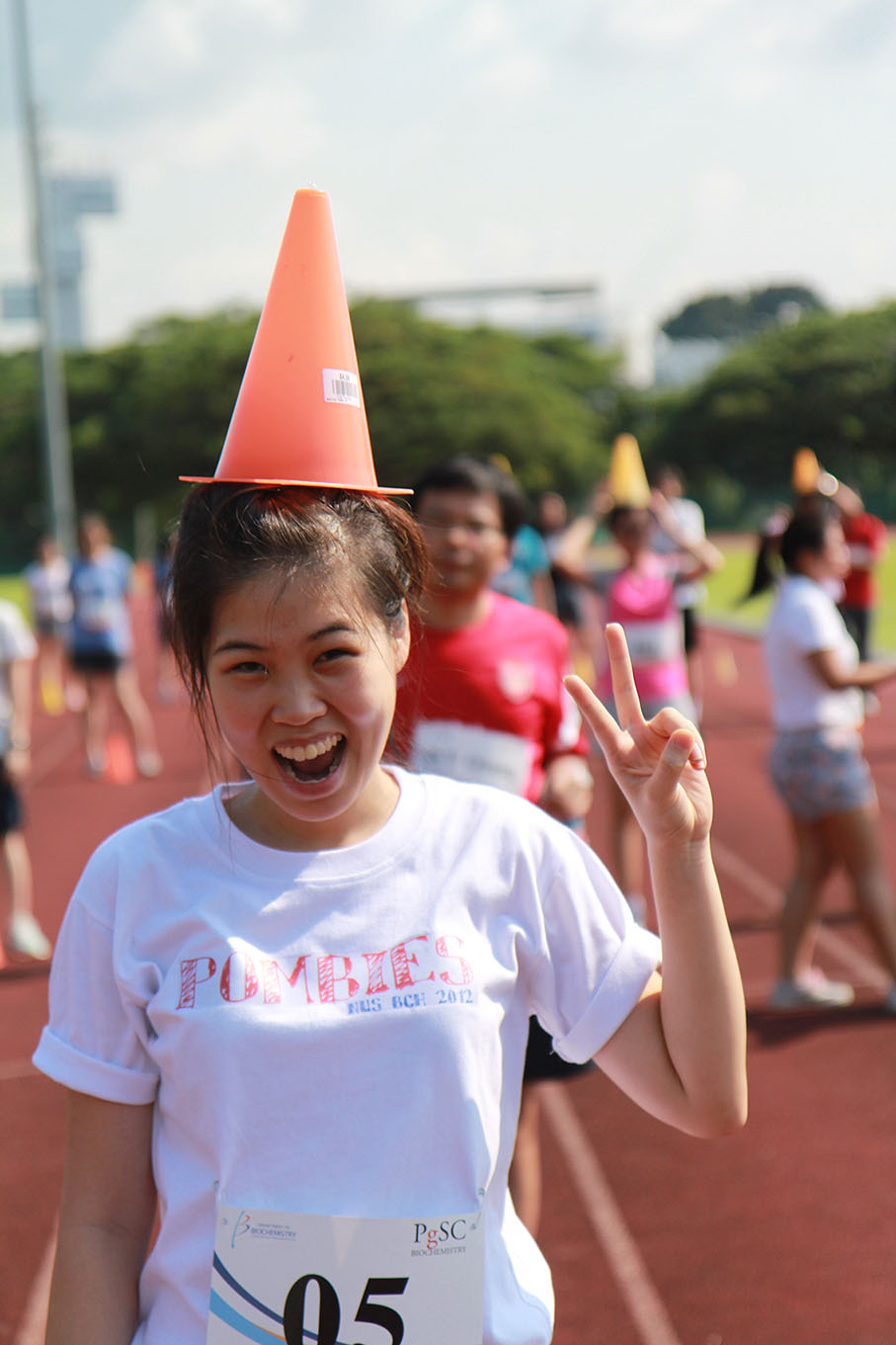
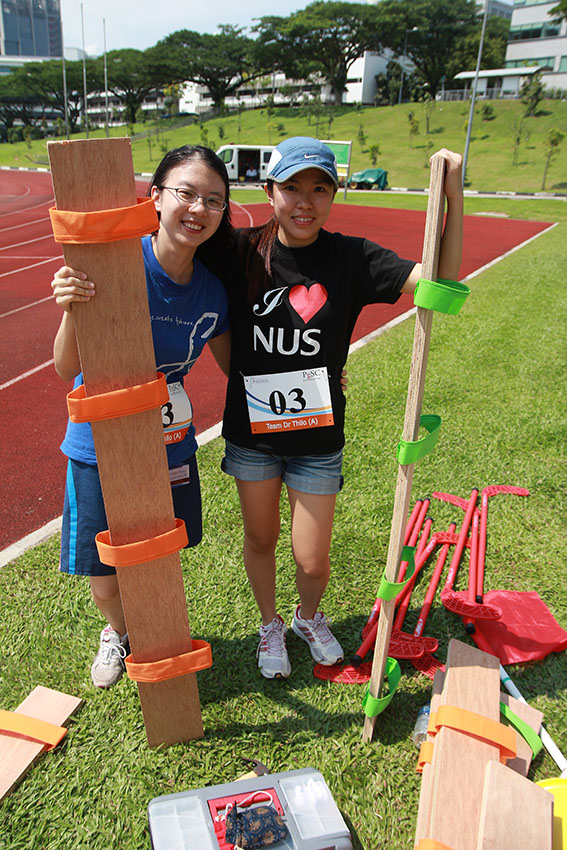
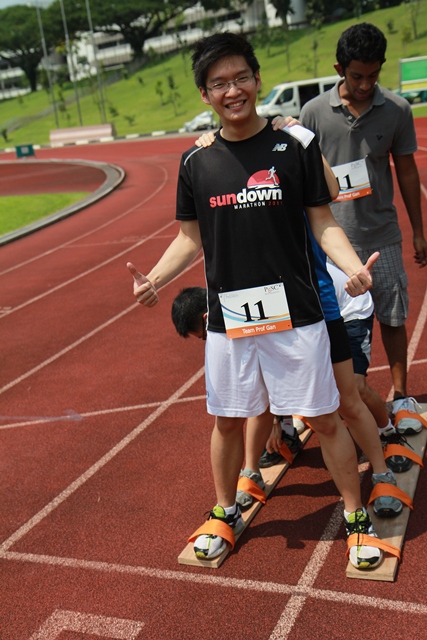
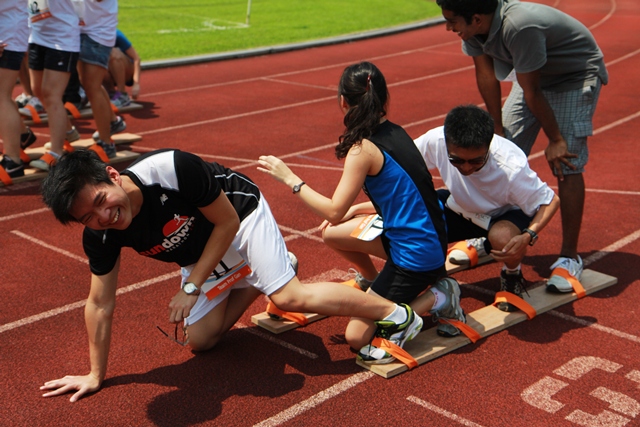
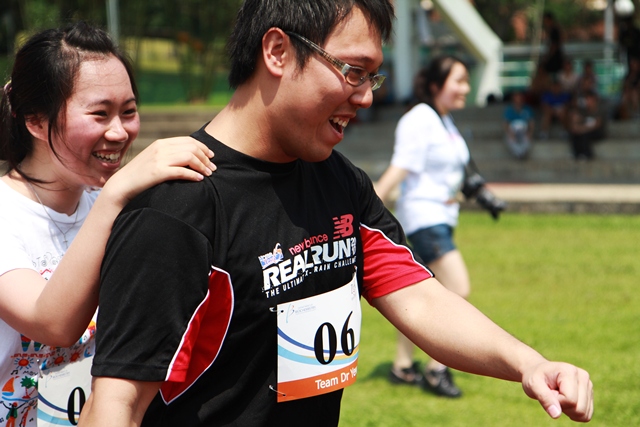
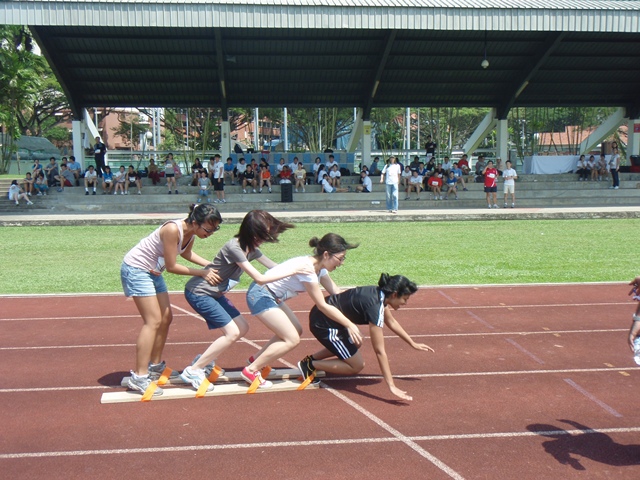
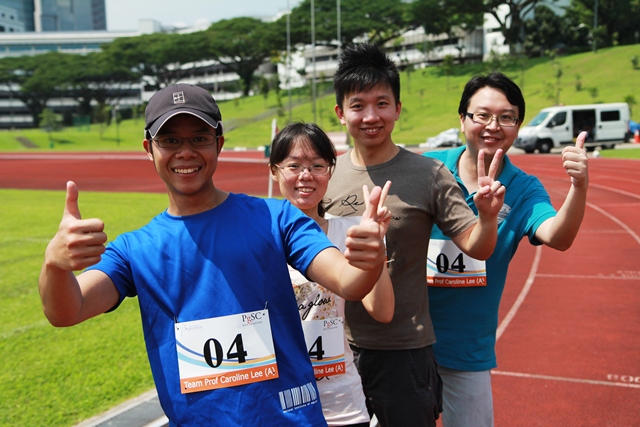
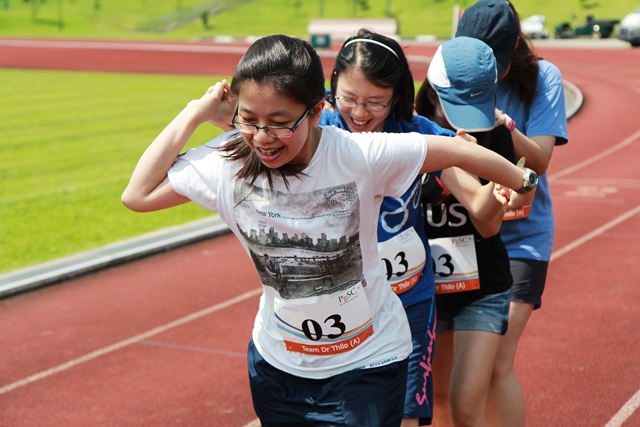
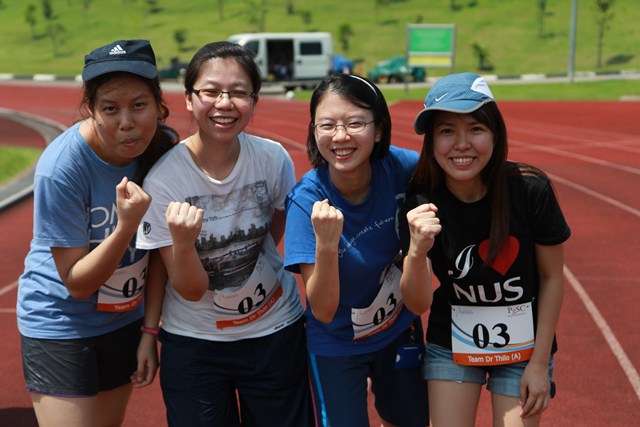
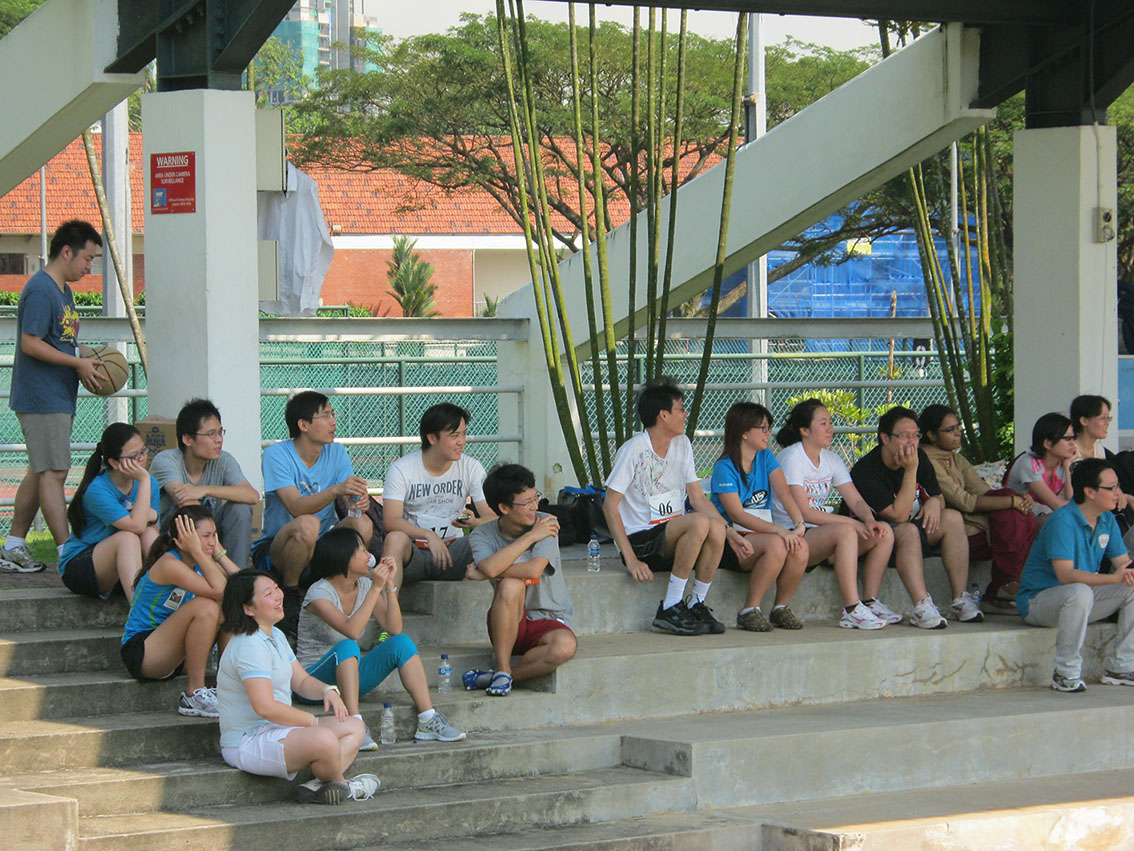
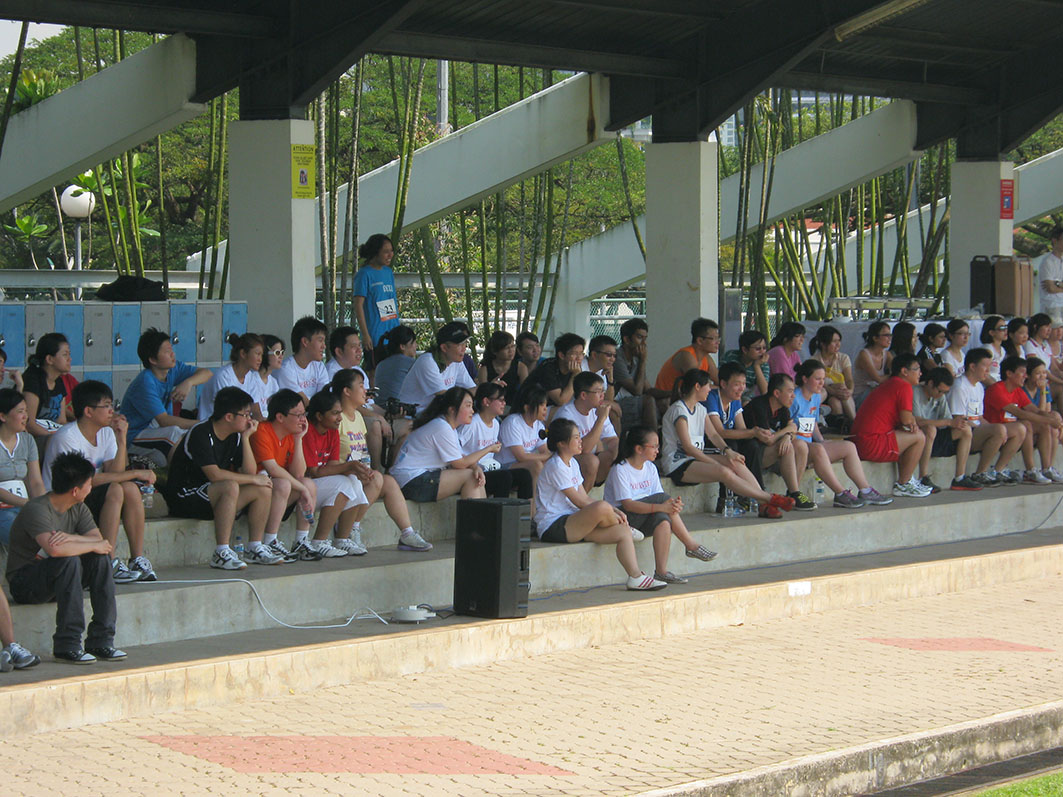
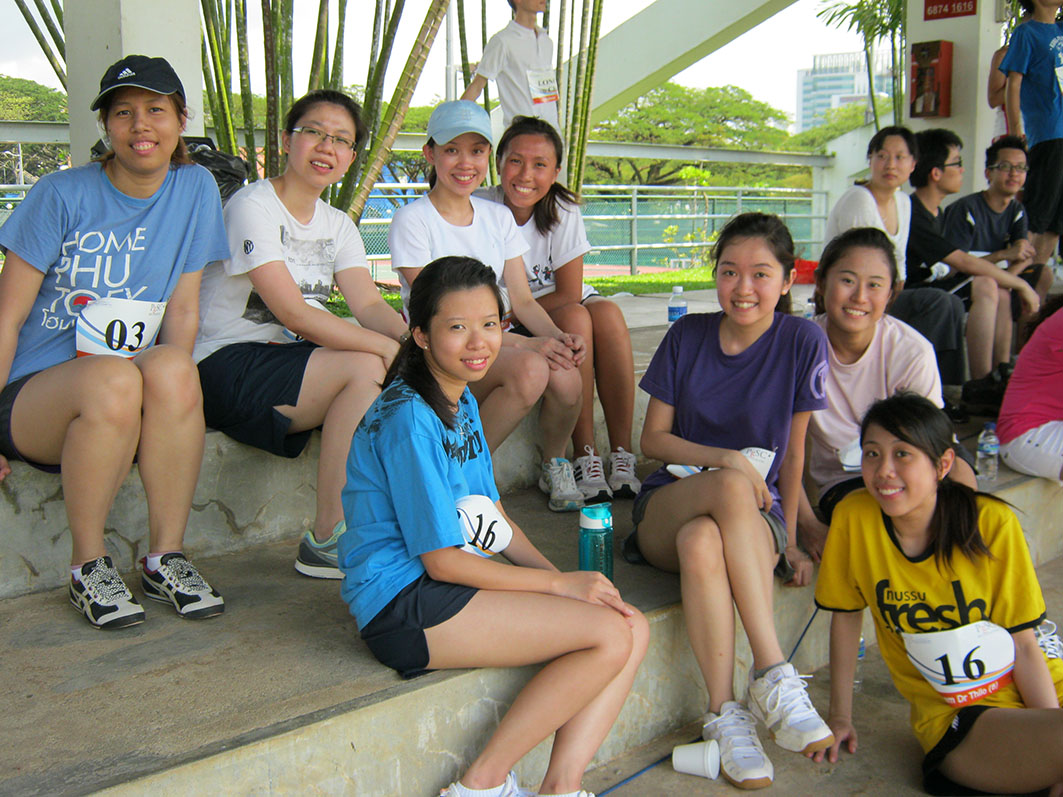
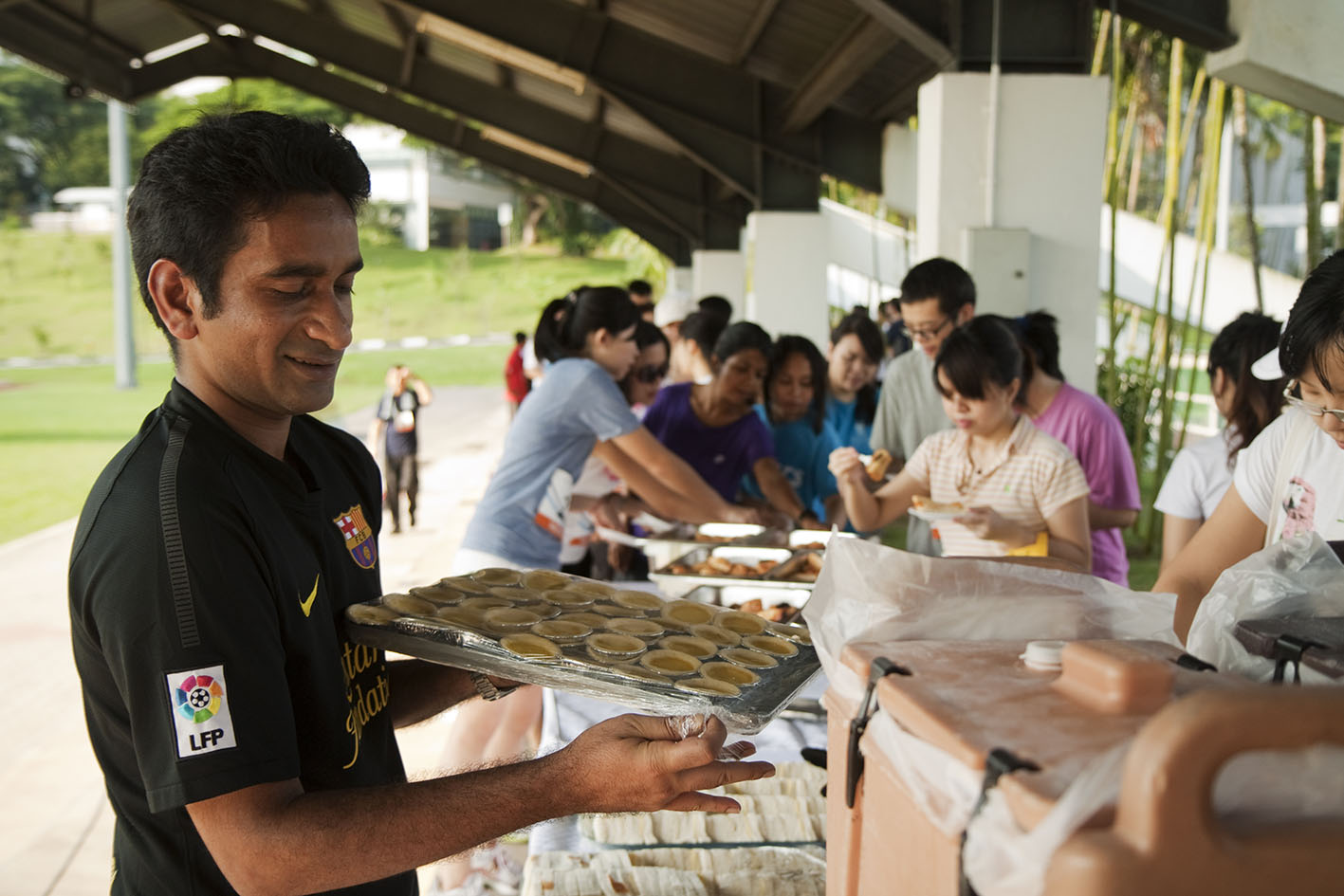
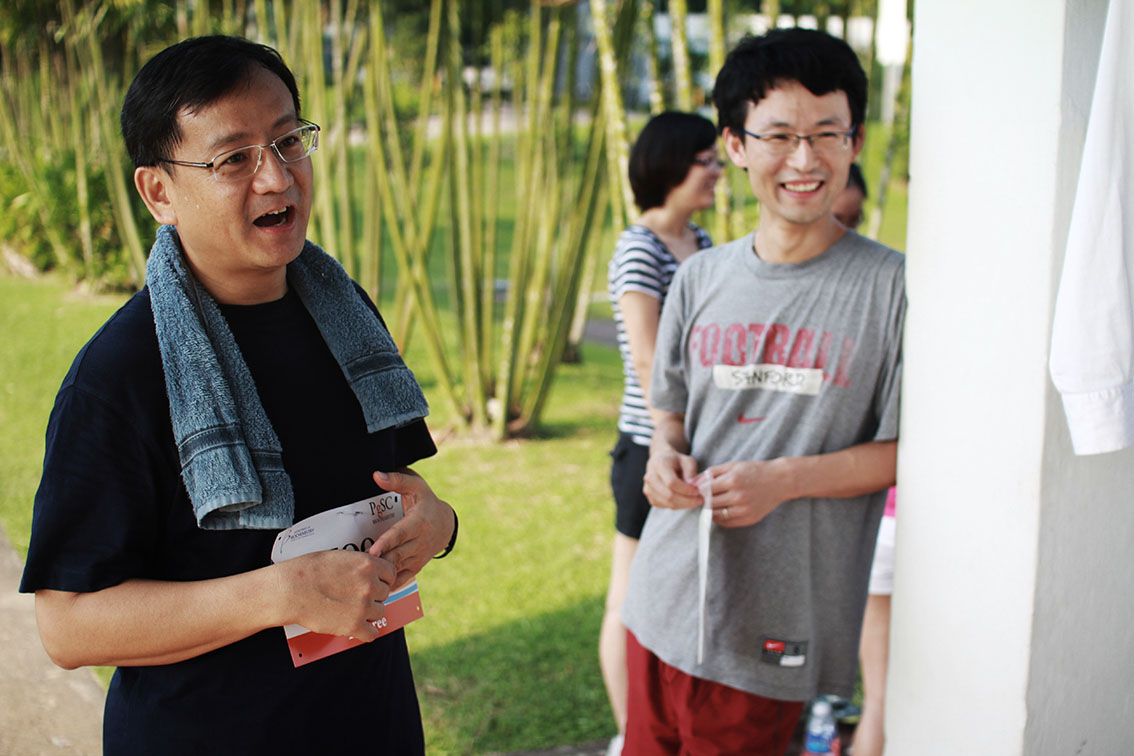
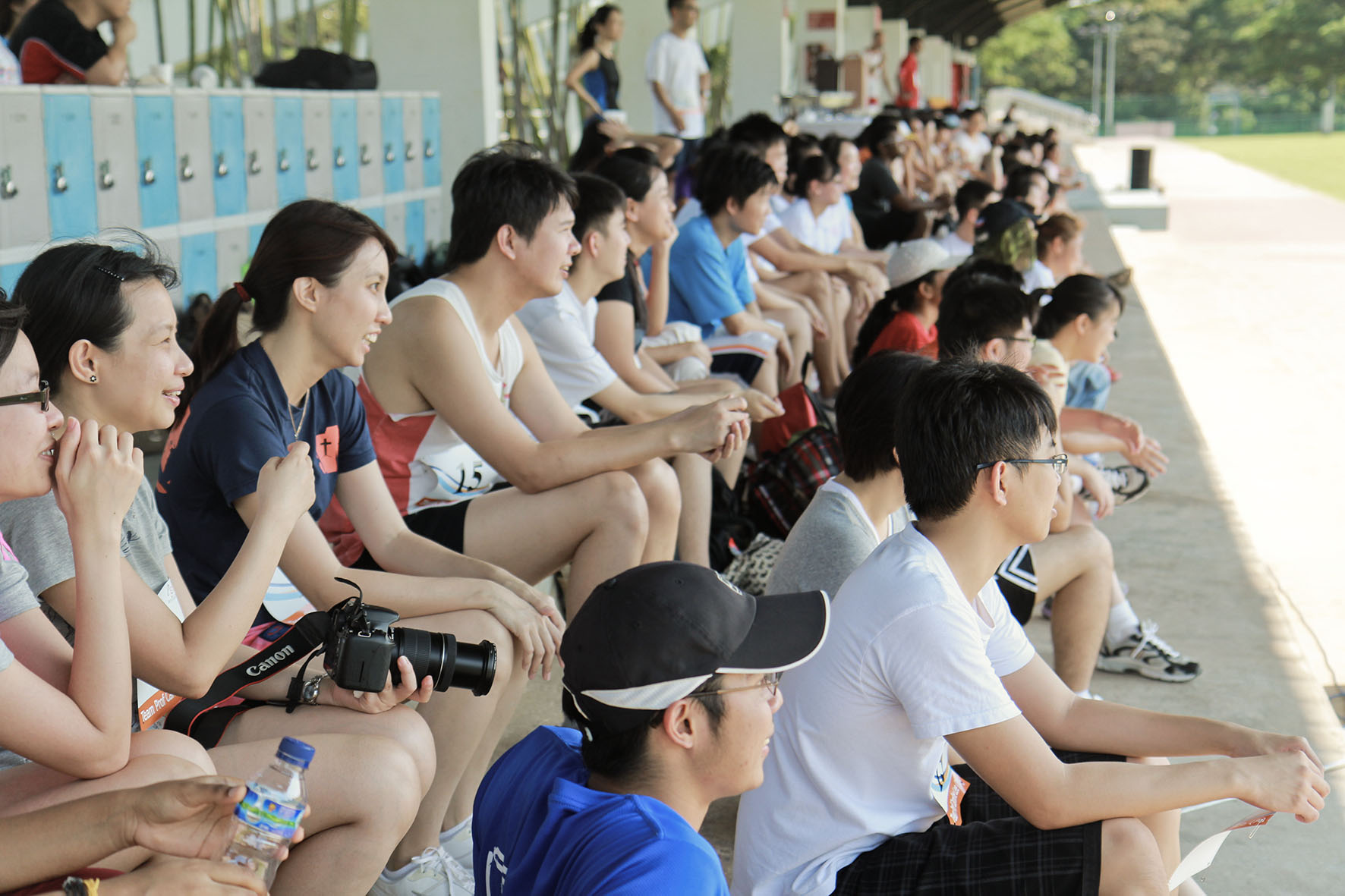
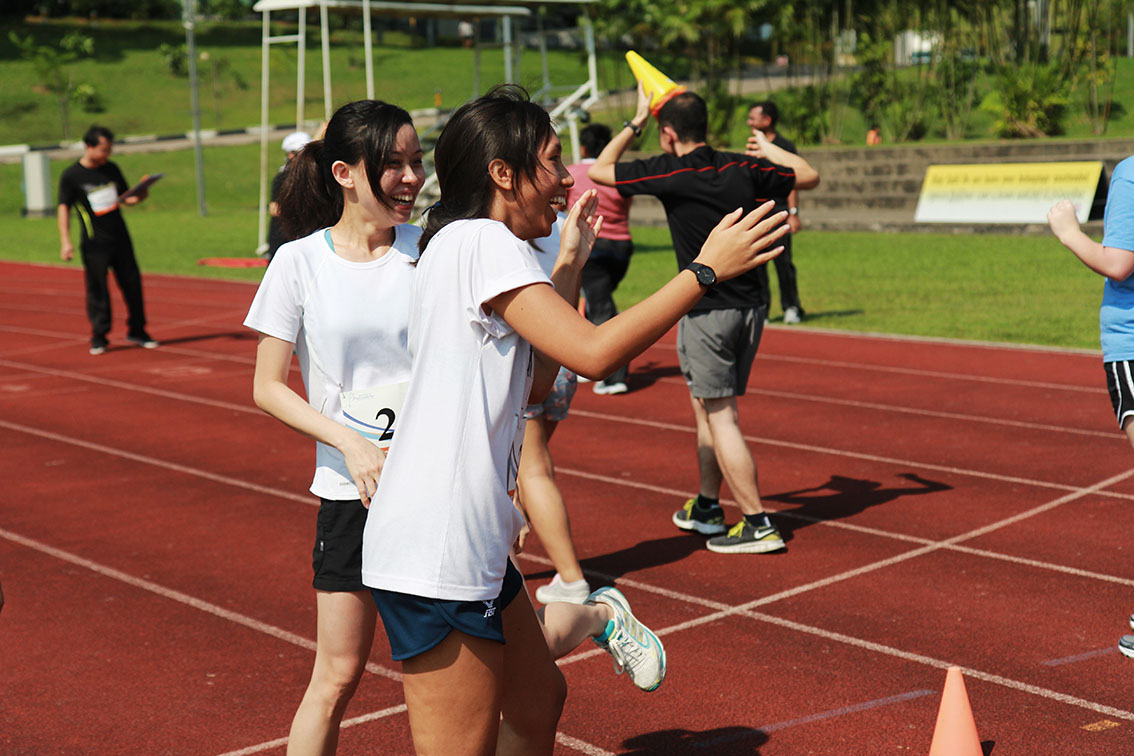
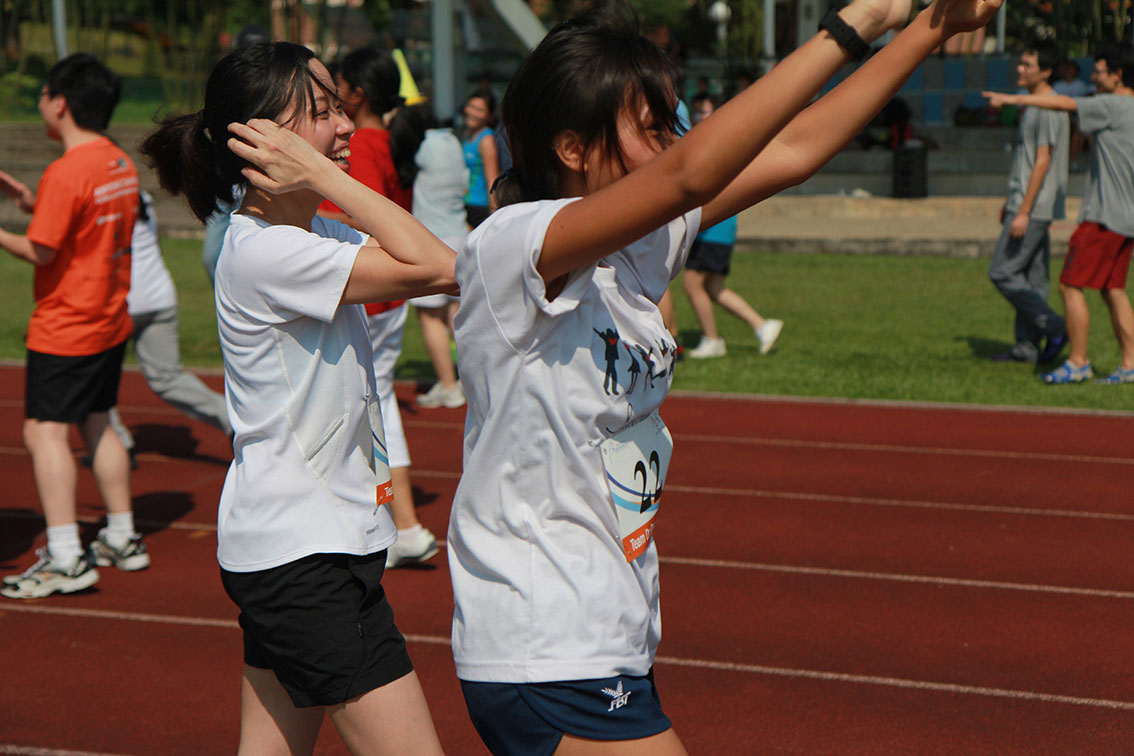
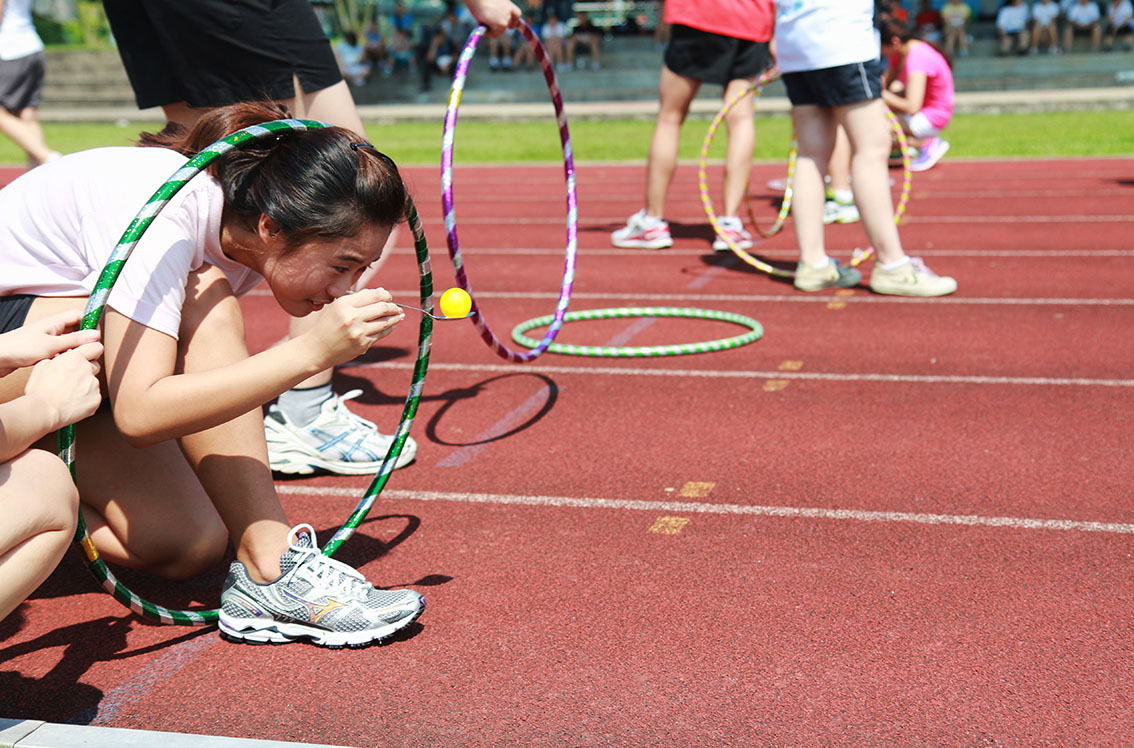
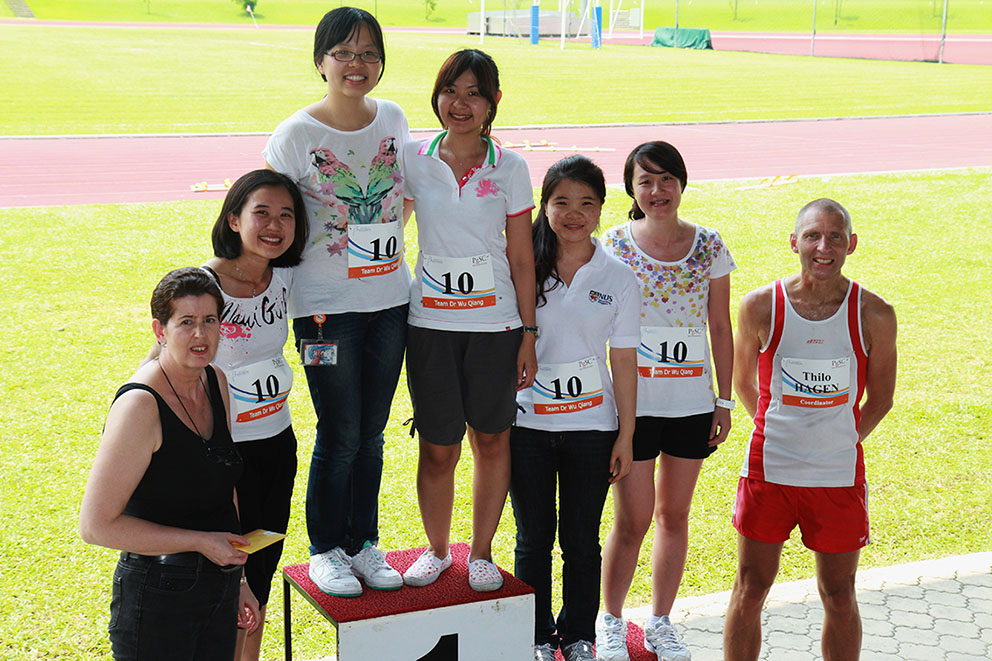
Testing out the games:
I was especially happy that so many Profs joined these events and took over most of the umpire roles. In fact, it required very little encouragement to get them to participate.
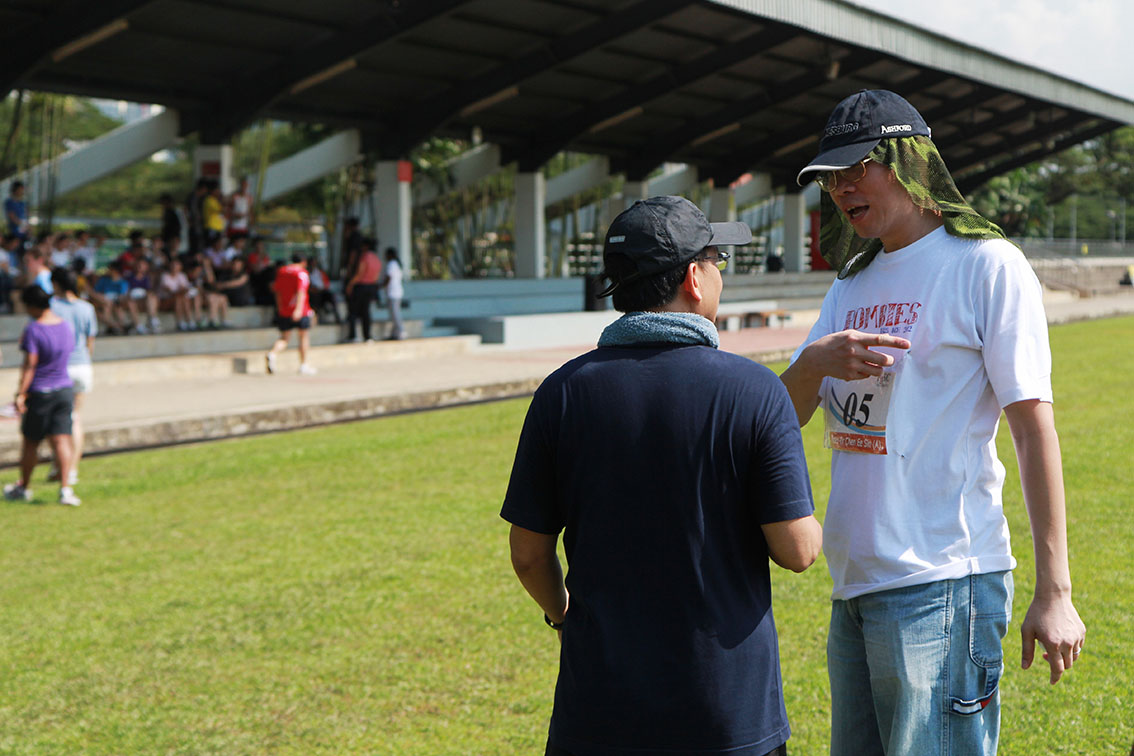
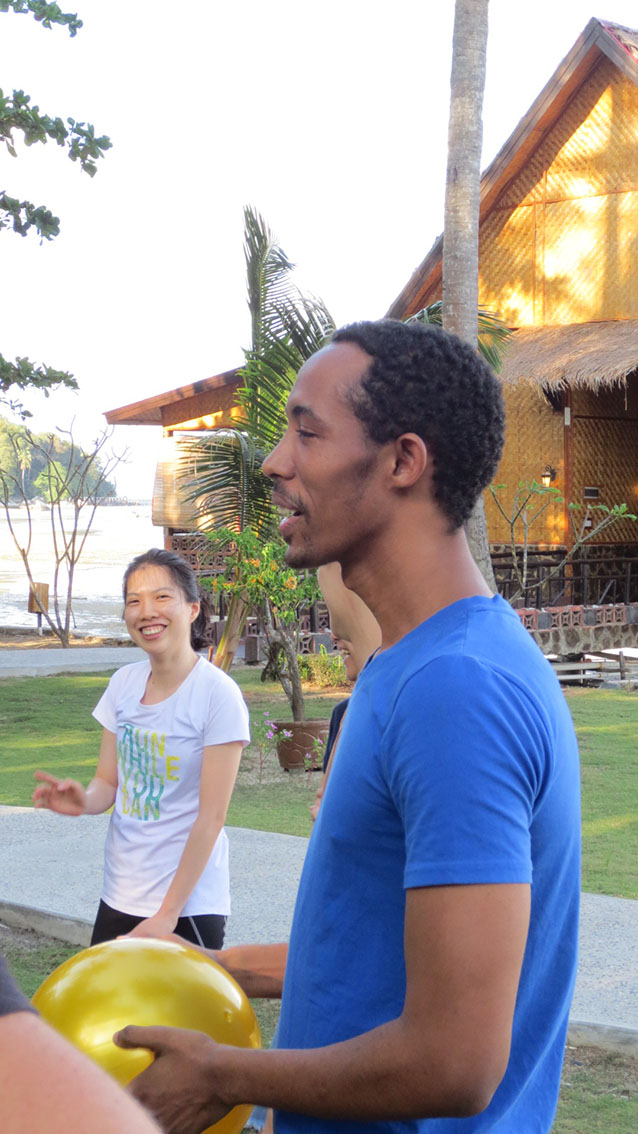
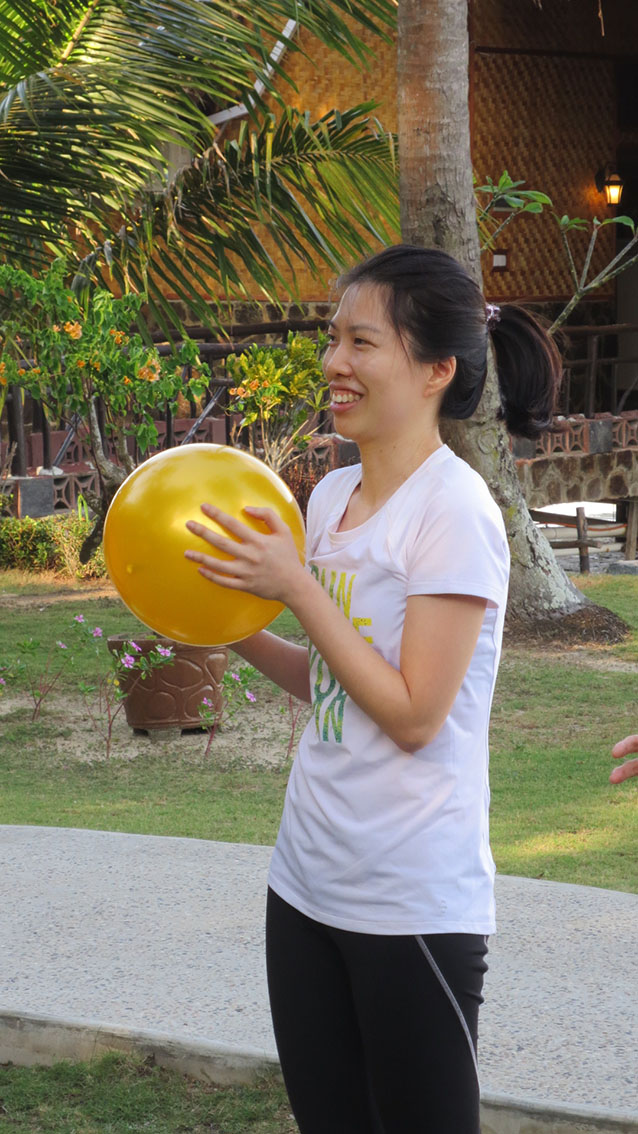
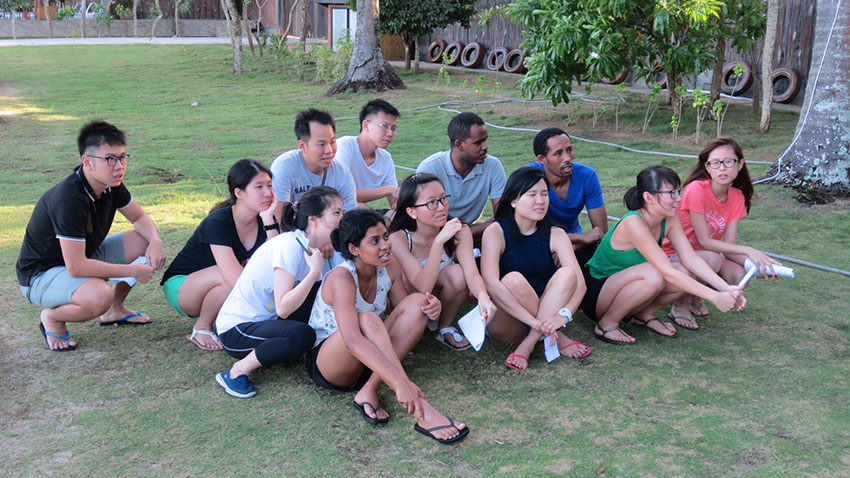
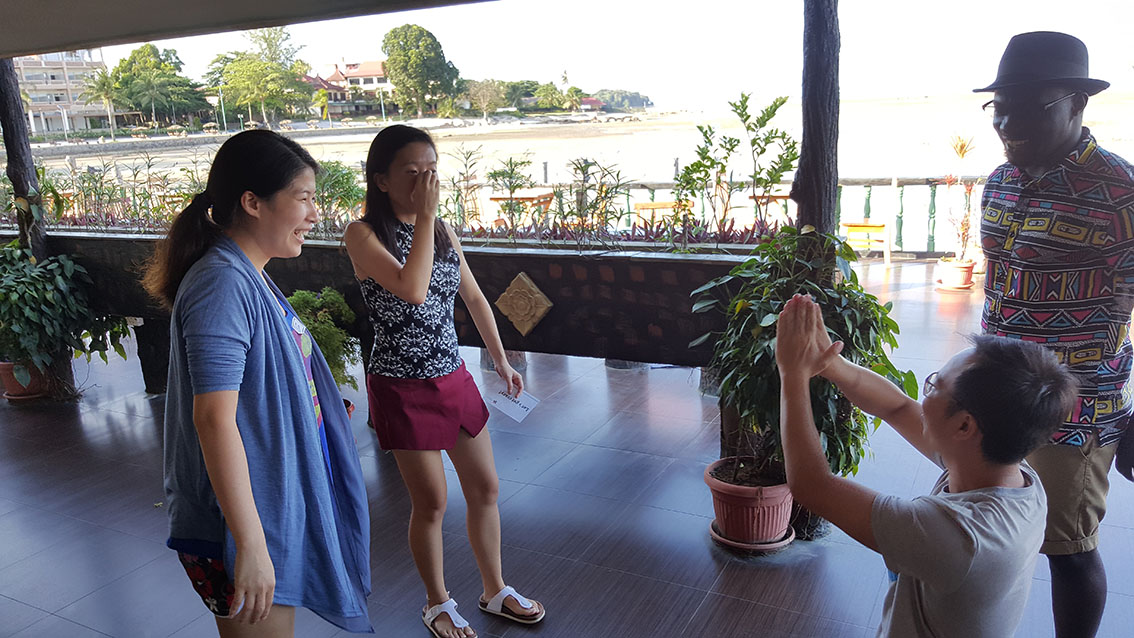
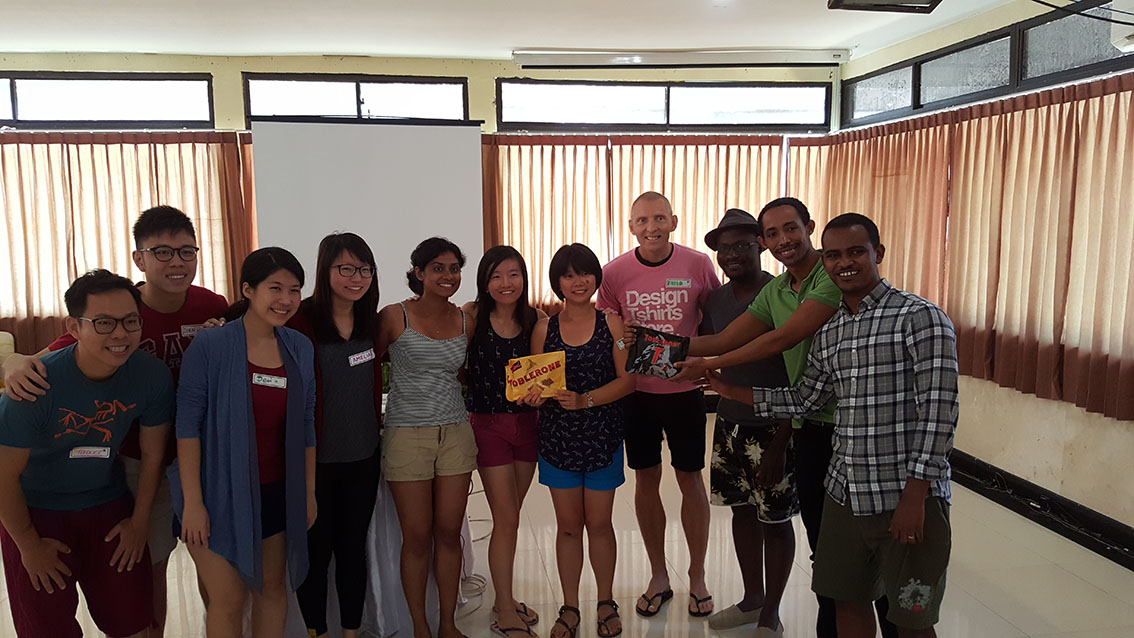
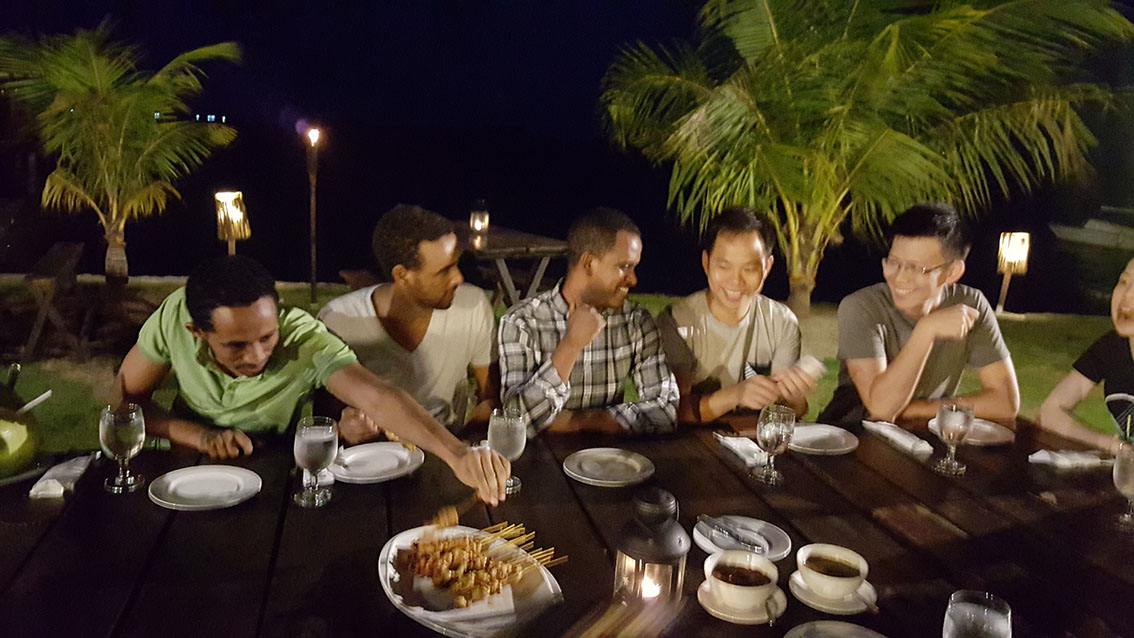
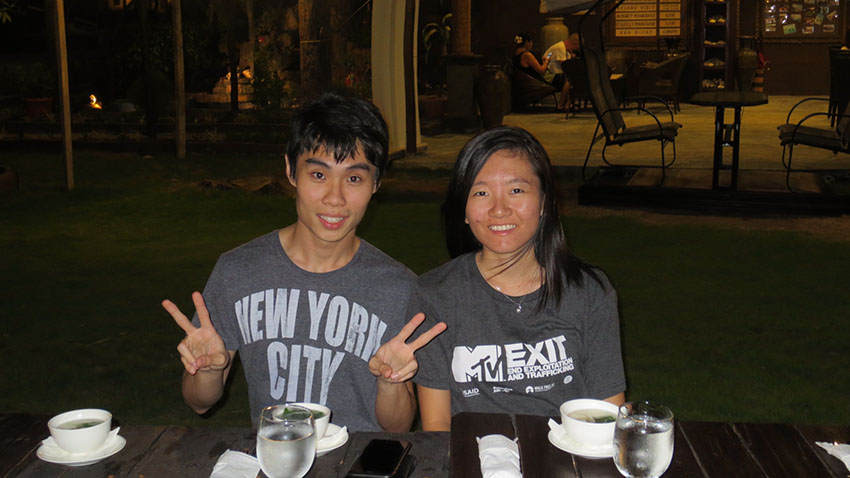
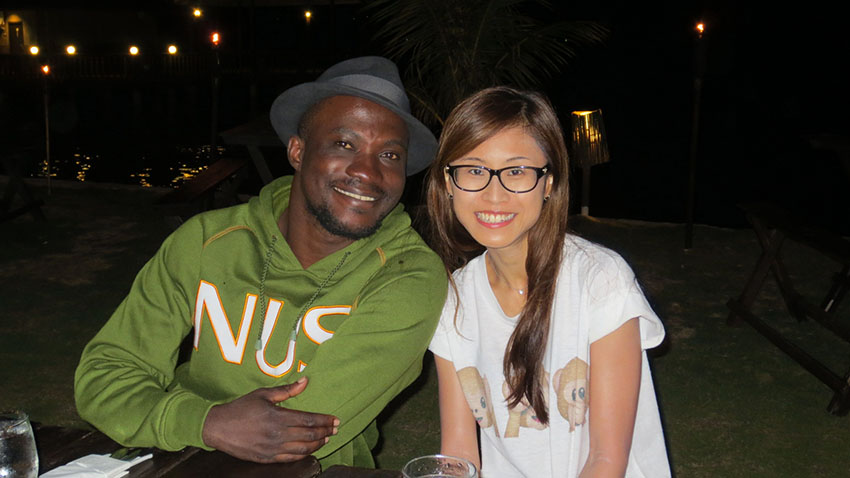
We also went on two amazing postgraduate student retreats at Cameron Highlands in Malaysia and Bintan in Indonesia, which I will not forget. These retreats were only possible thanks to some hugely enthusiastic postgraduate student committees, which organised many fun activities.
Department of Biochemistry Postgraduate Student Retreat in Bintan

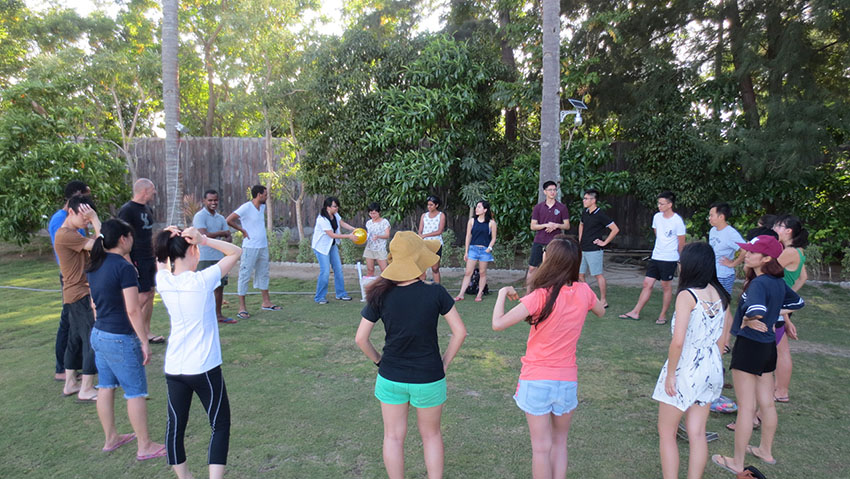
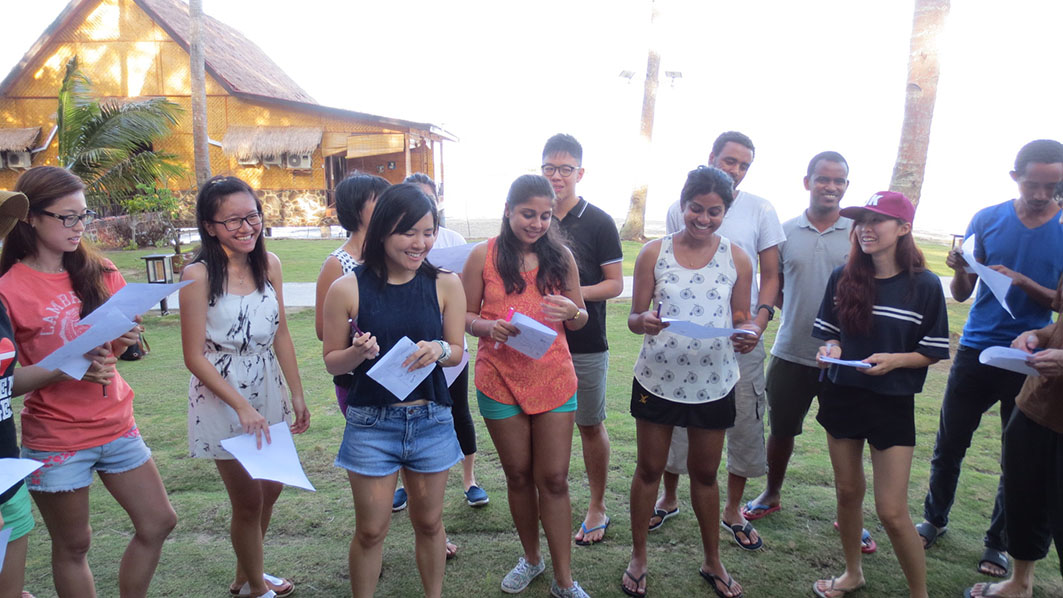
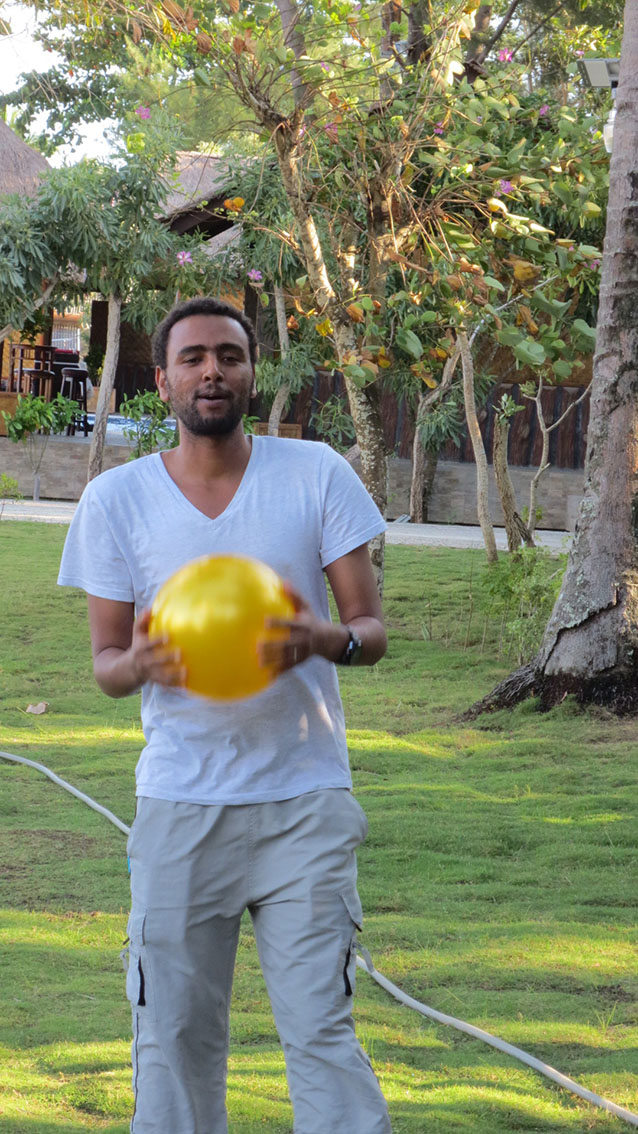
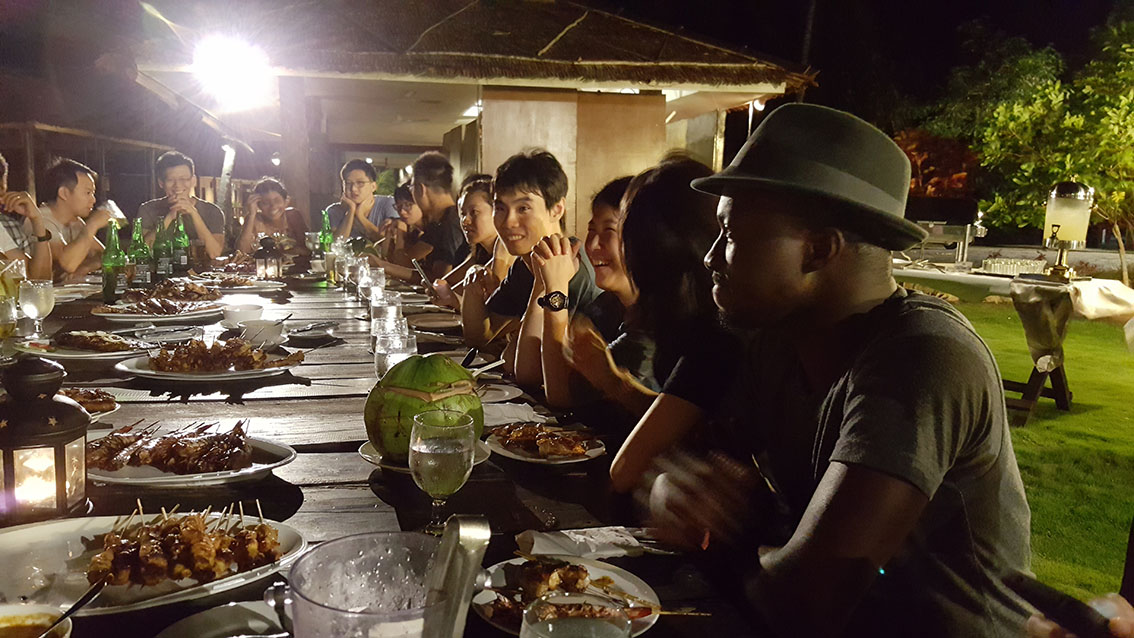
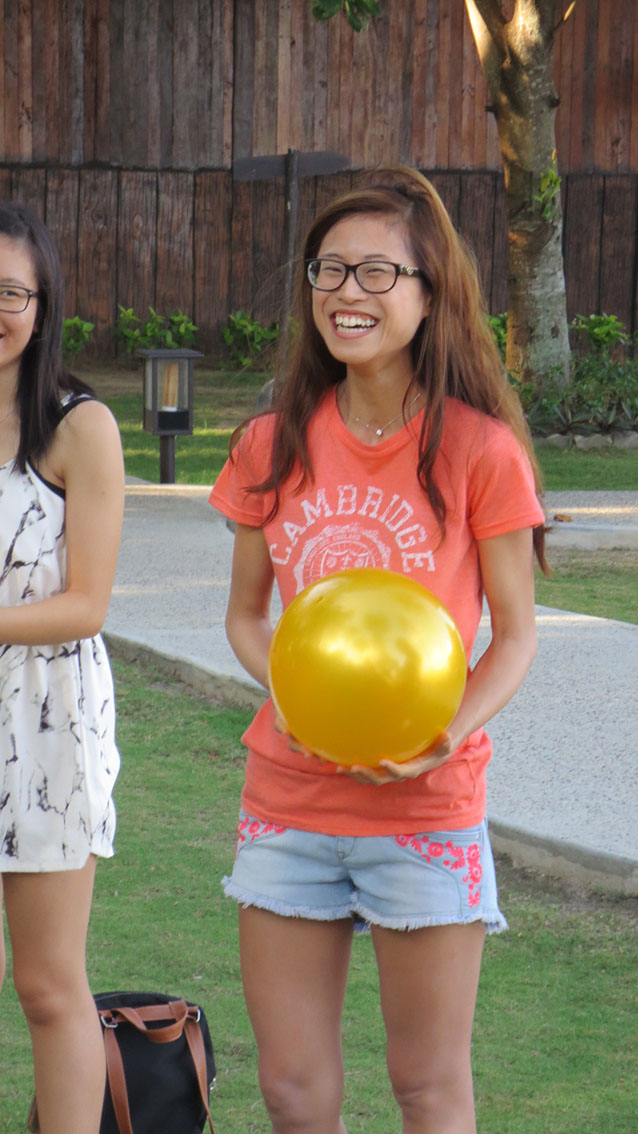
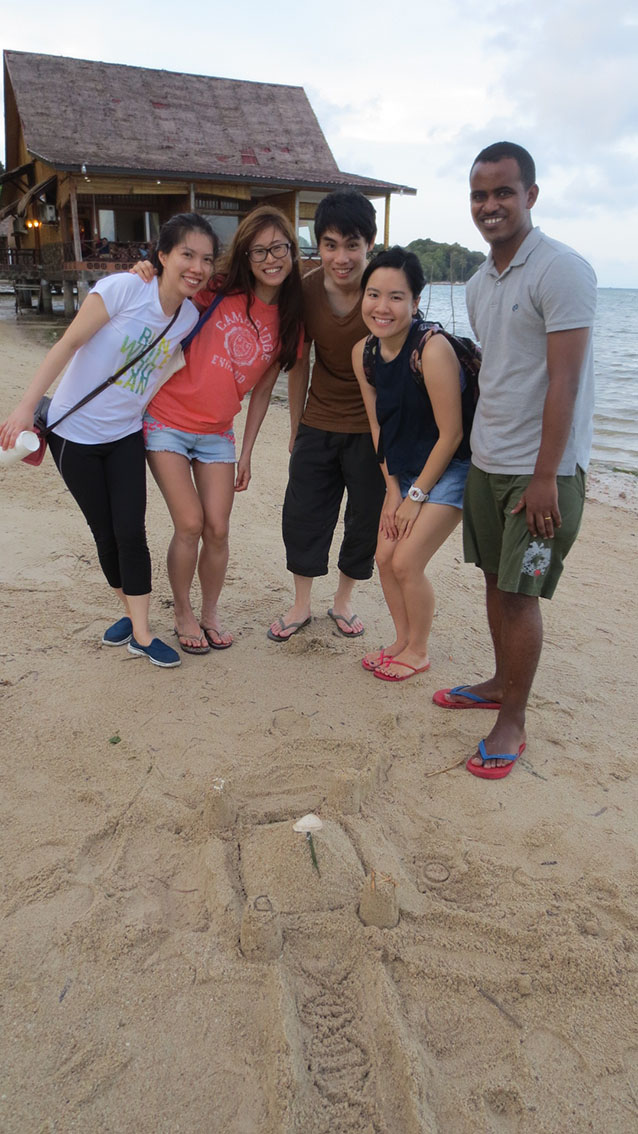
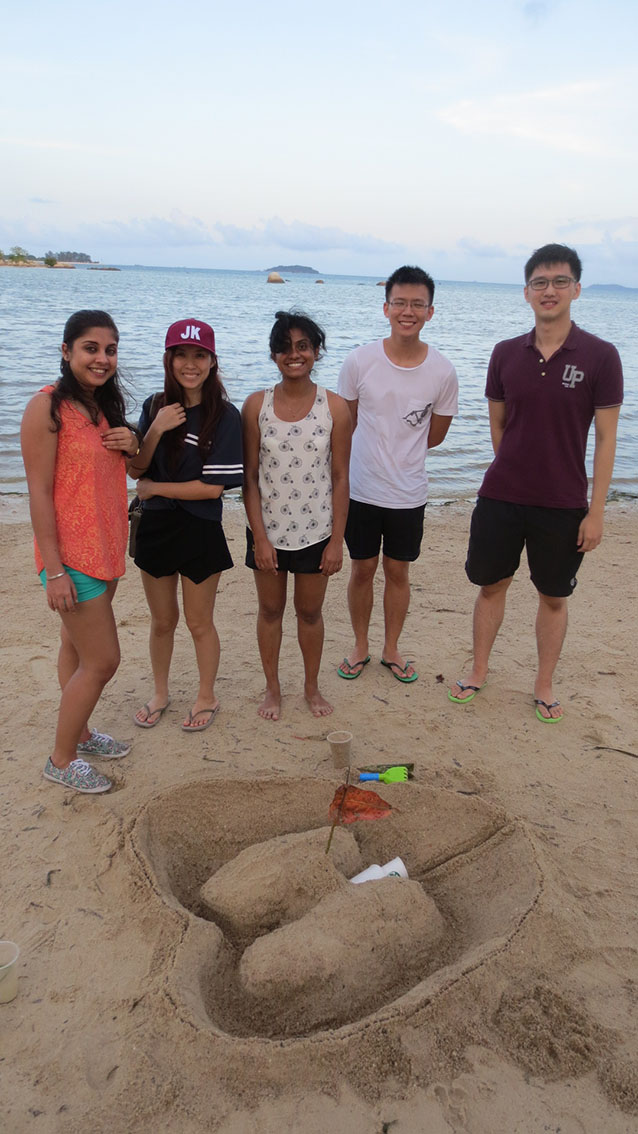
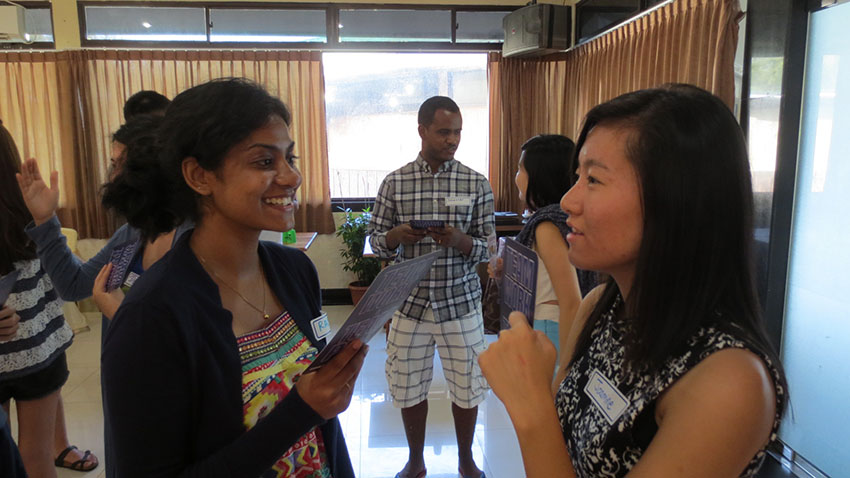
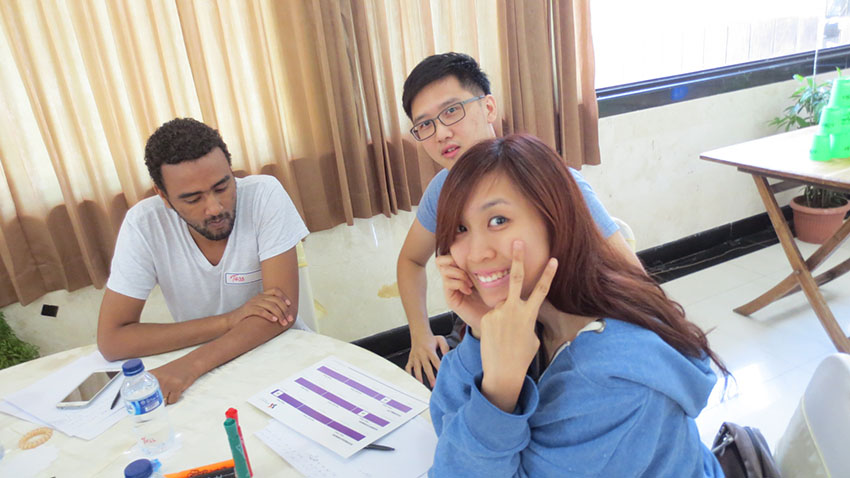
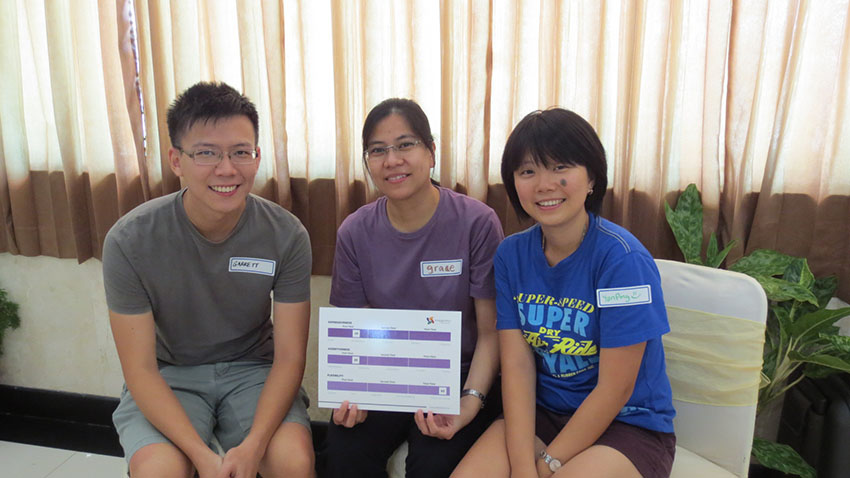
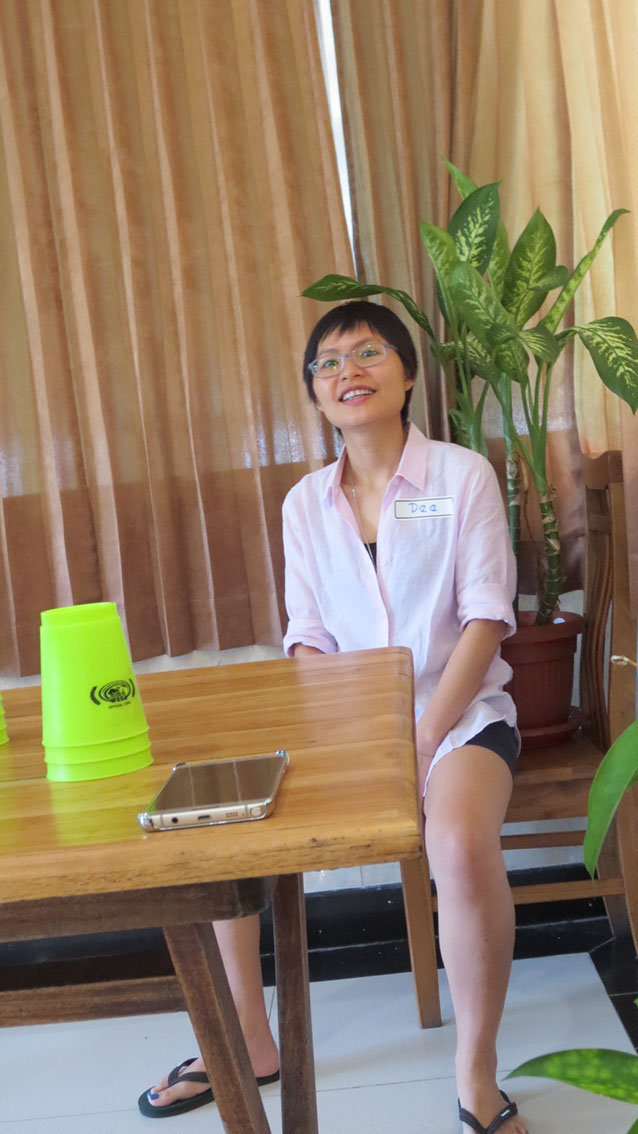
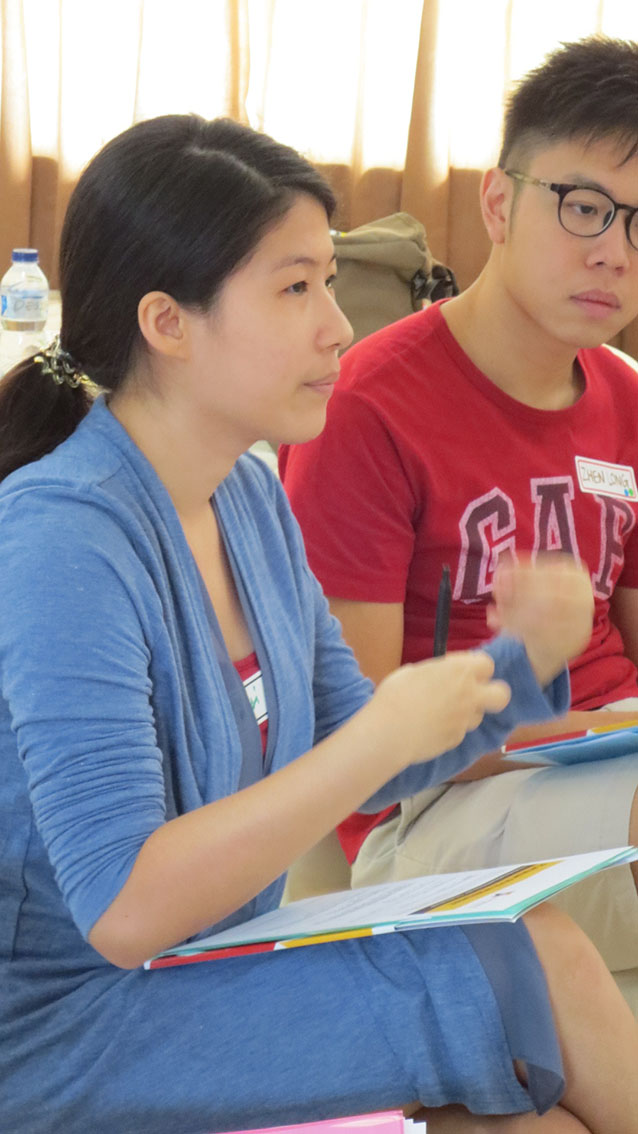
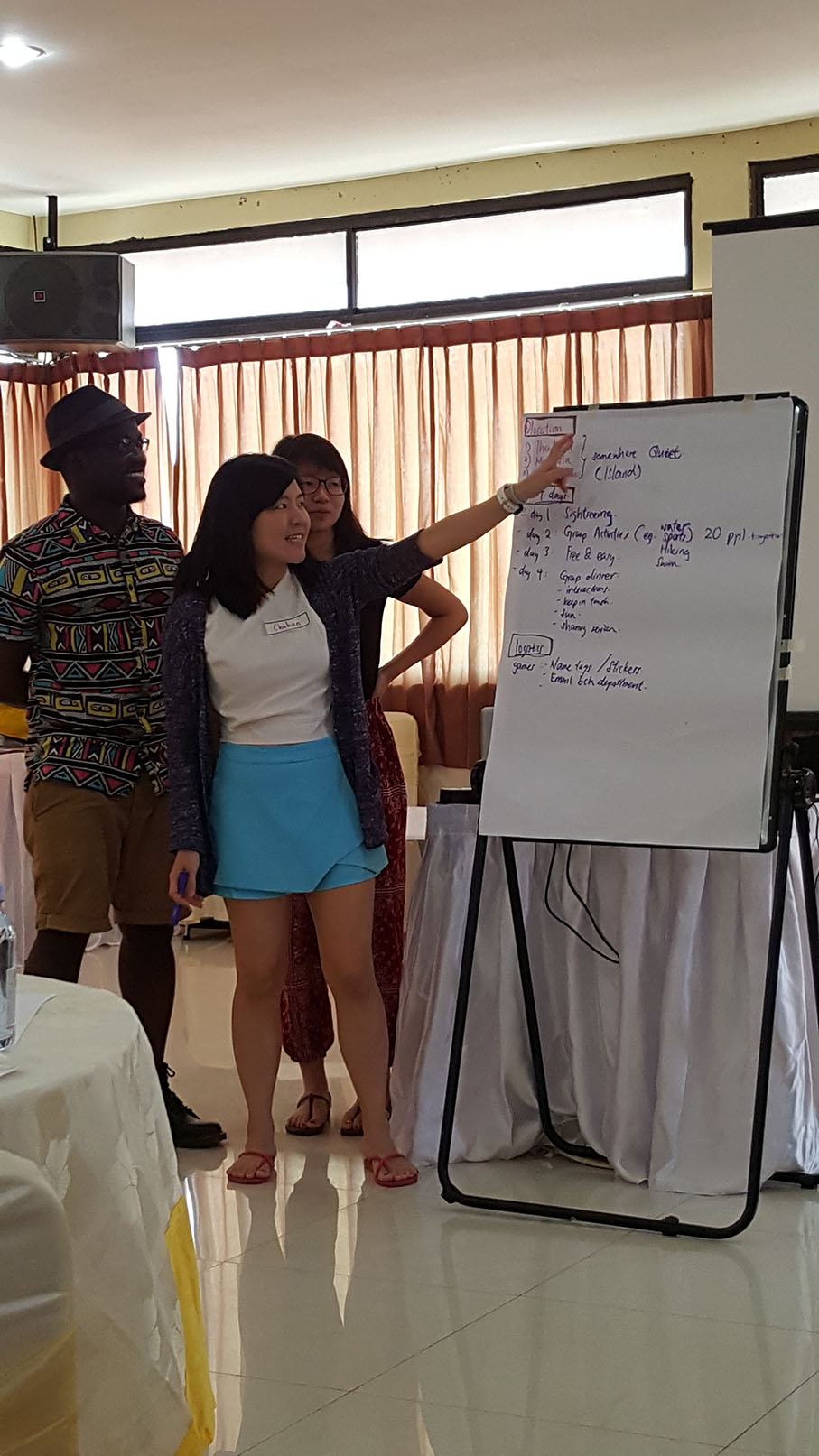
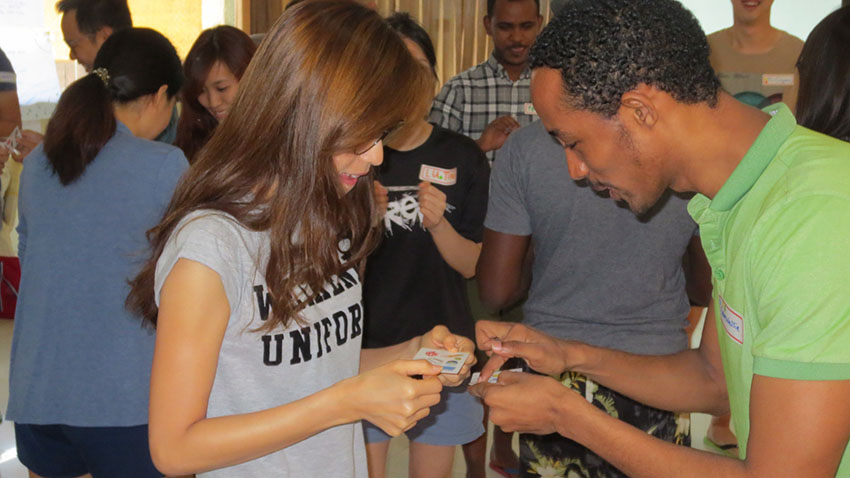
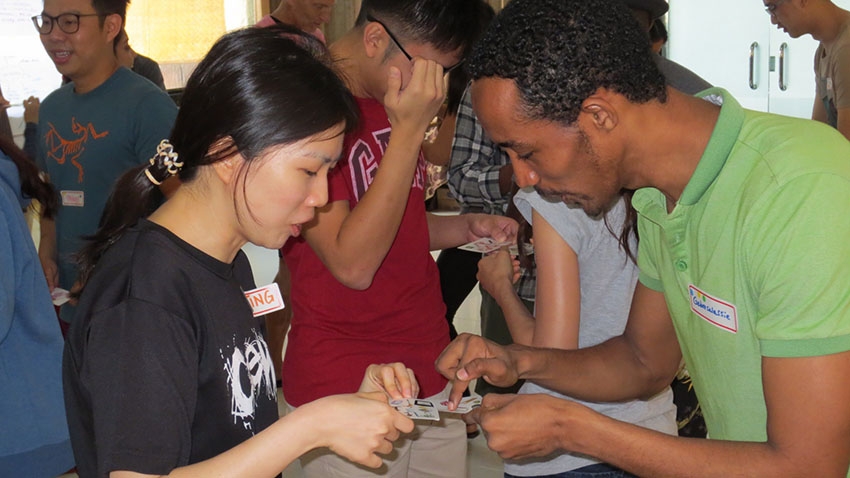
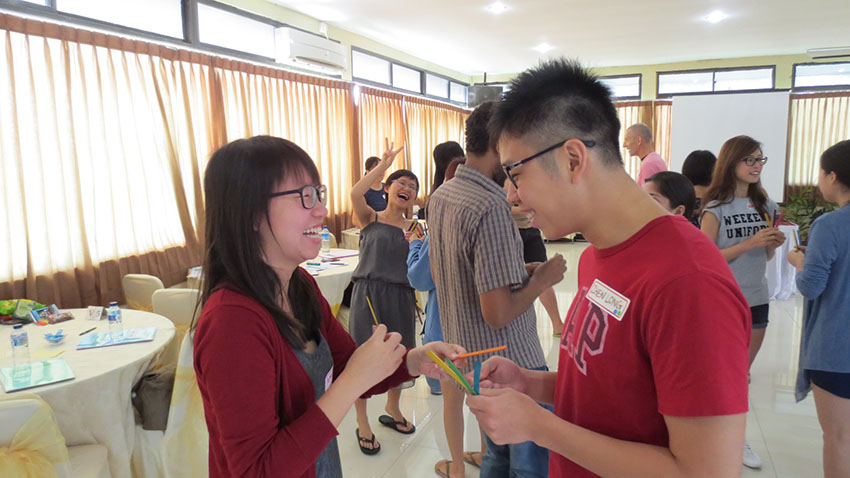
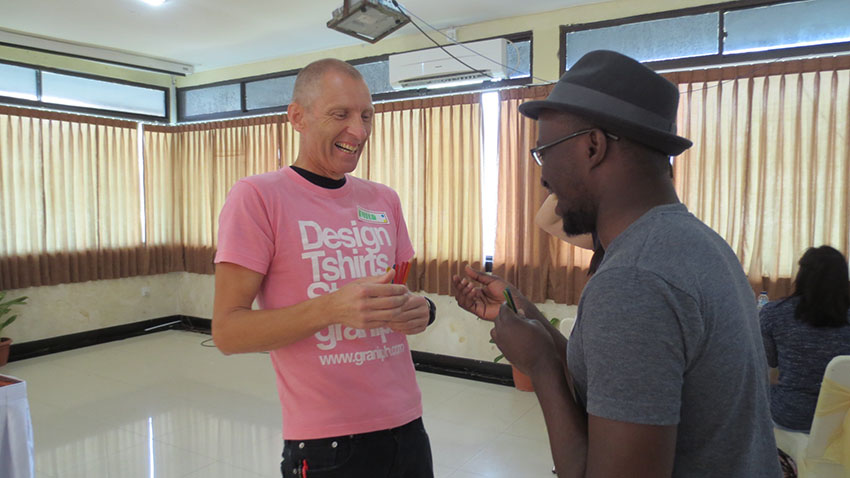
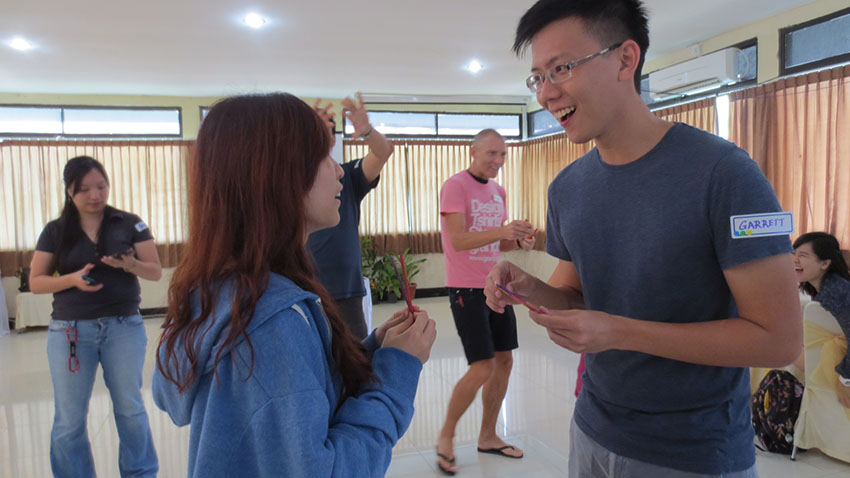
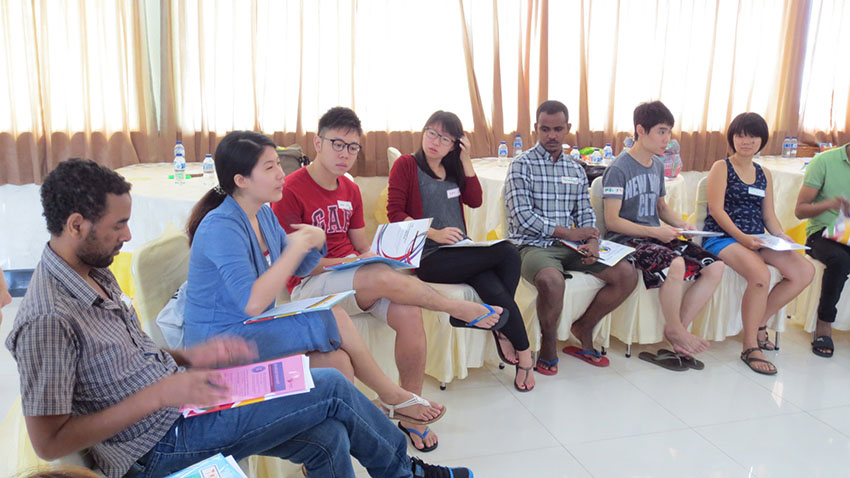
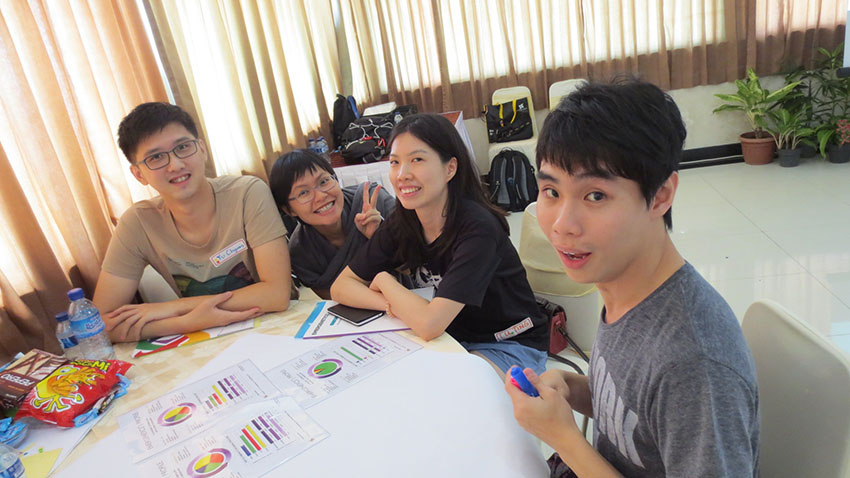
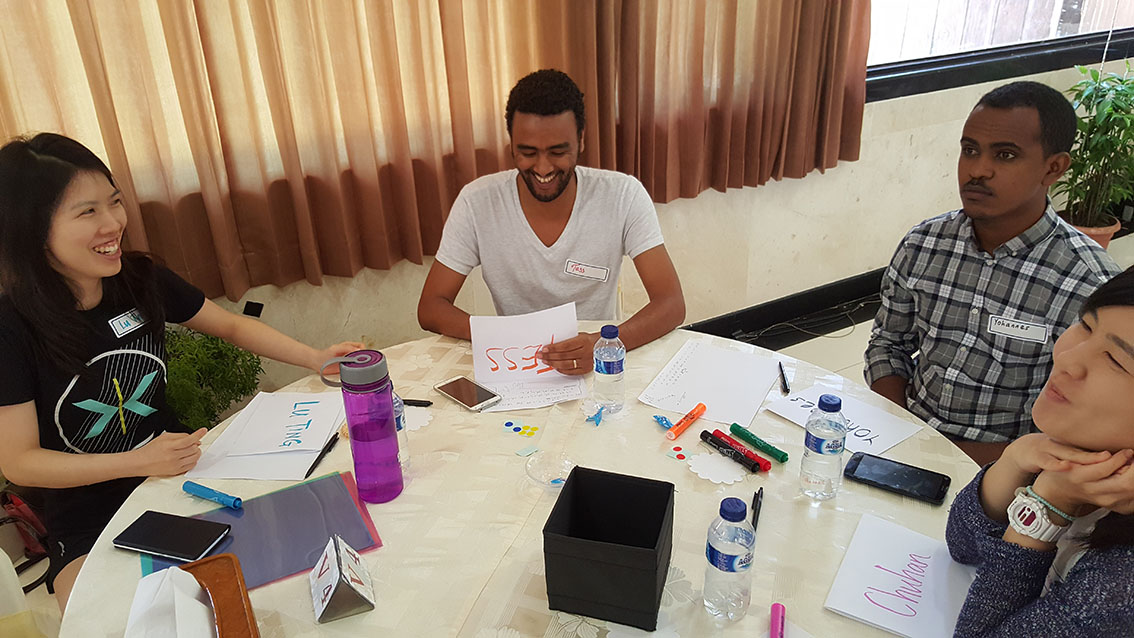
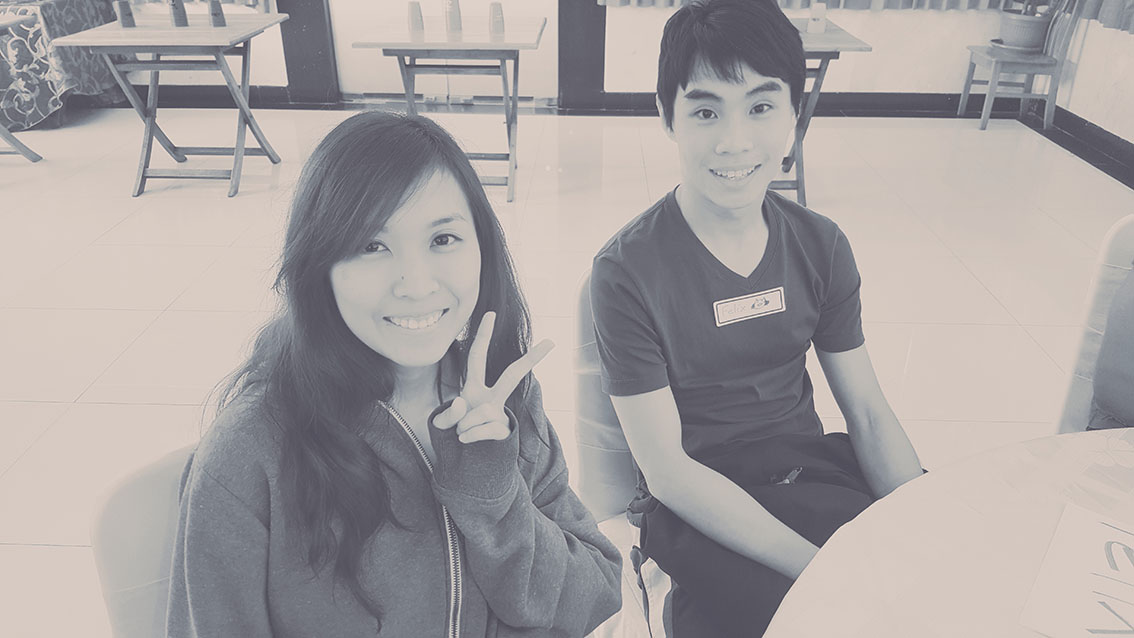
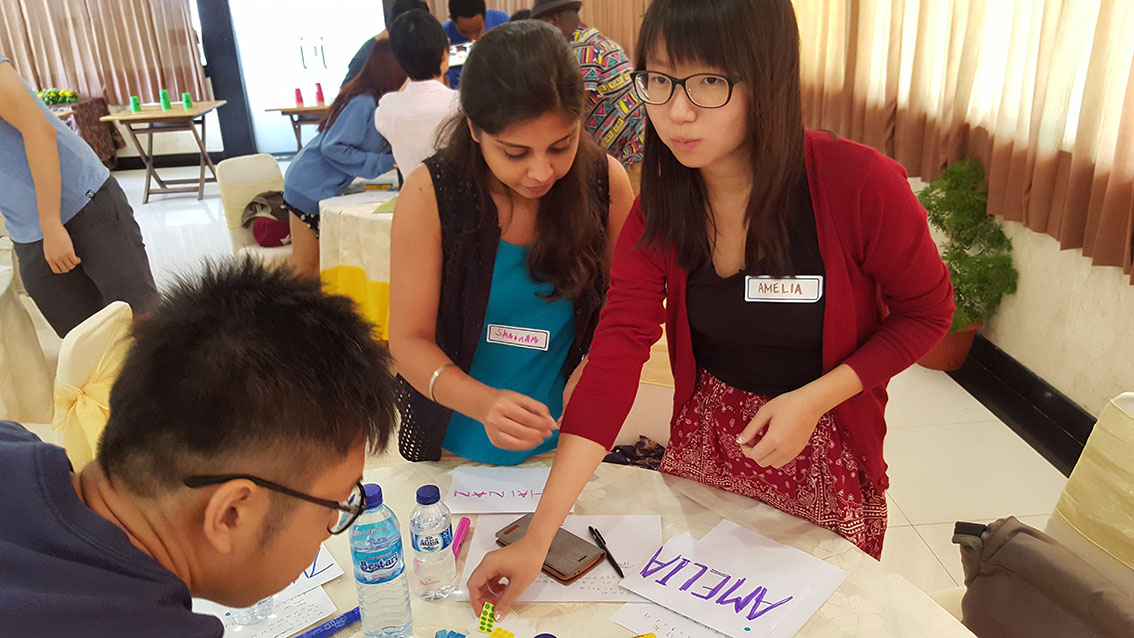
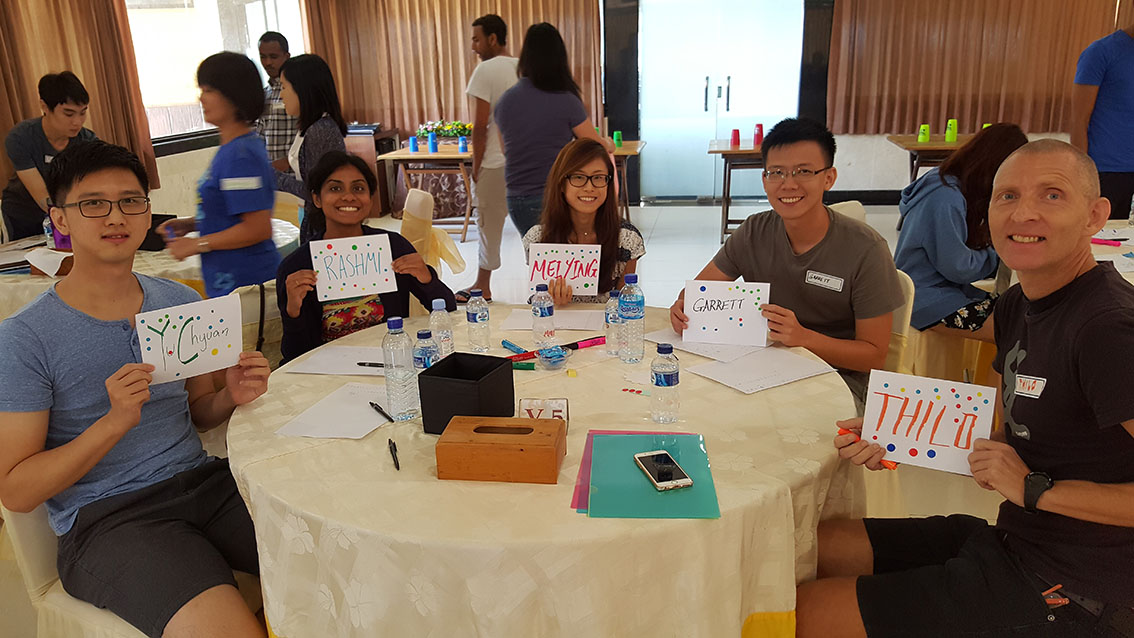
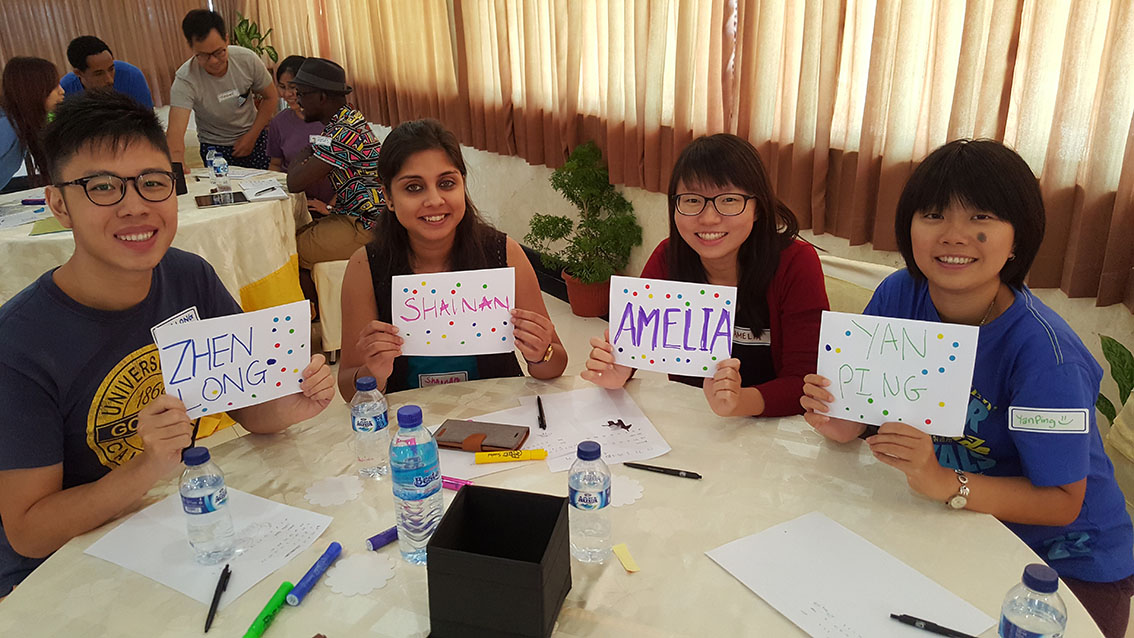
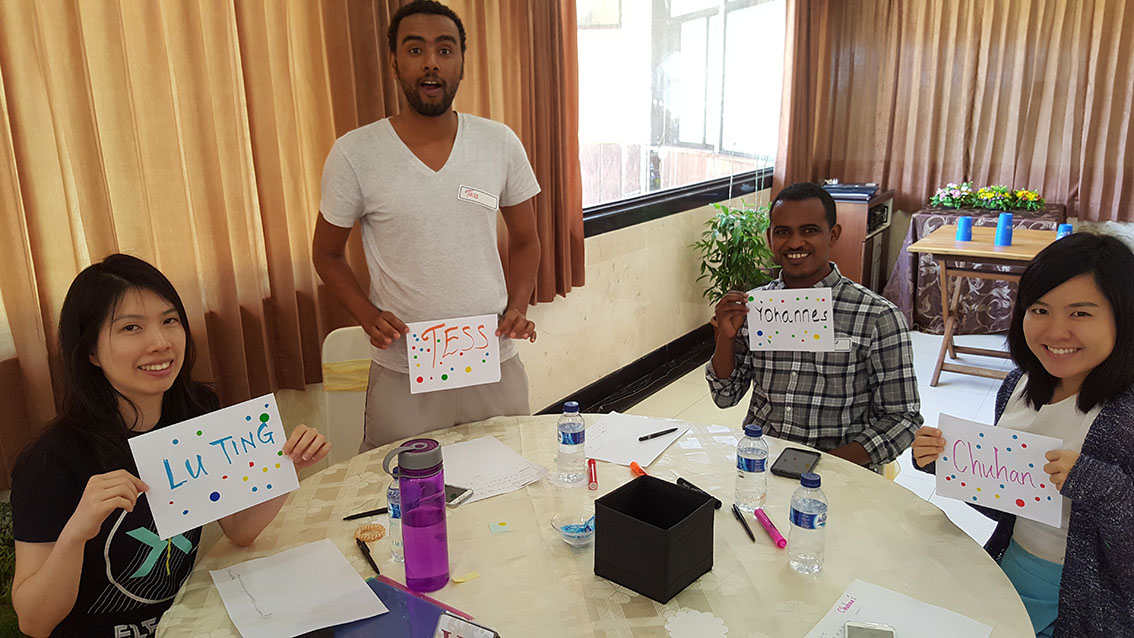
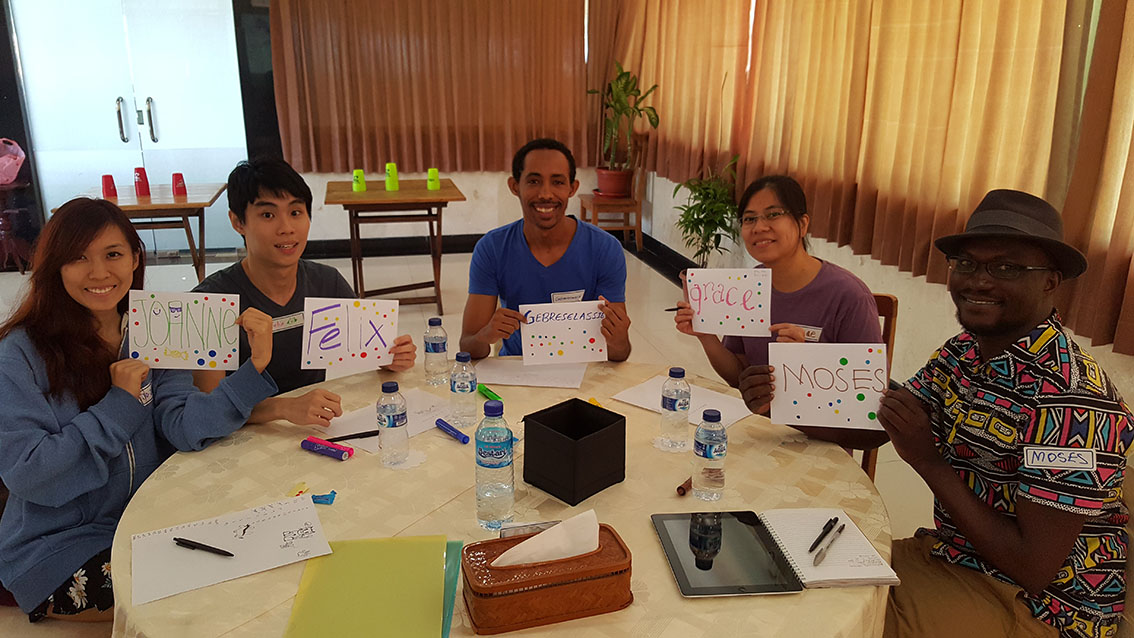
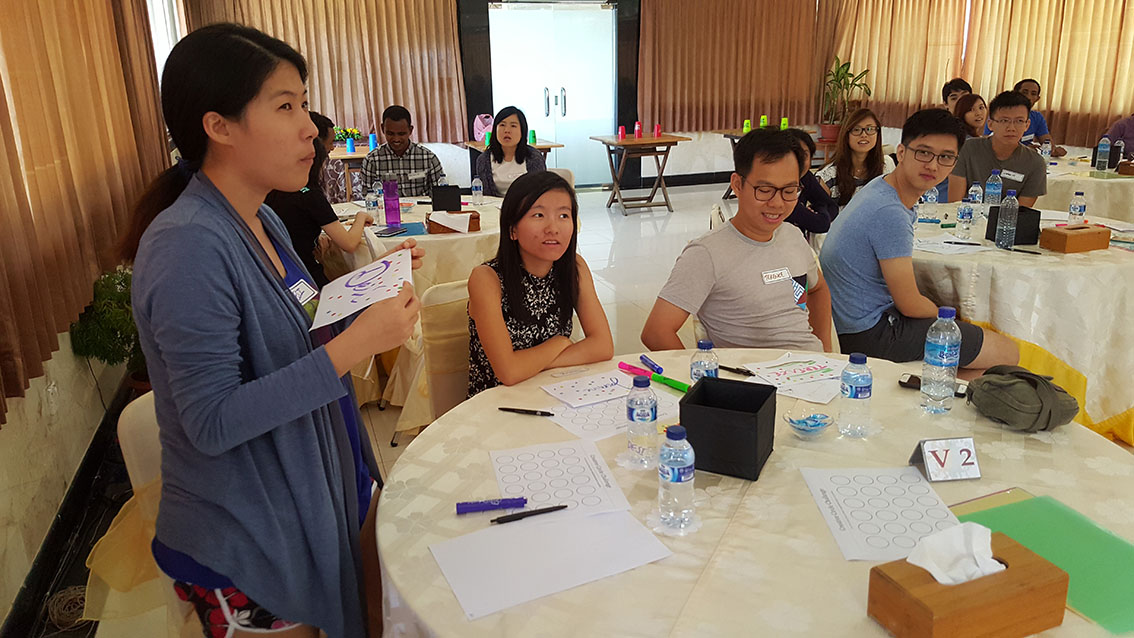
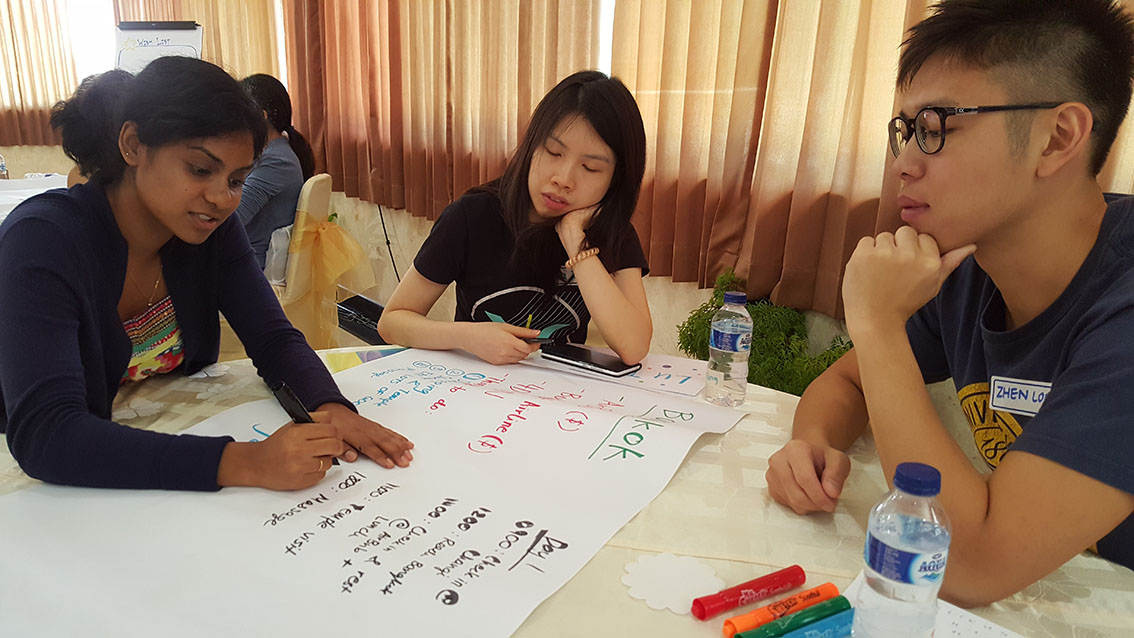
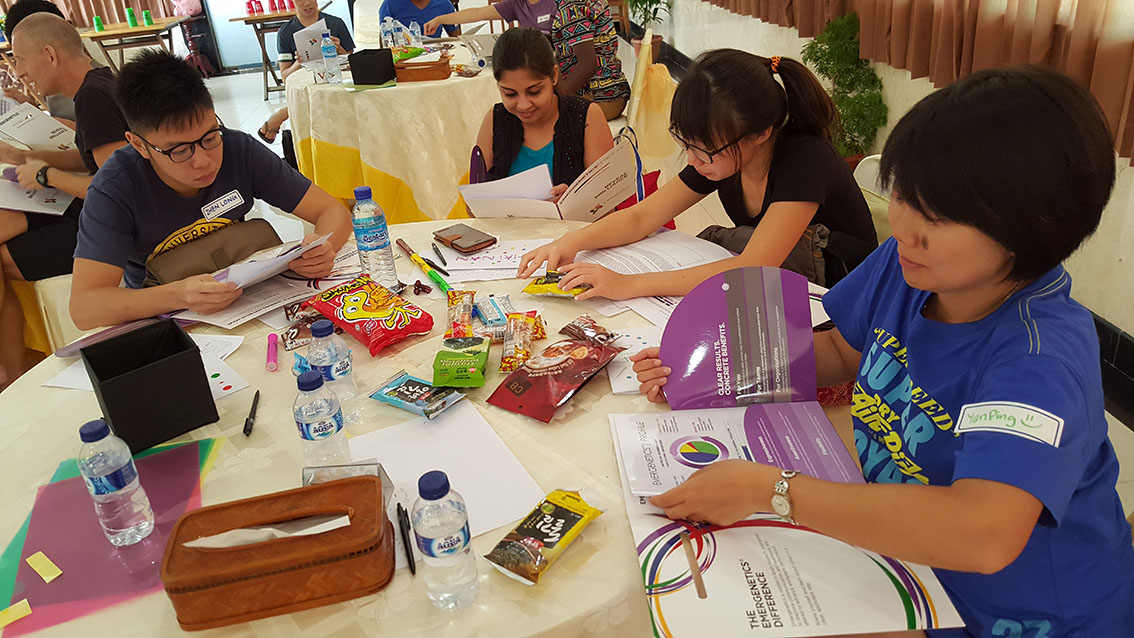
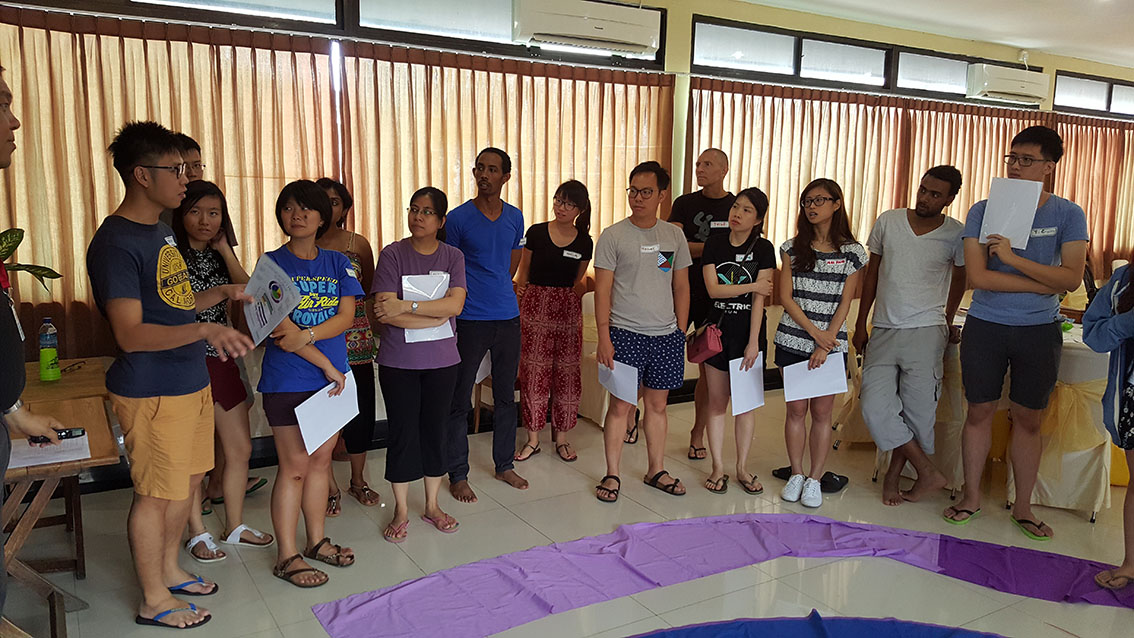
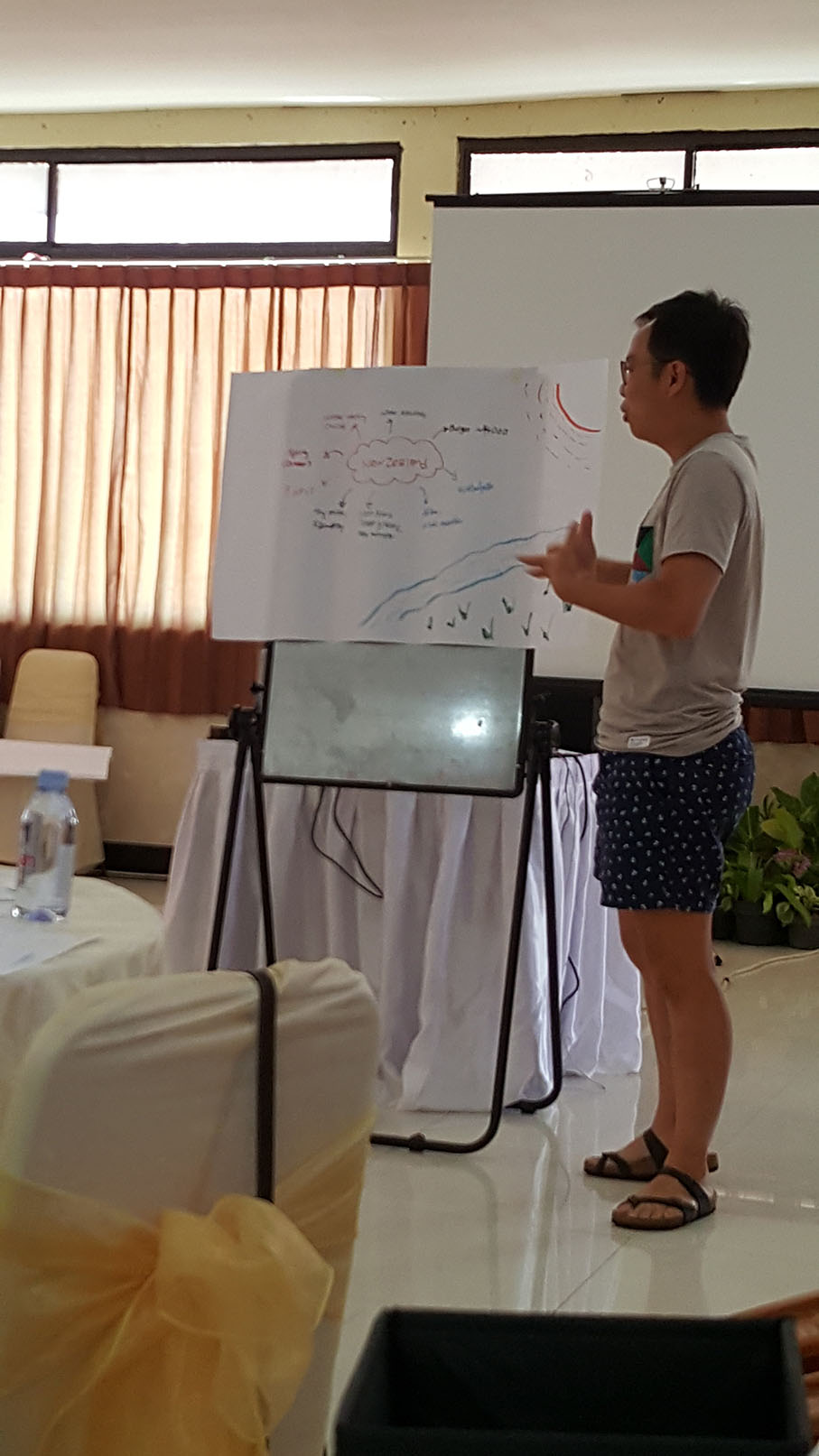
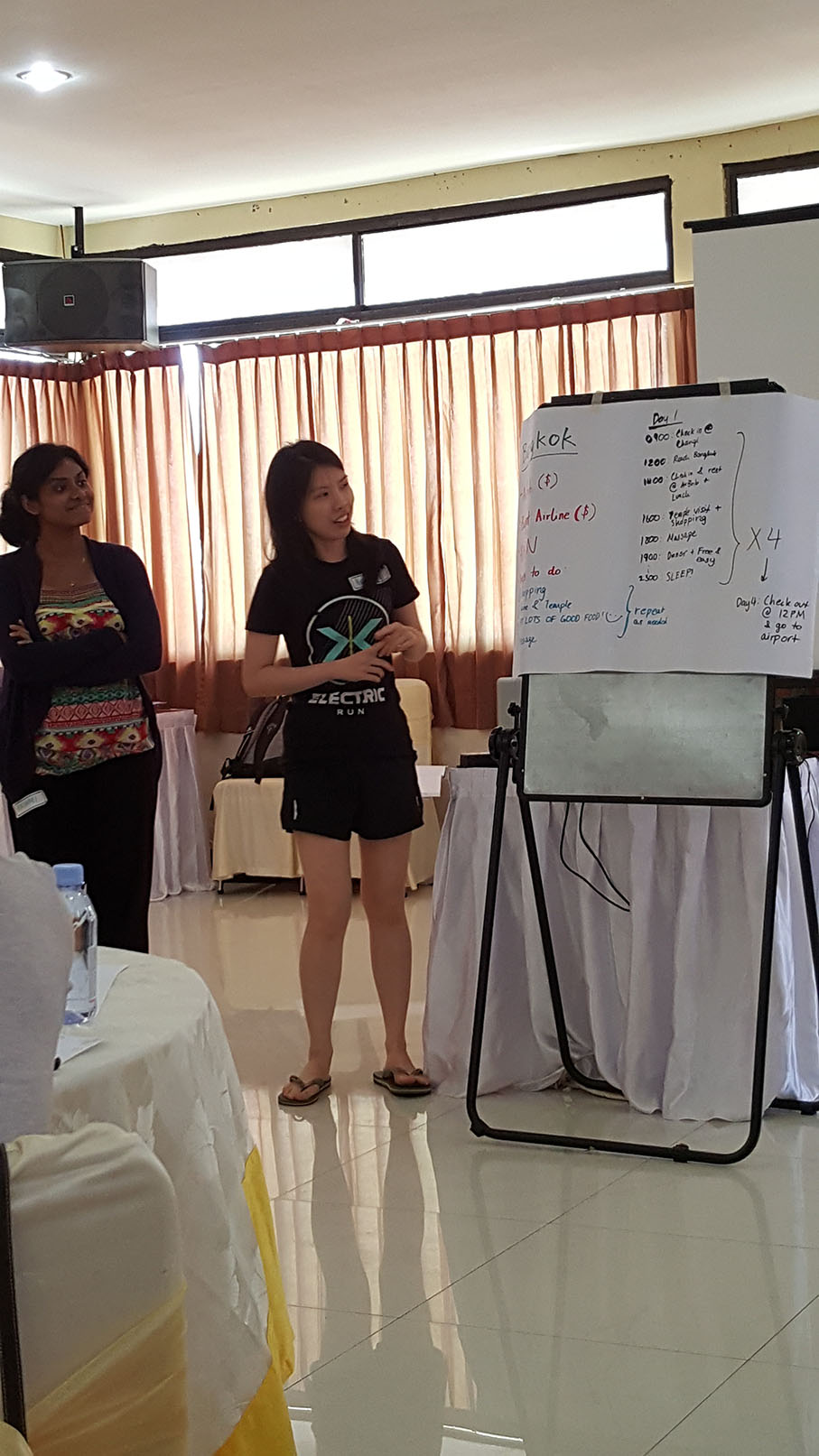
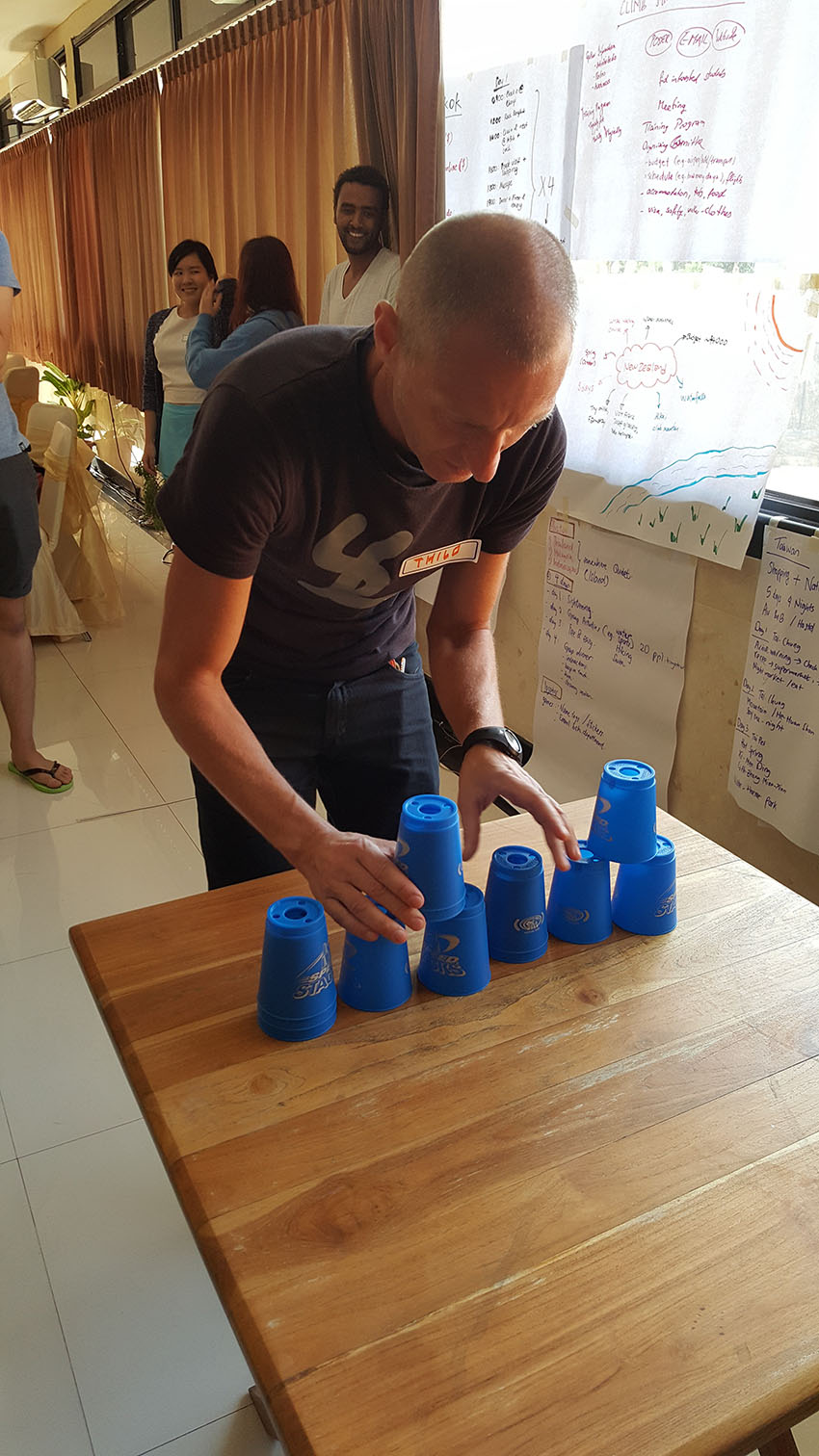
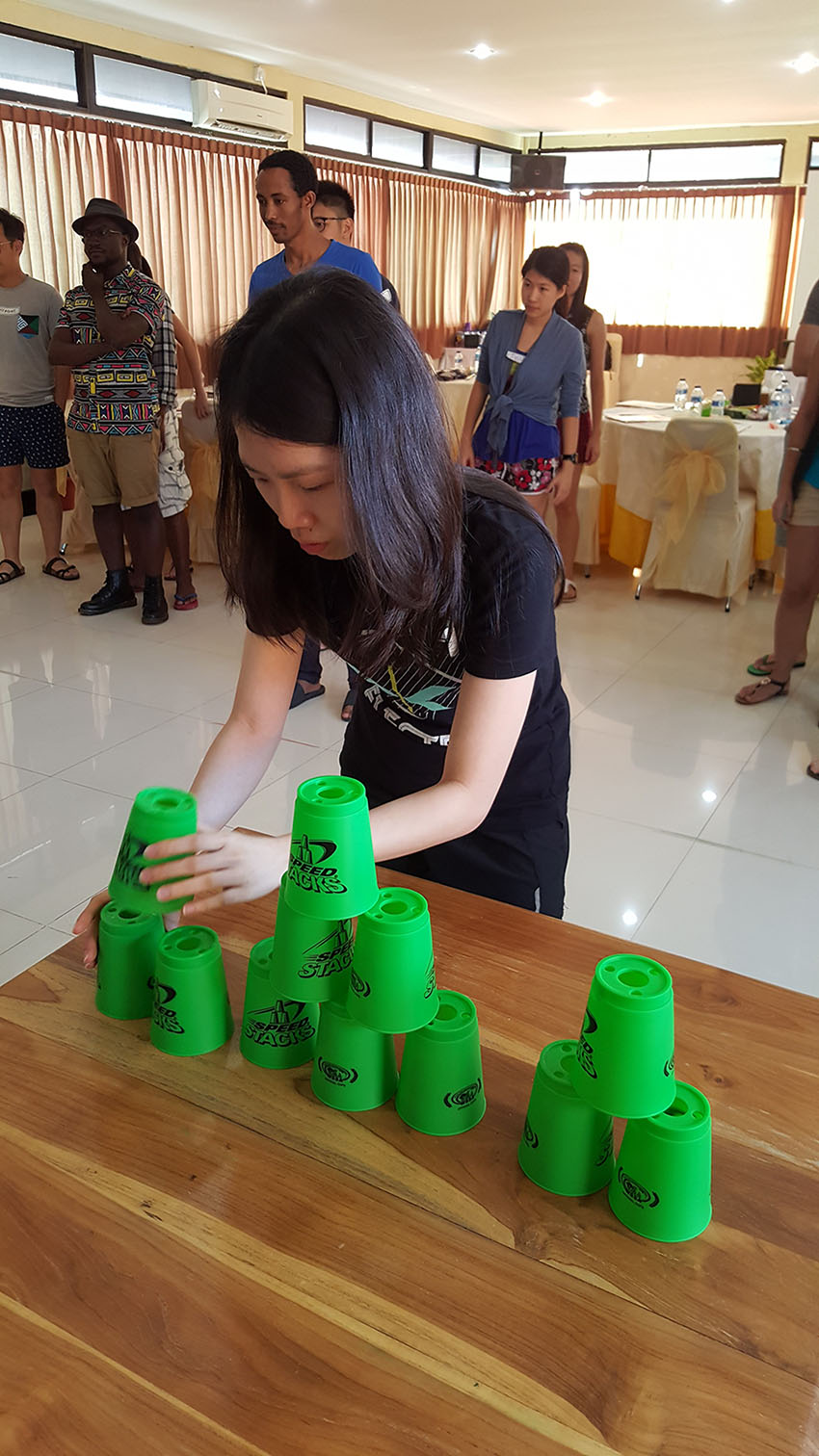
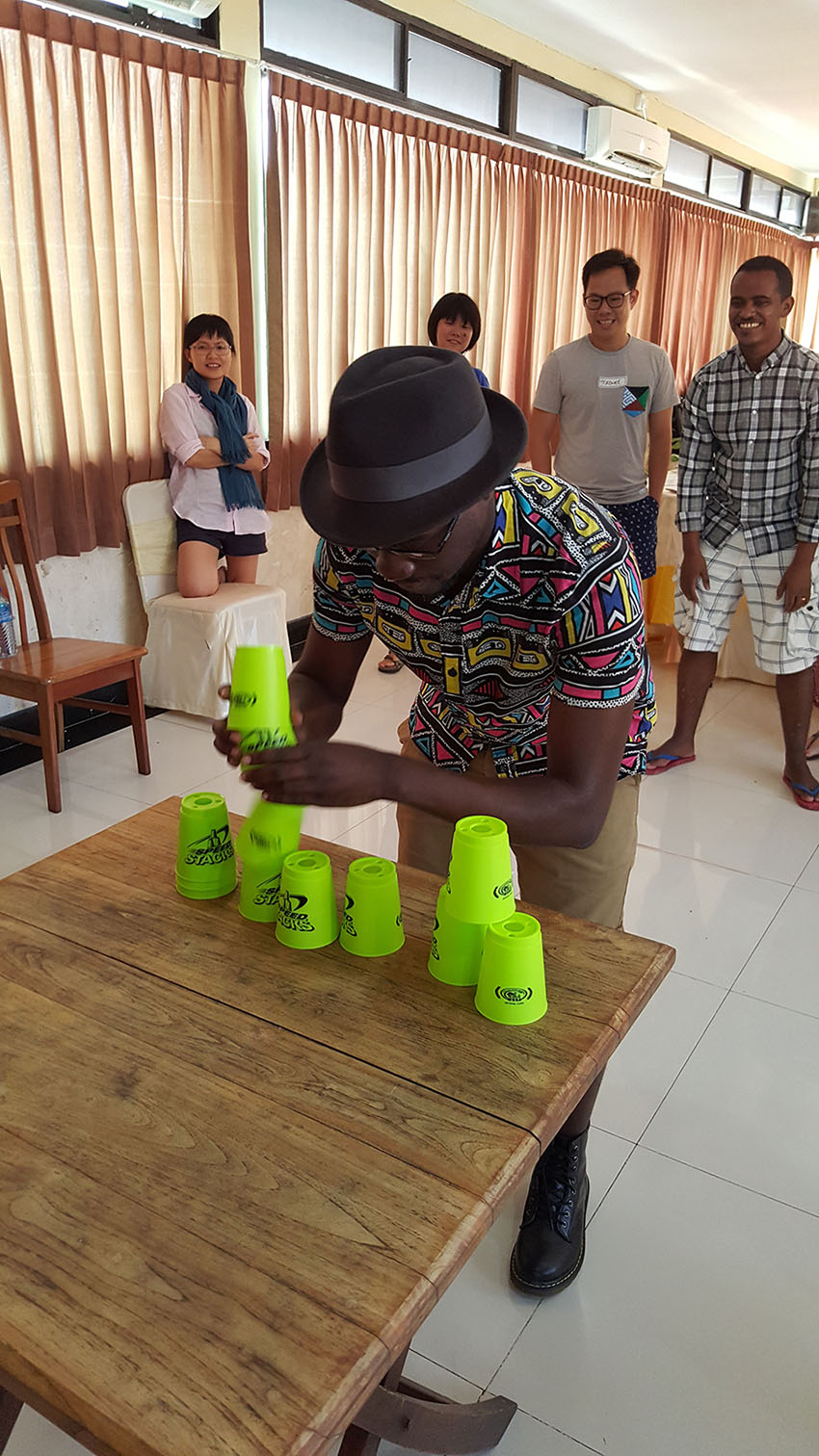
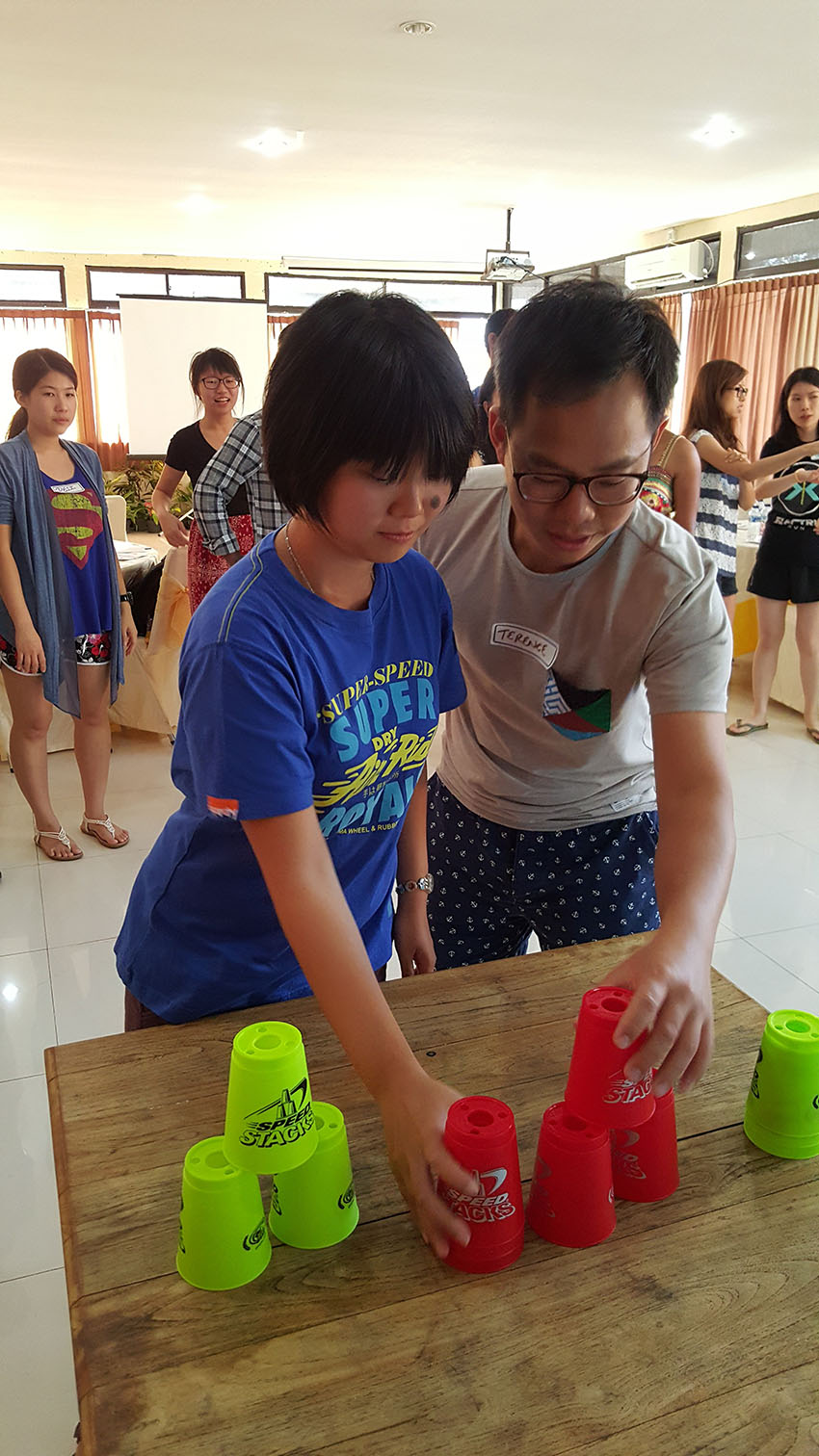
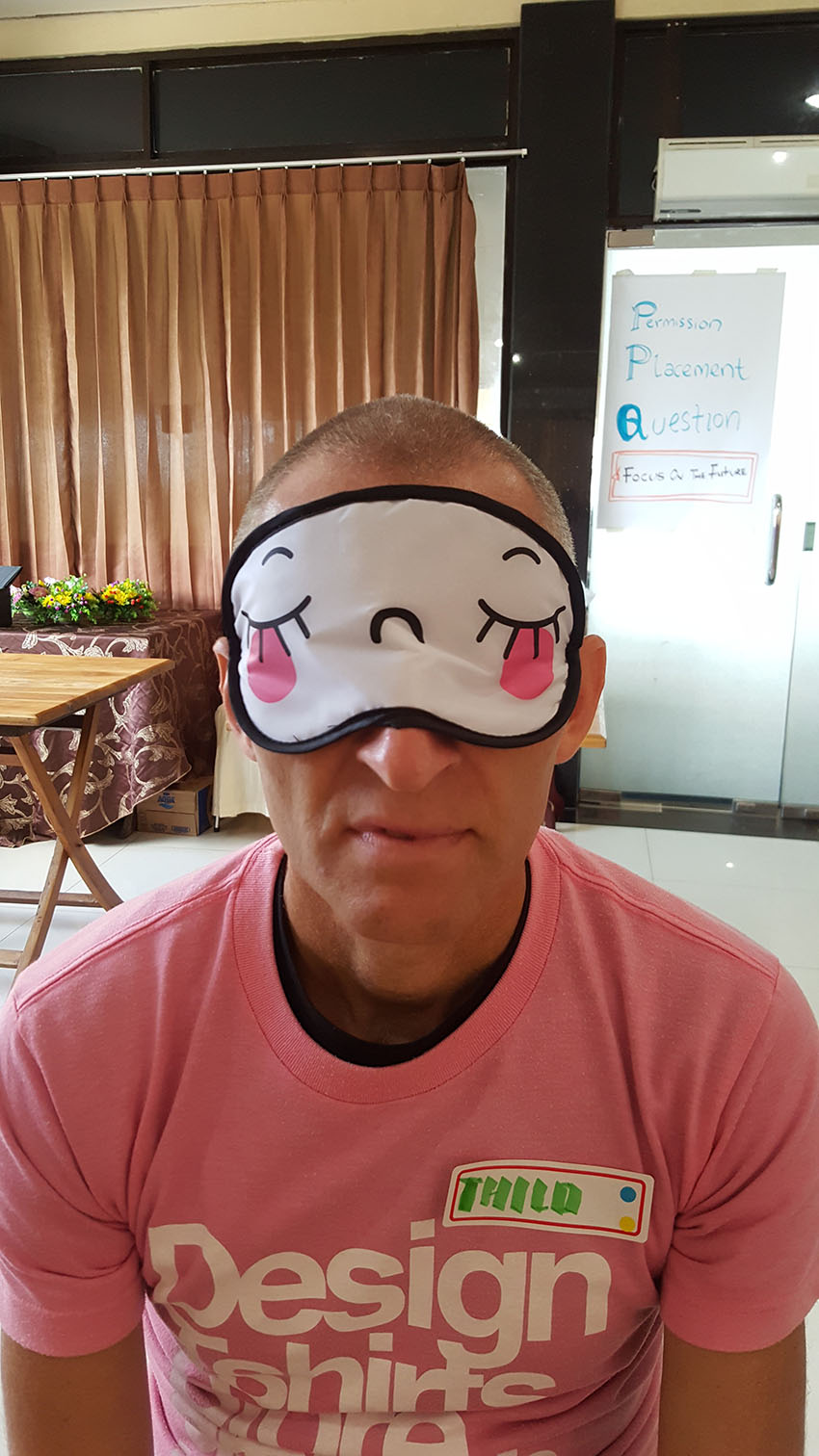
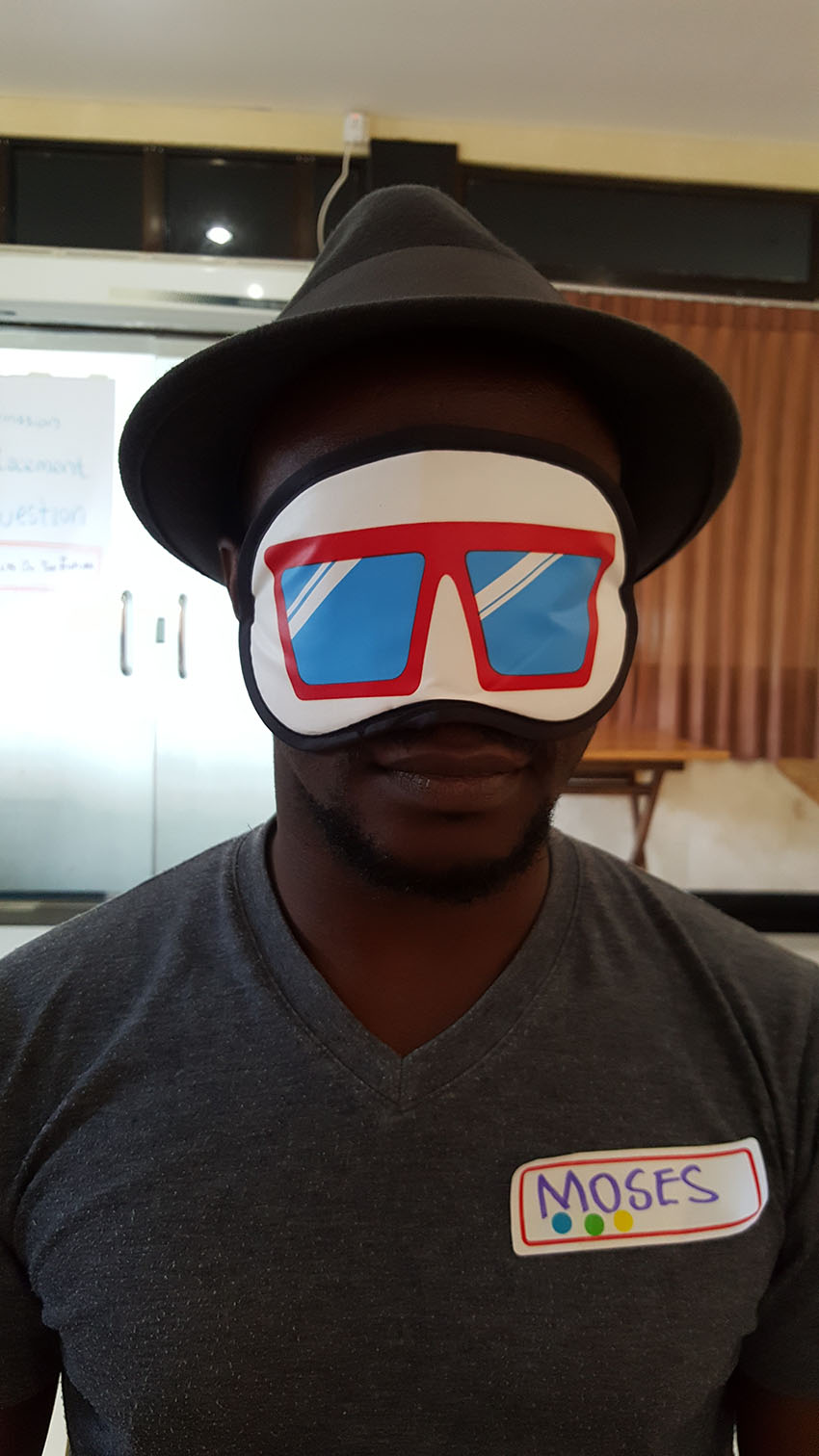
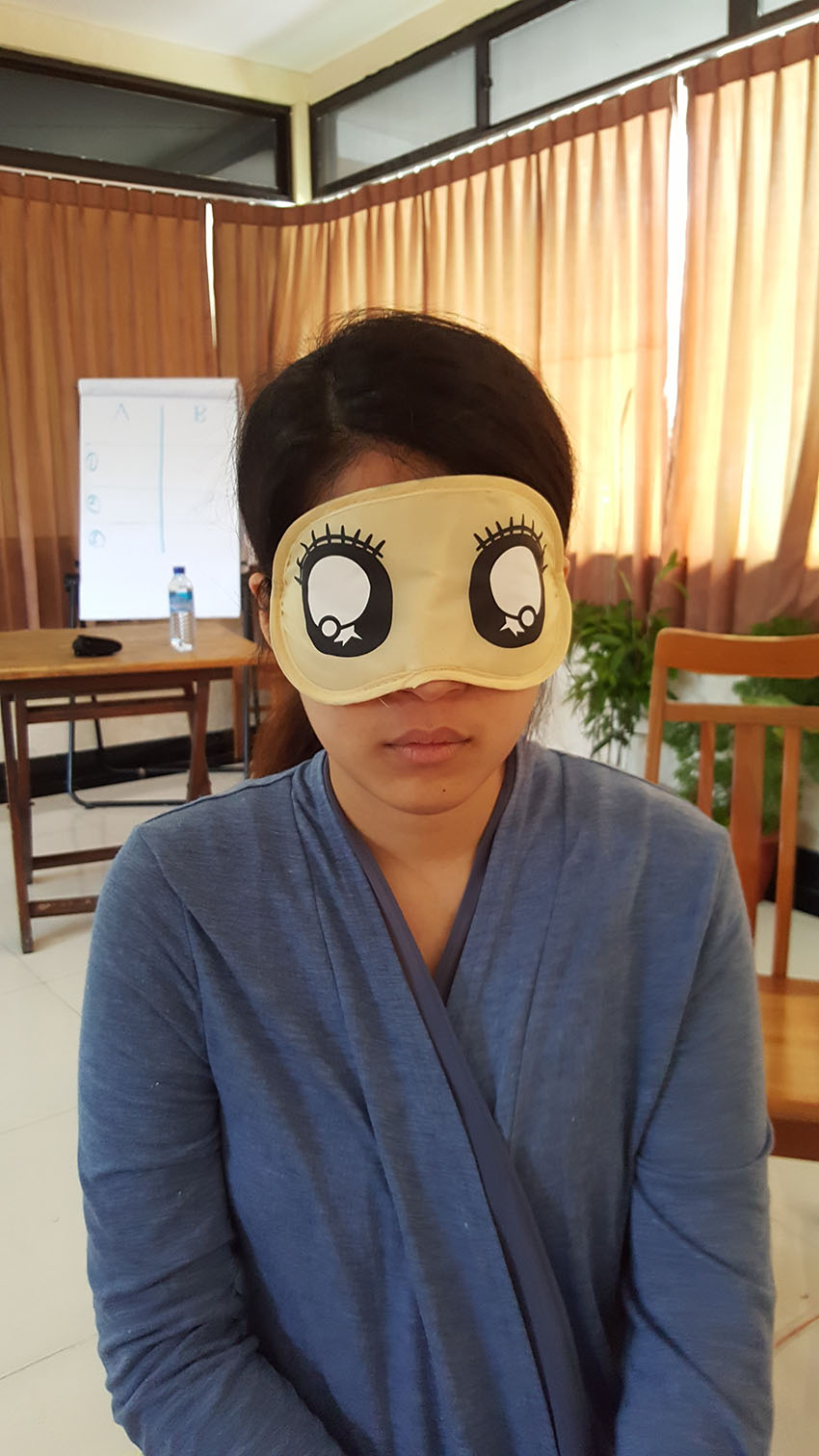
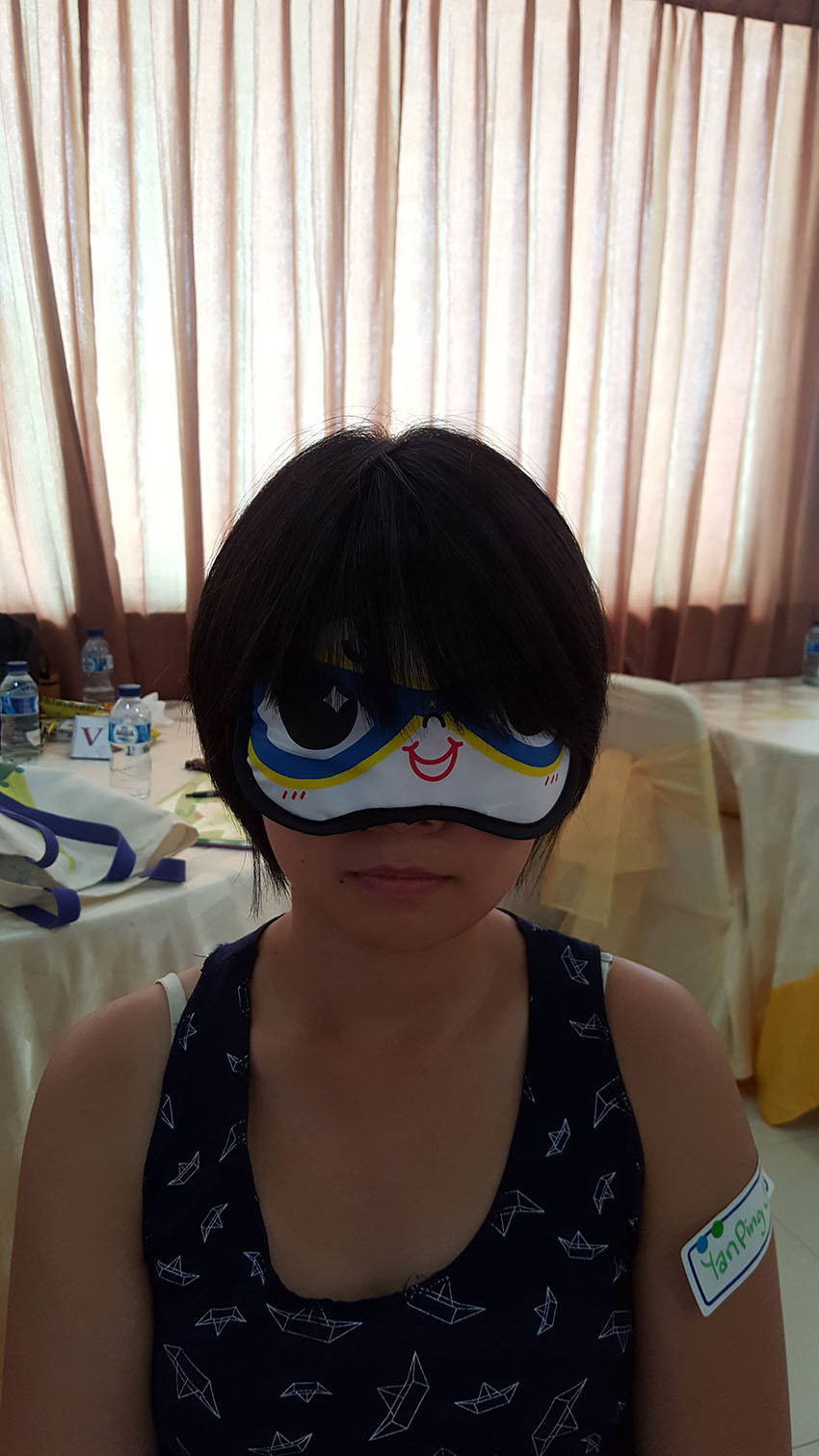
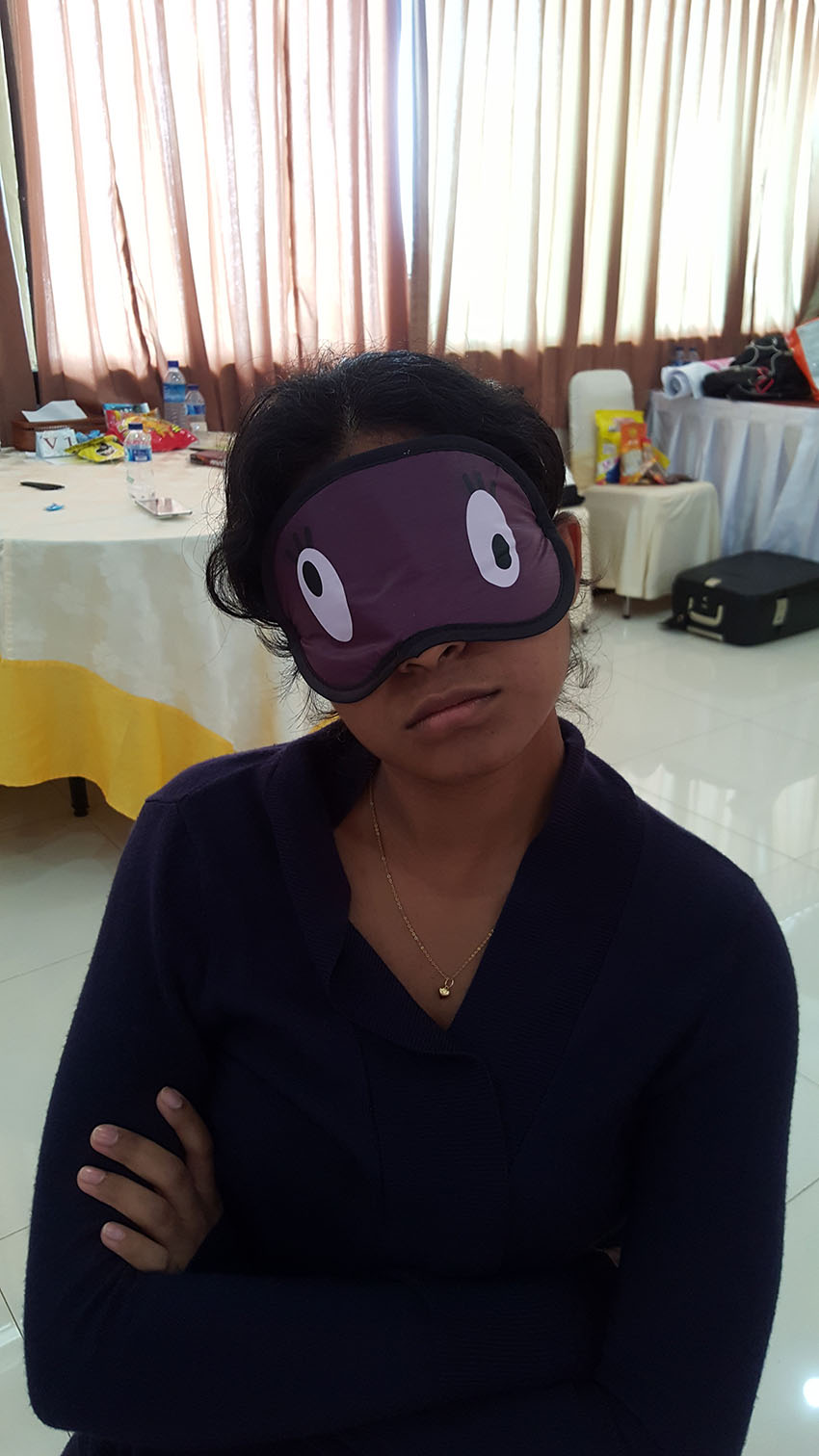

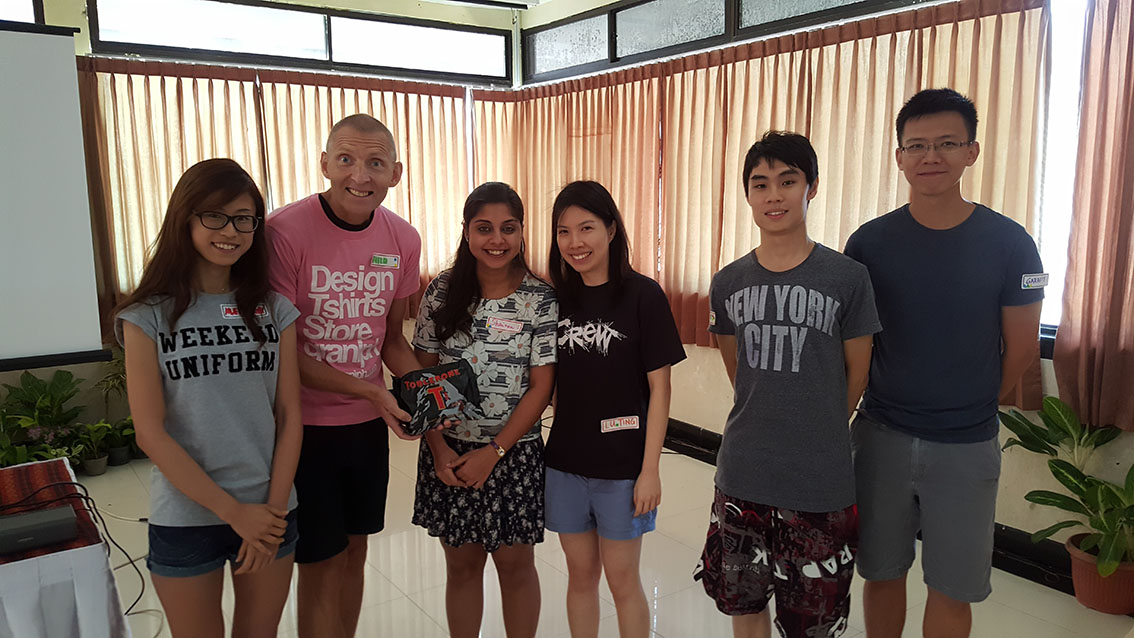



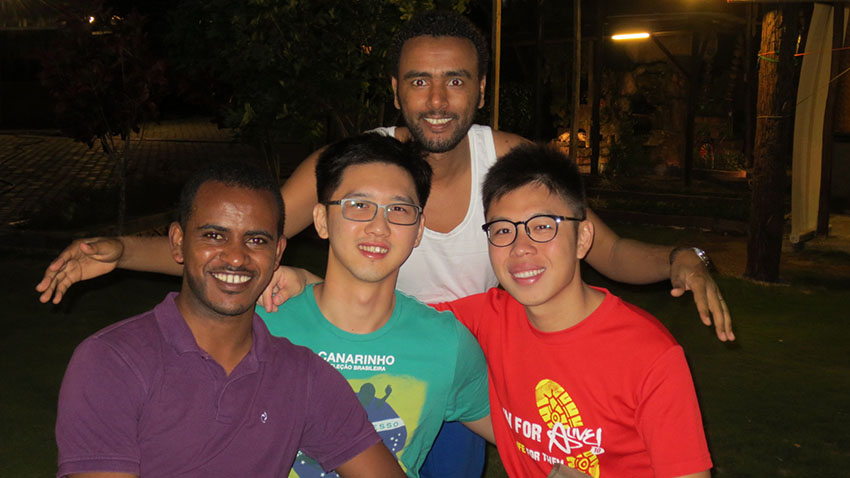
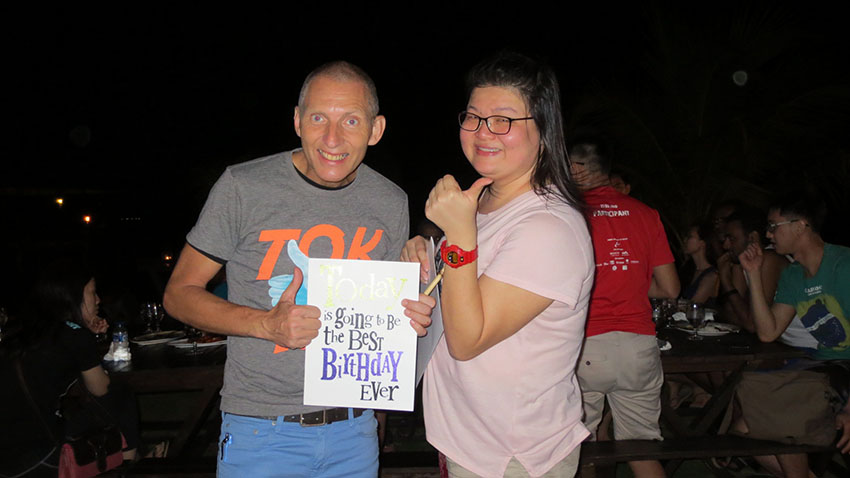

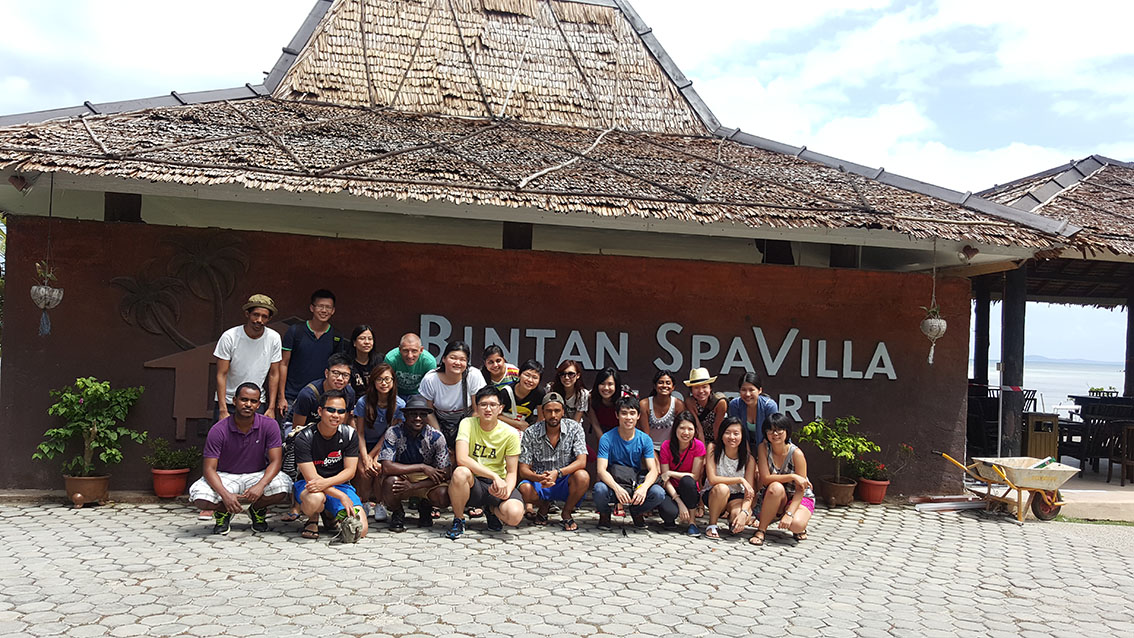
There was one other person who was instrumental in making these retreats and many other departmental events happen, and this person is Dee Pham.
Dee, our departmental support staff for postgraduate studies, was dedicated to offer her time, advice and advocacy to make the PhD studies of our students as smooth as possible and to help our students enjoy their time in our department. I am certain that our former graduate students will always remember Dee’s humour and her enthusiasm to help. There is no better way to illustrate our students’ appreciation for what Dee has done than watching the comments students made in the video below, which we presented to Dee upon her departure from the department.
And then there were our annual Department of Biochemistry student symposia. Over the years, we had various amazing student committees who organised truly memorable events. A key factor in motivating our graduate student committees was likely that they had the autonomy to make the important decisions, while I merely played an advisory role.
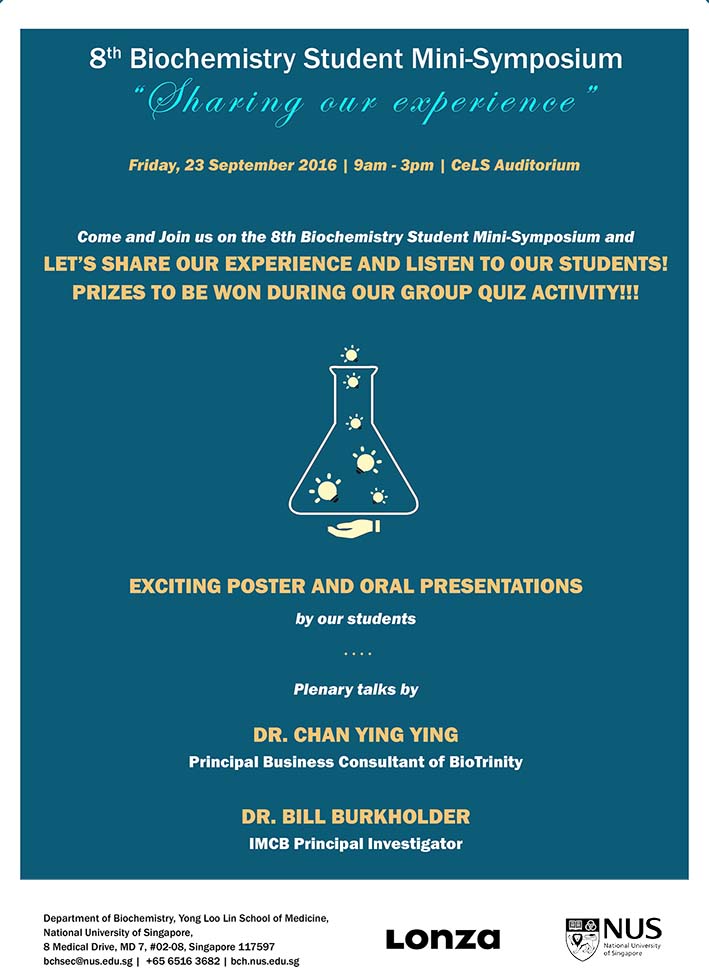
3rd Department of Biochemistry Student Symposium (2010)
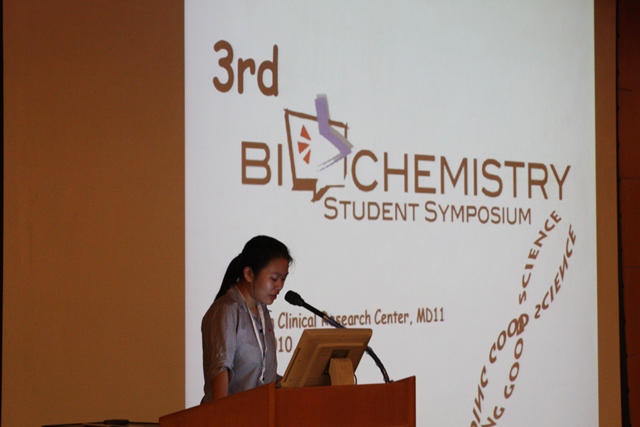
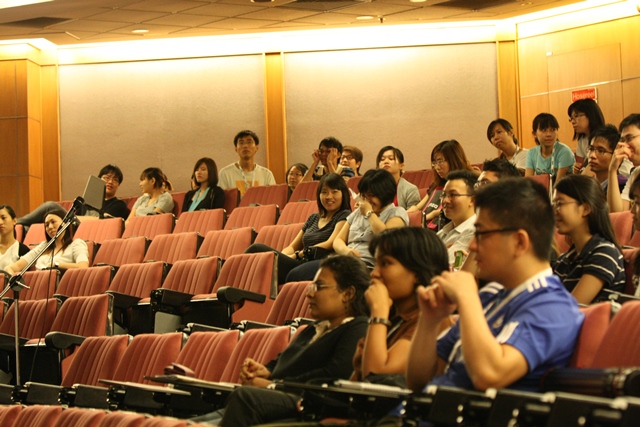
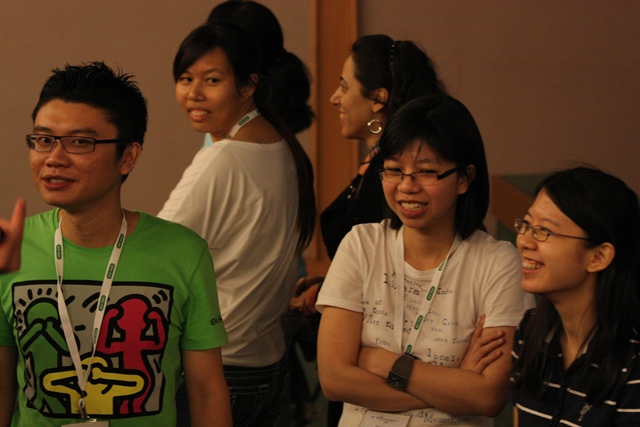
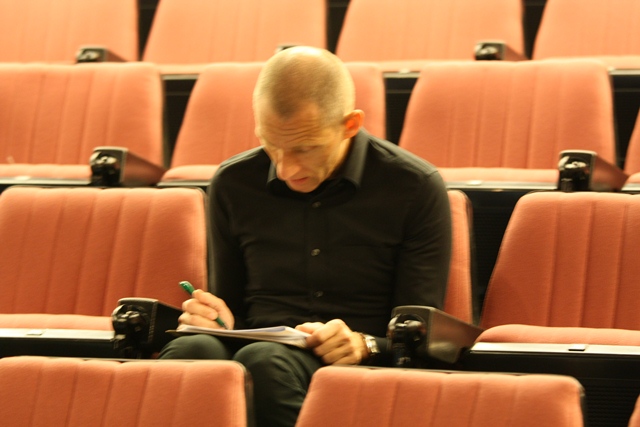
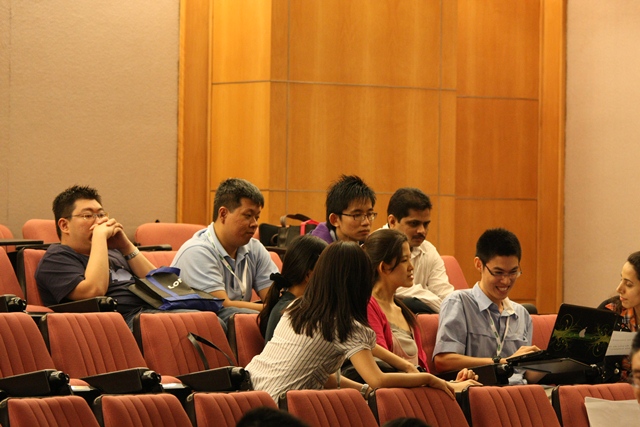
5th Department of Biochemistry Student Symposium (2012)
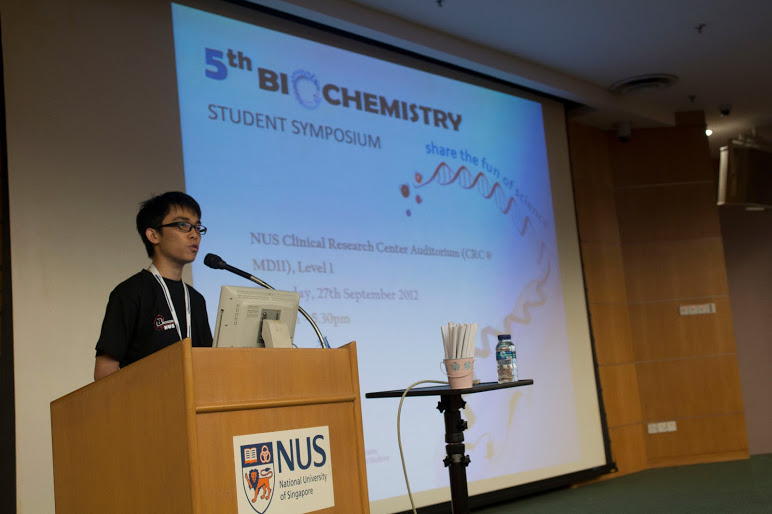
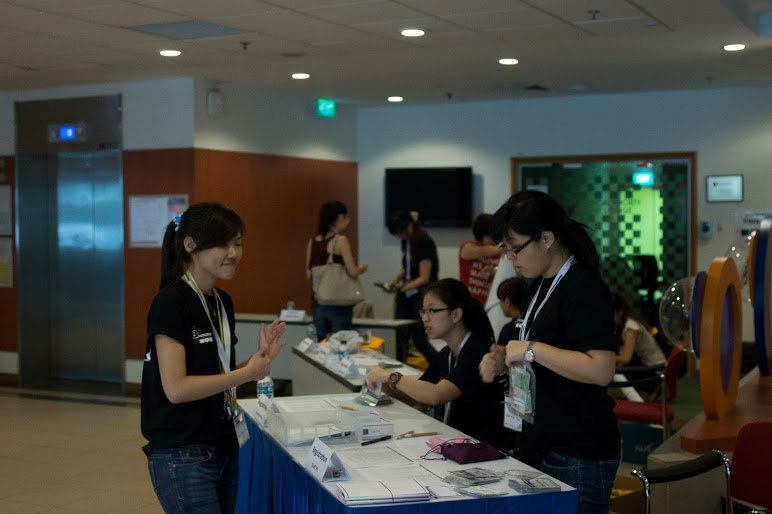
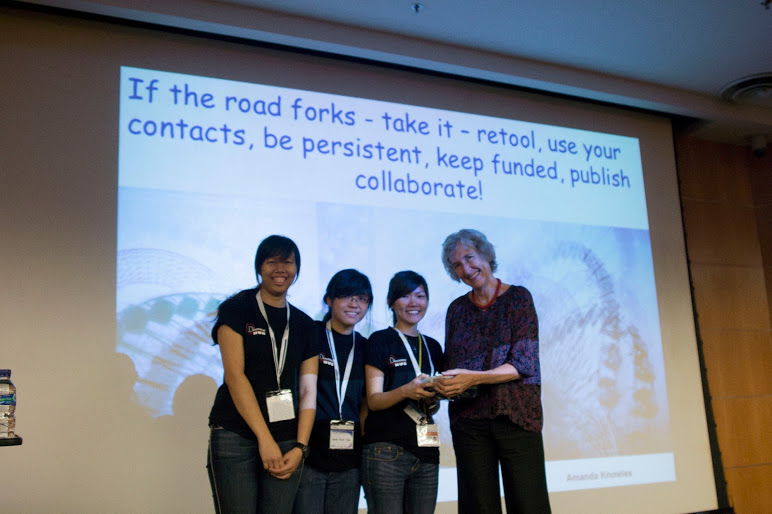
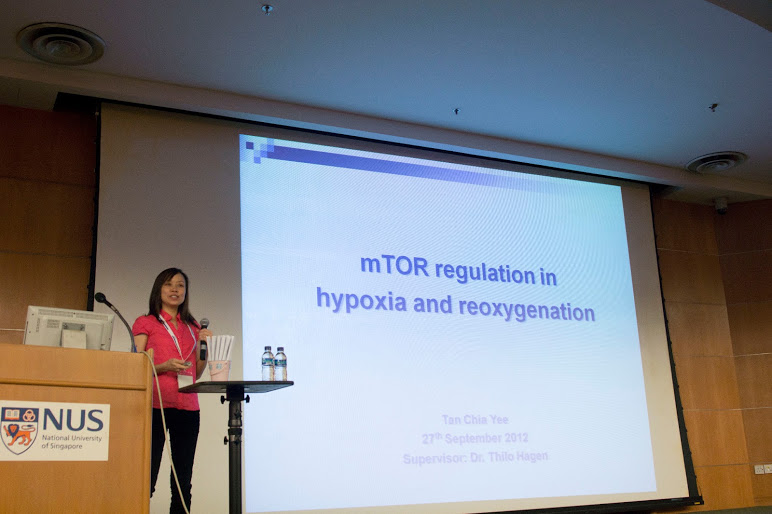
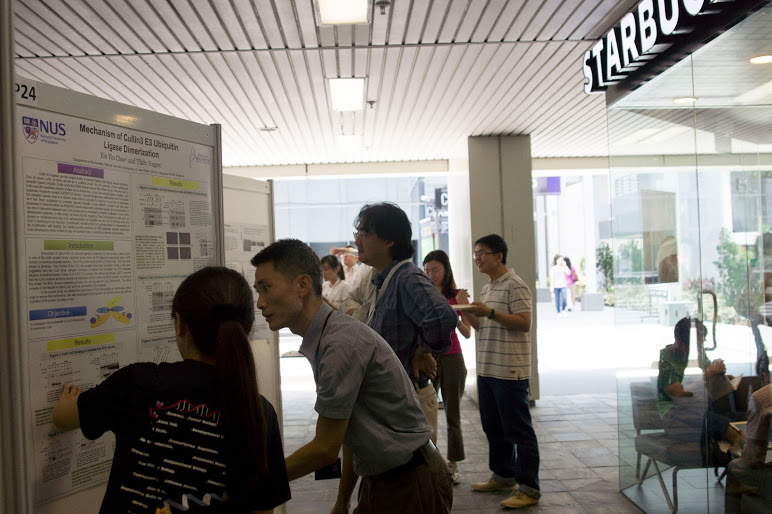
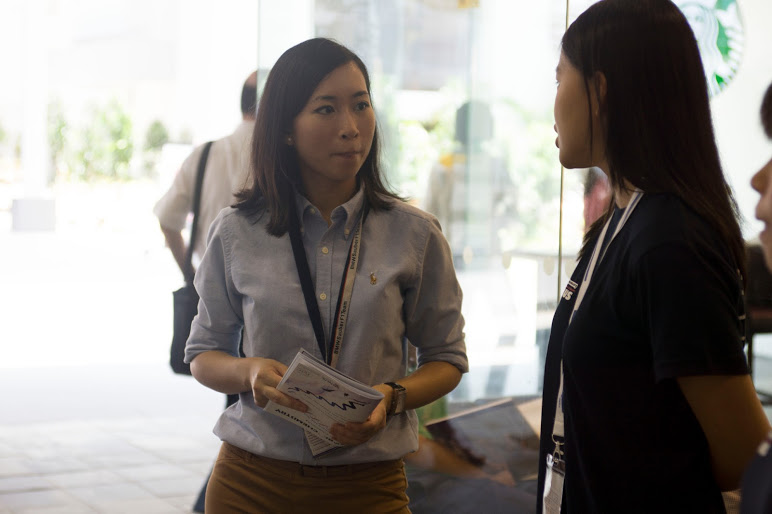
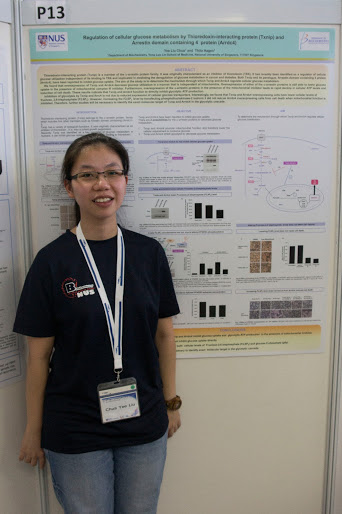
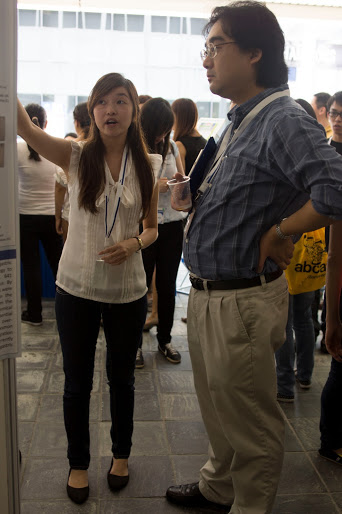
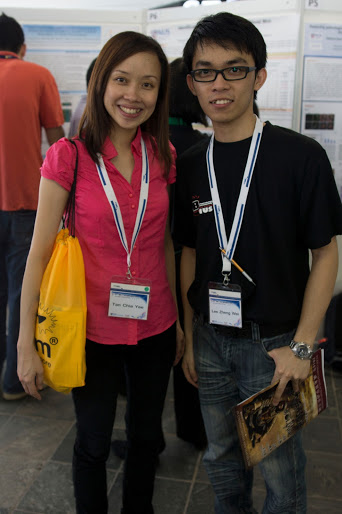
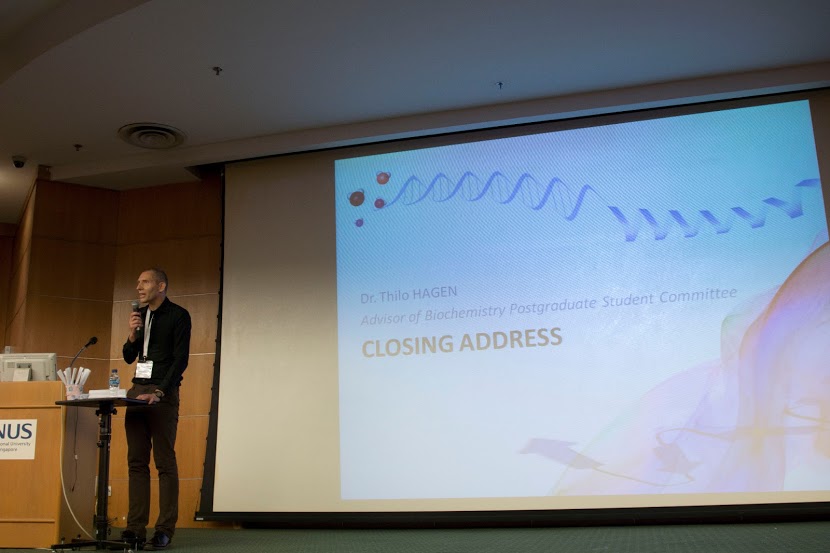
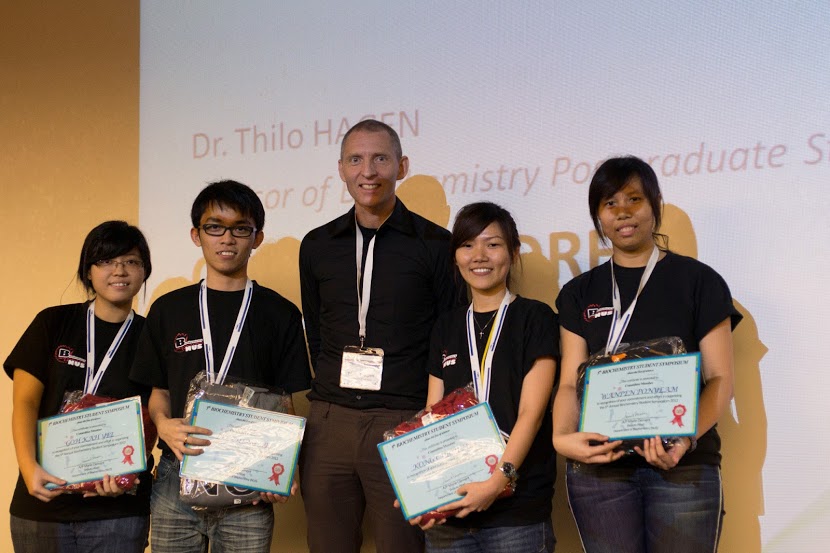
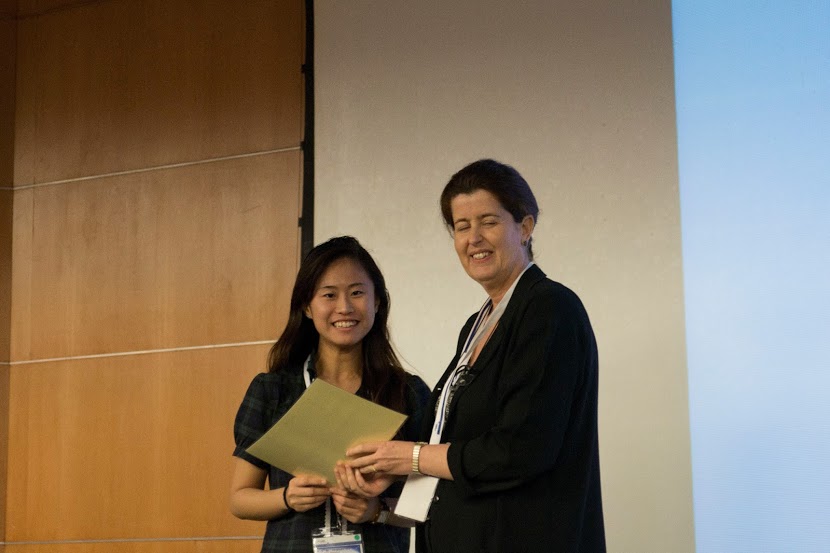
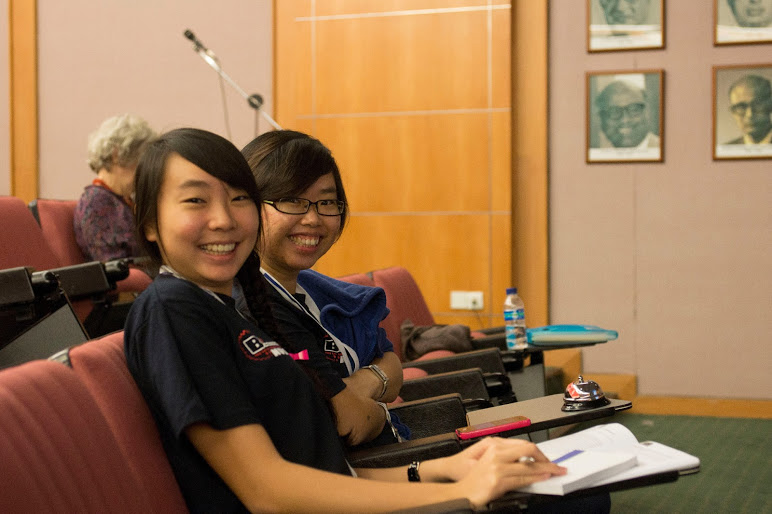
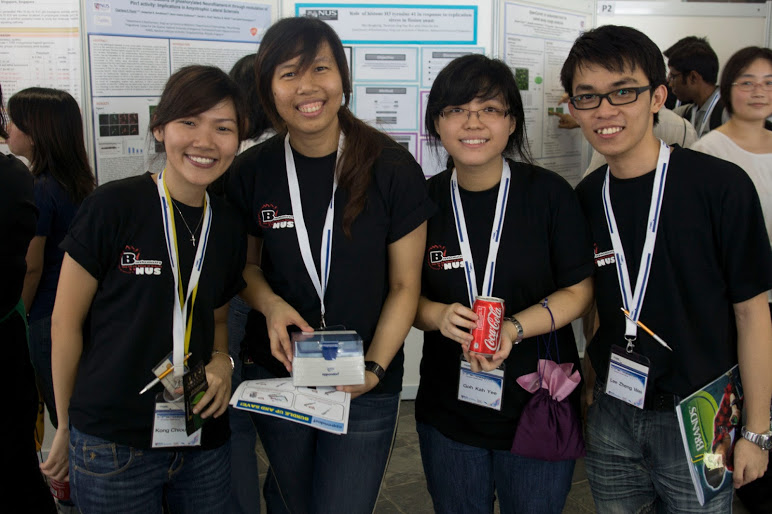
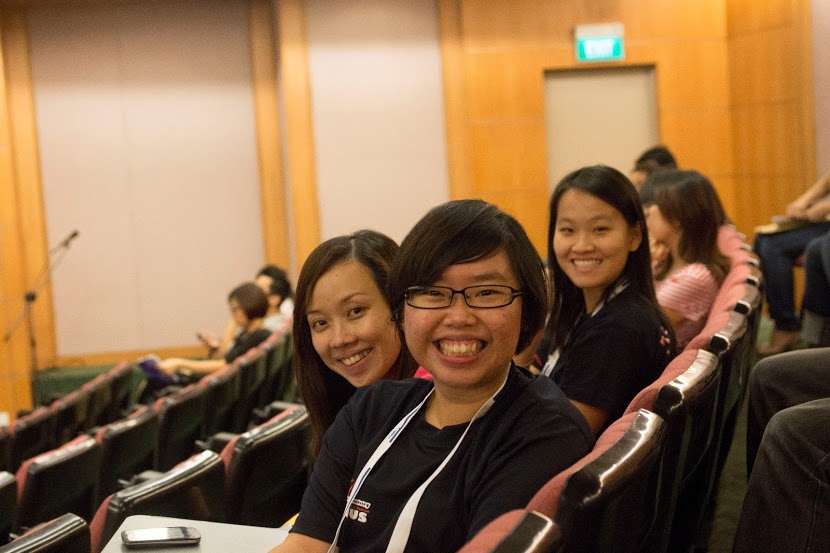
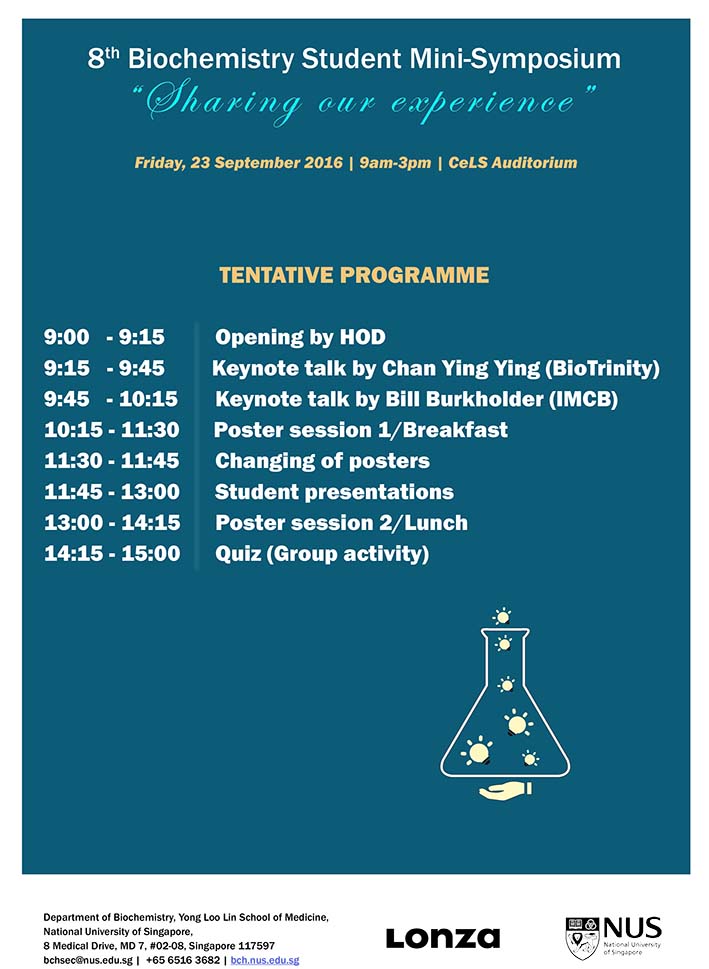
7th Department of Biochemistry Student Mini-Symposium (2015)
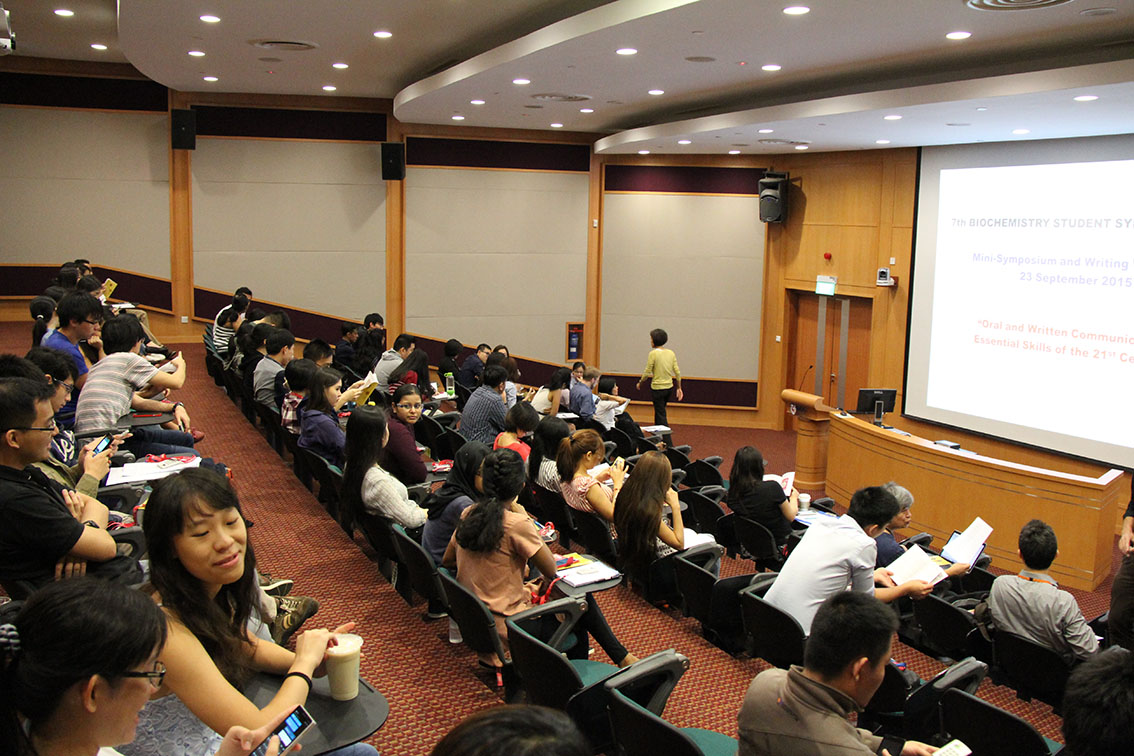
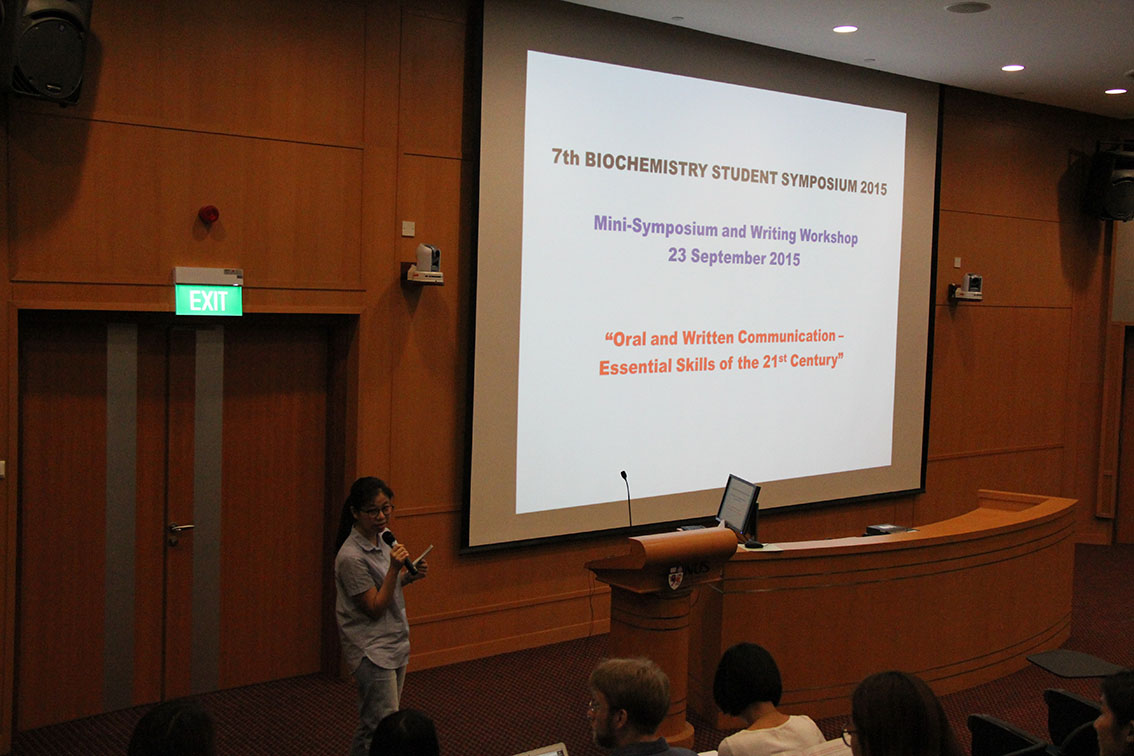
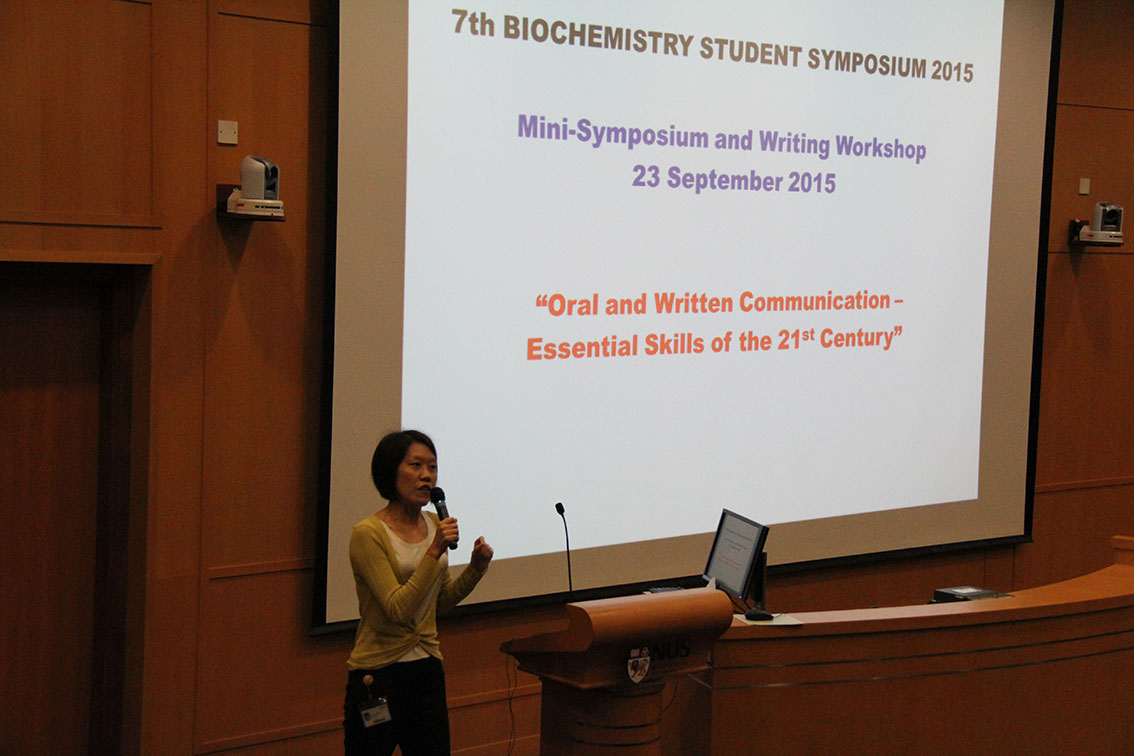
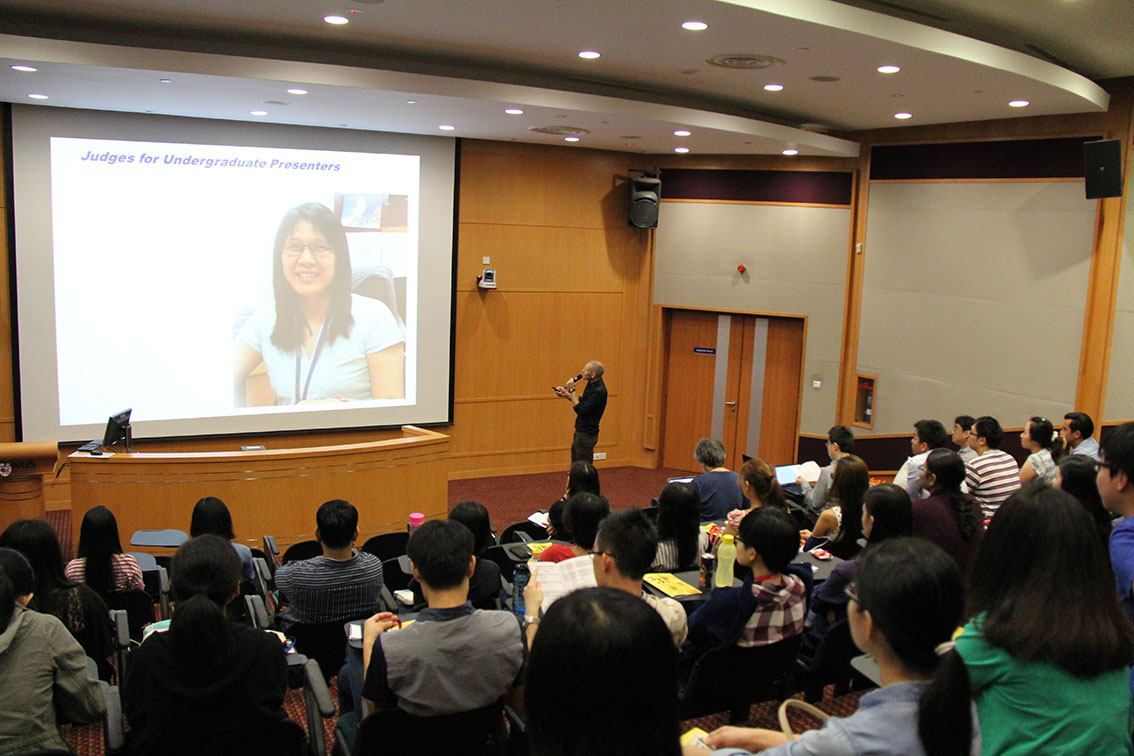
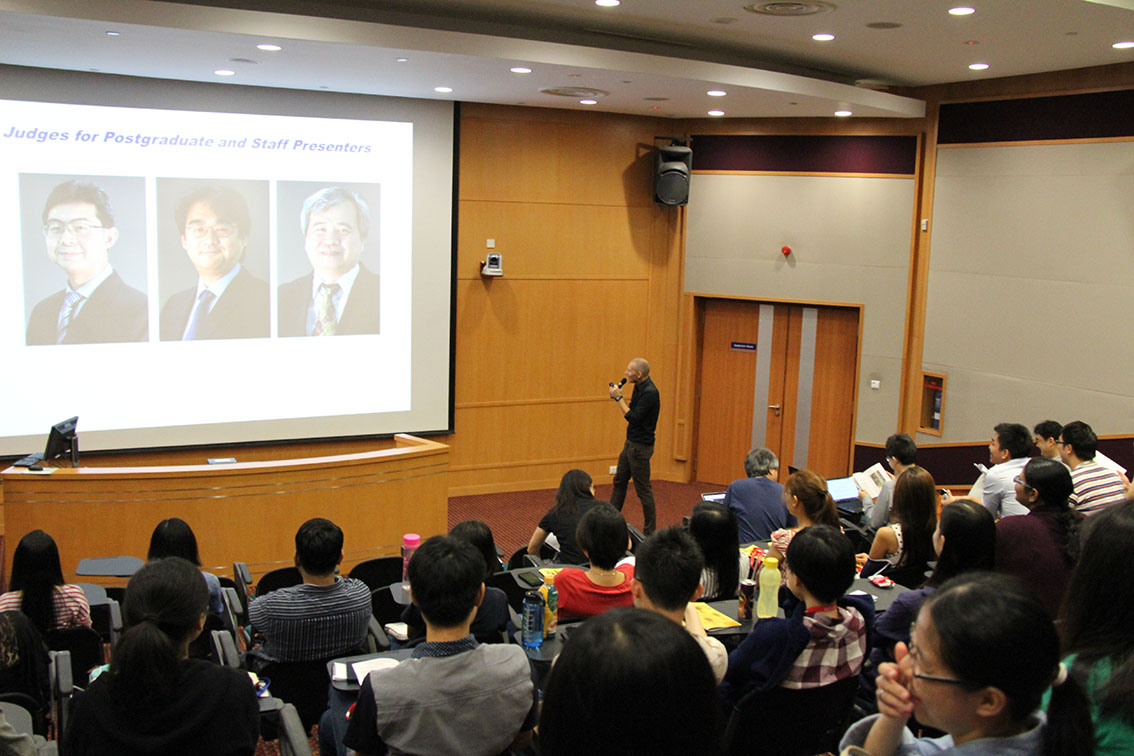
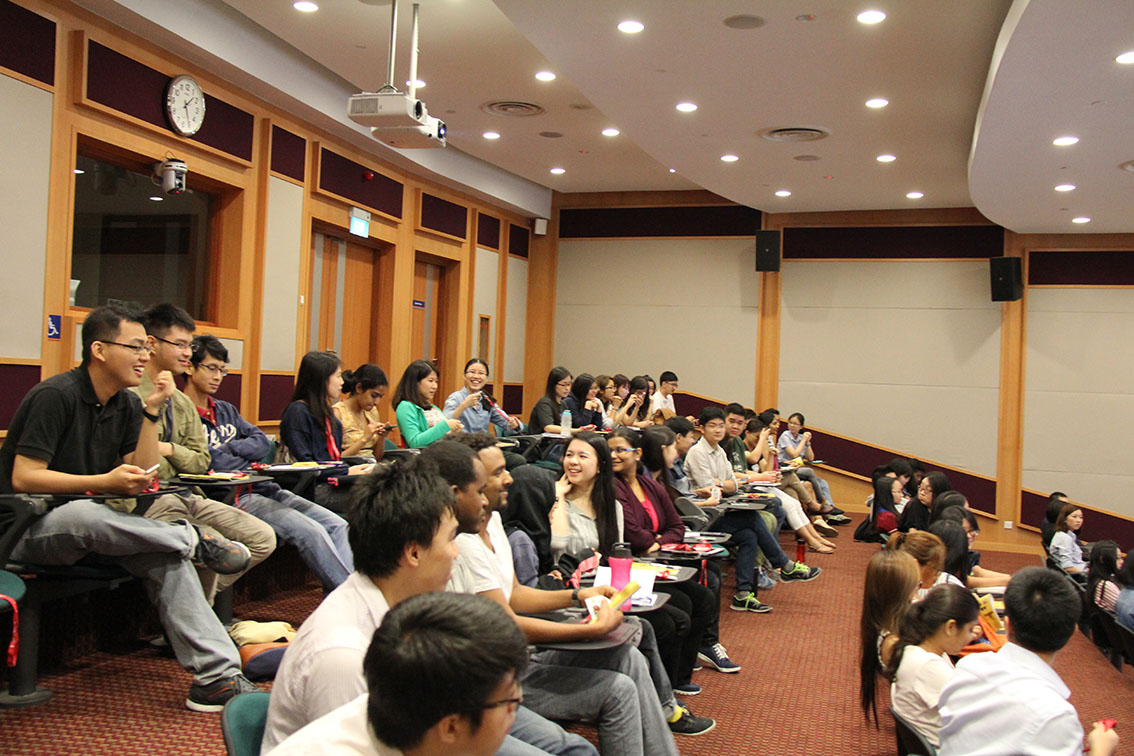
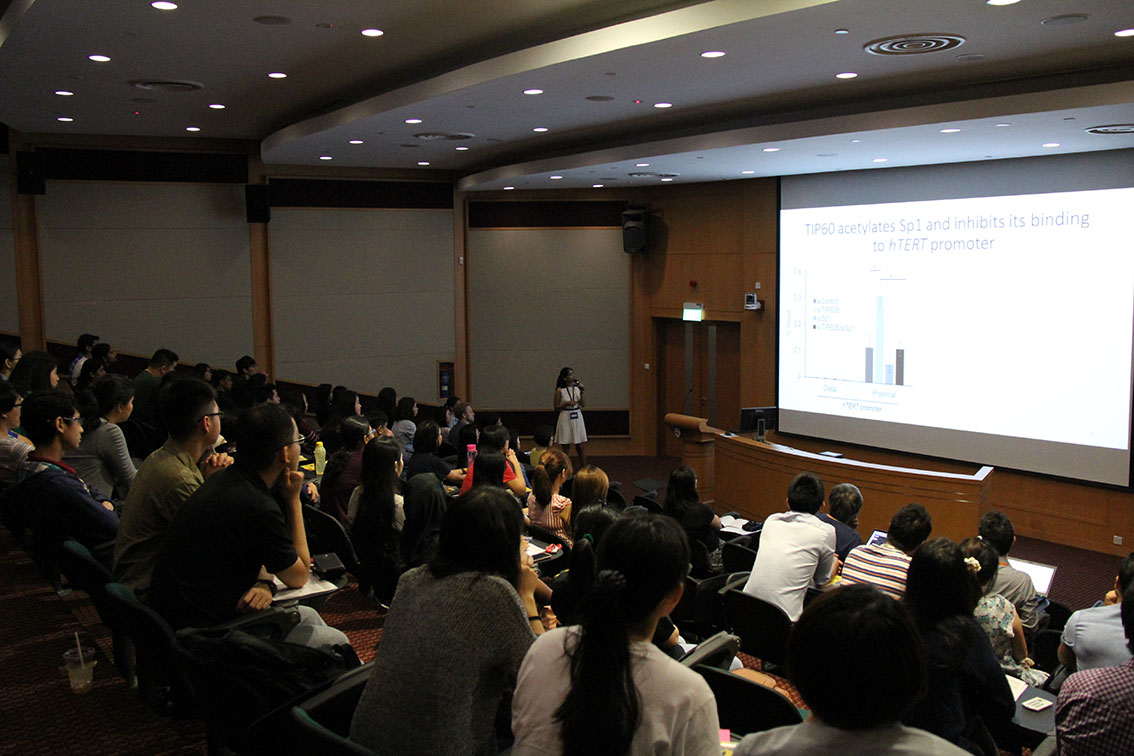
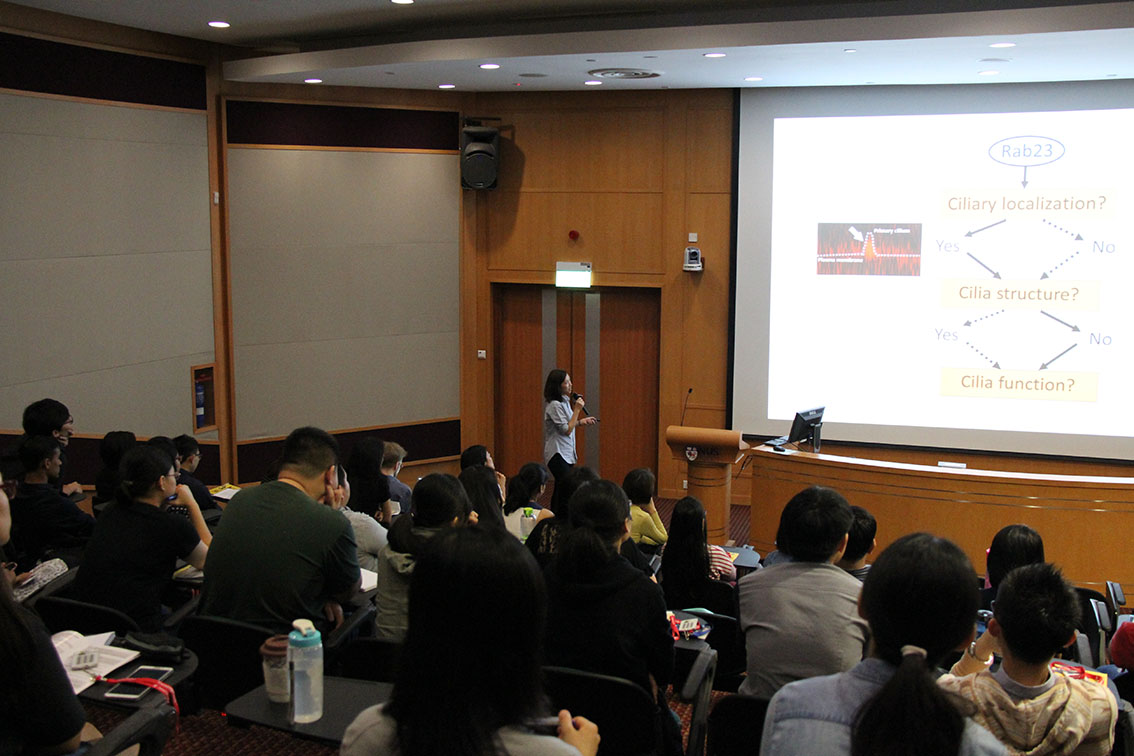
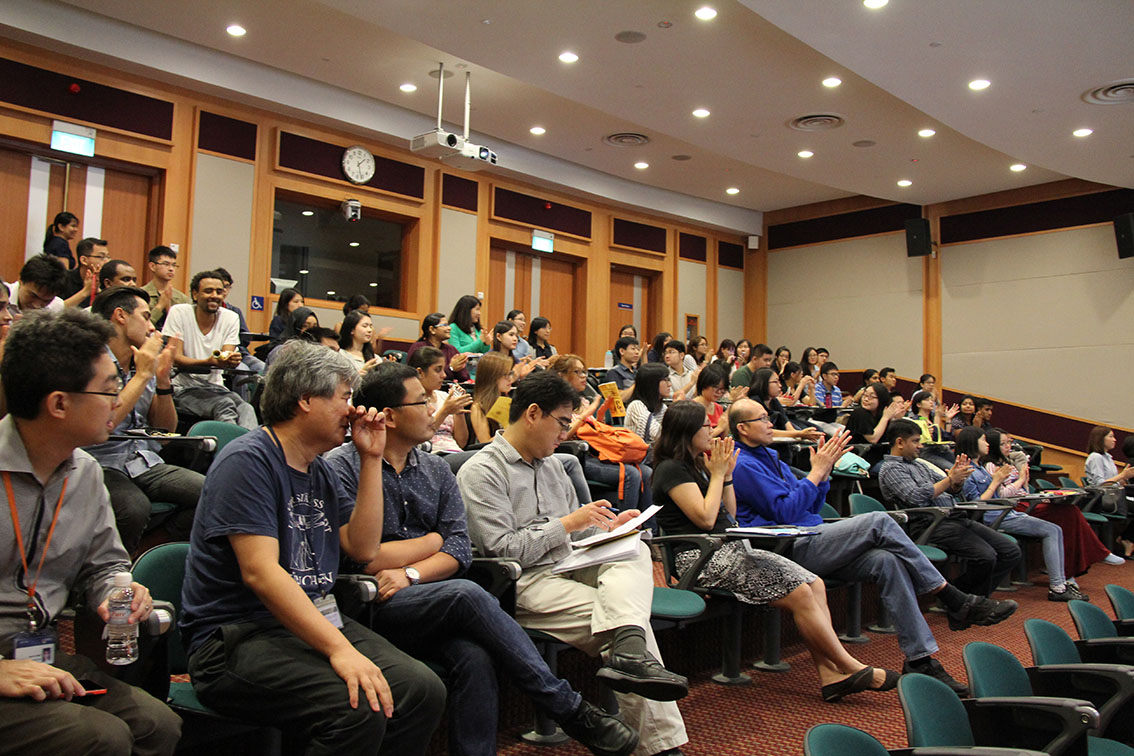
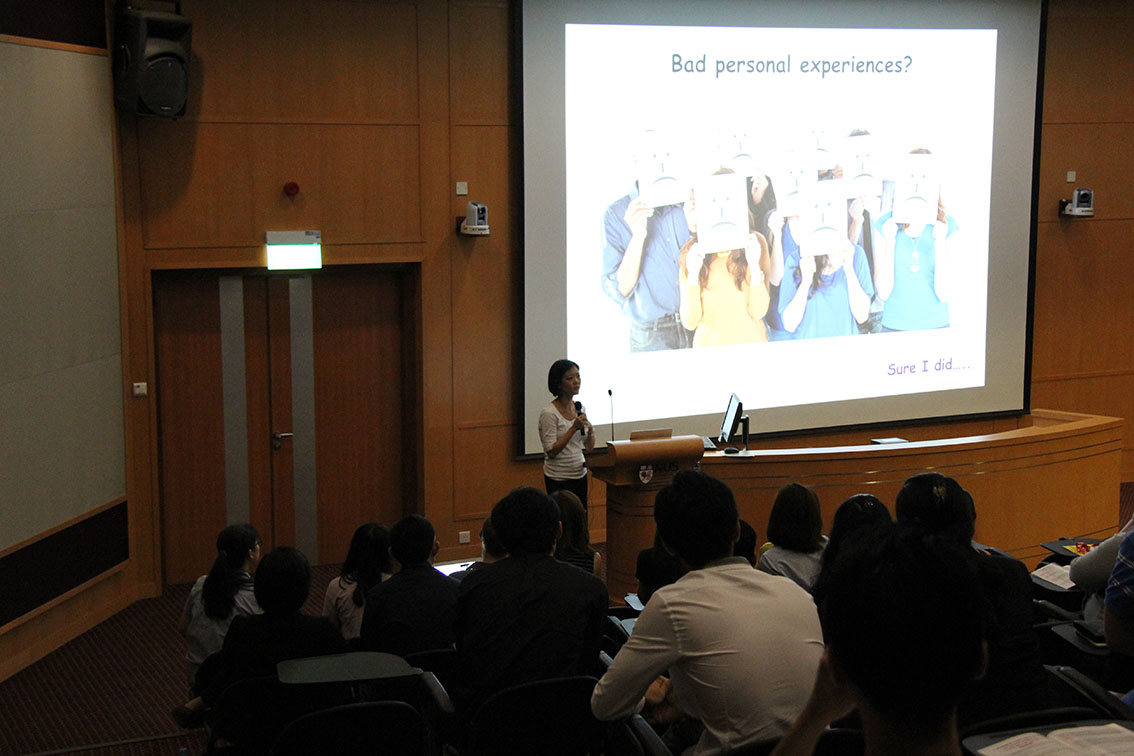
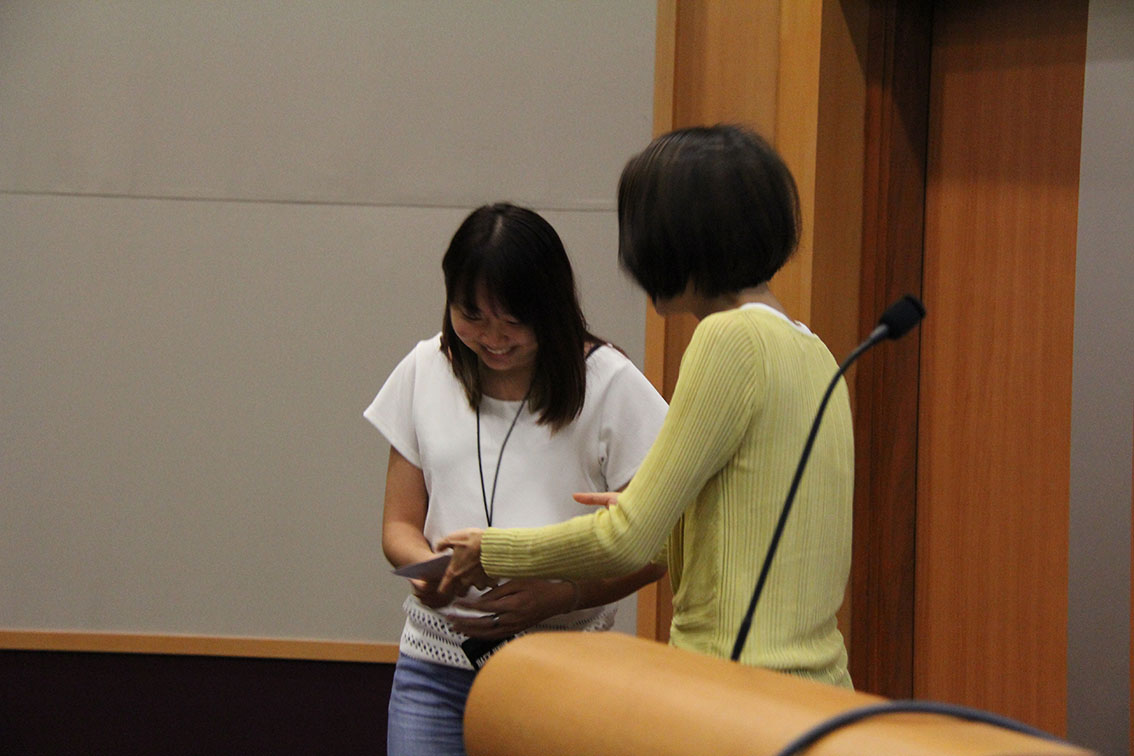
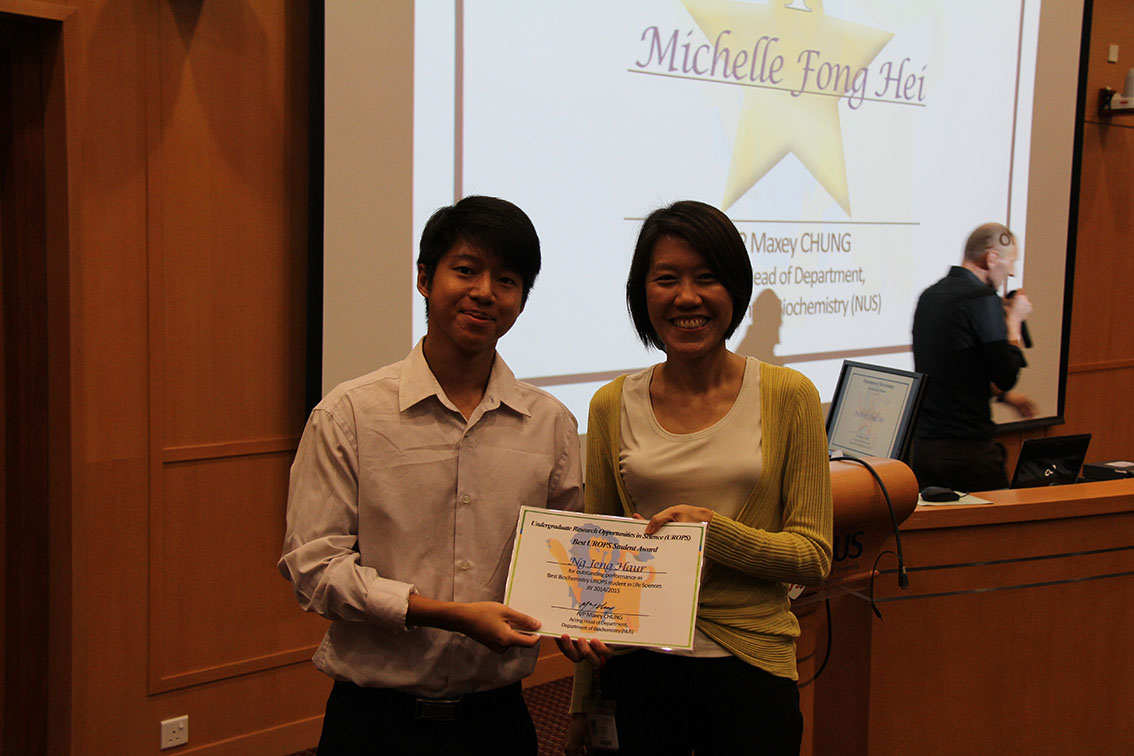
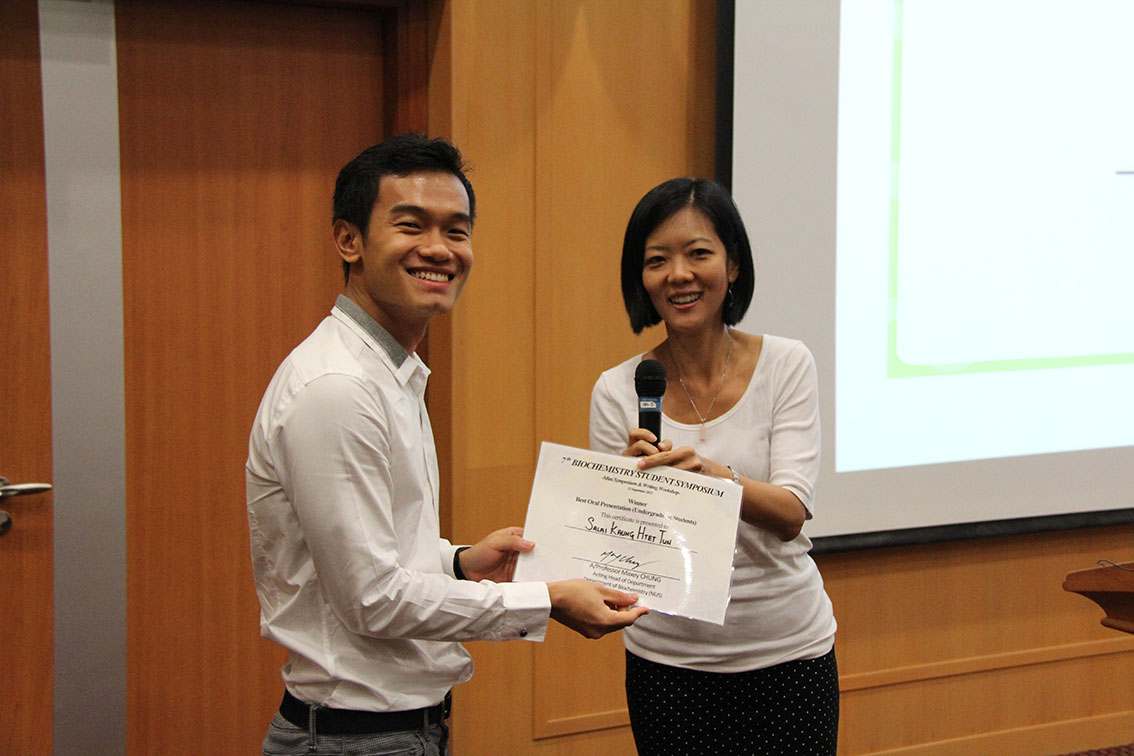
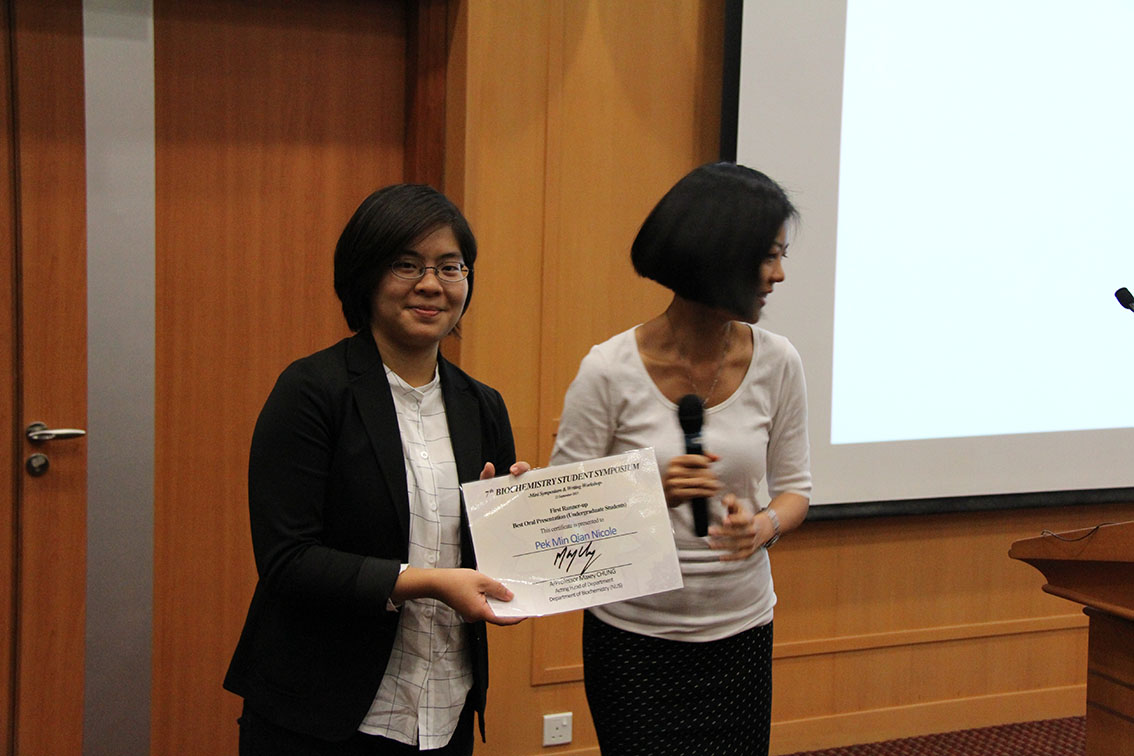
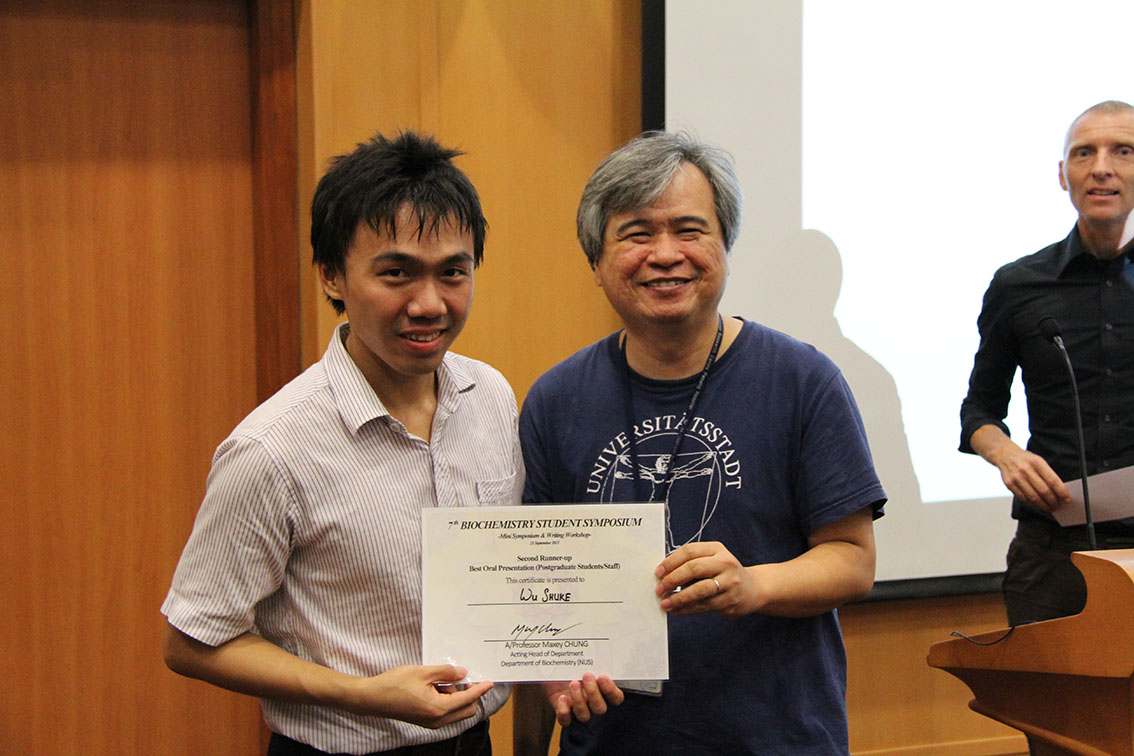
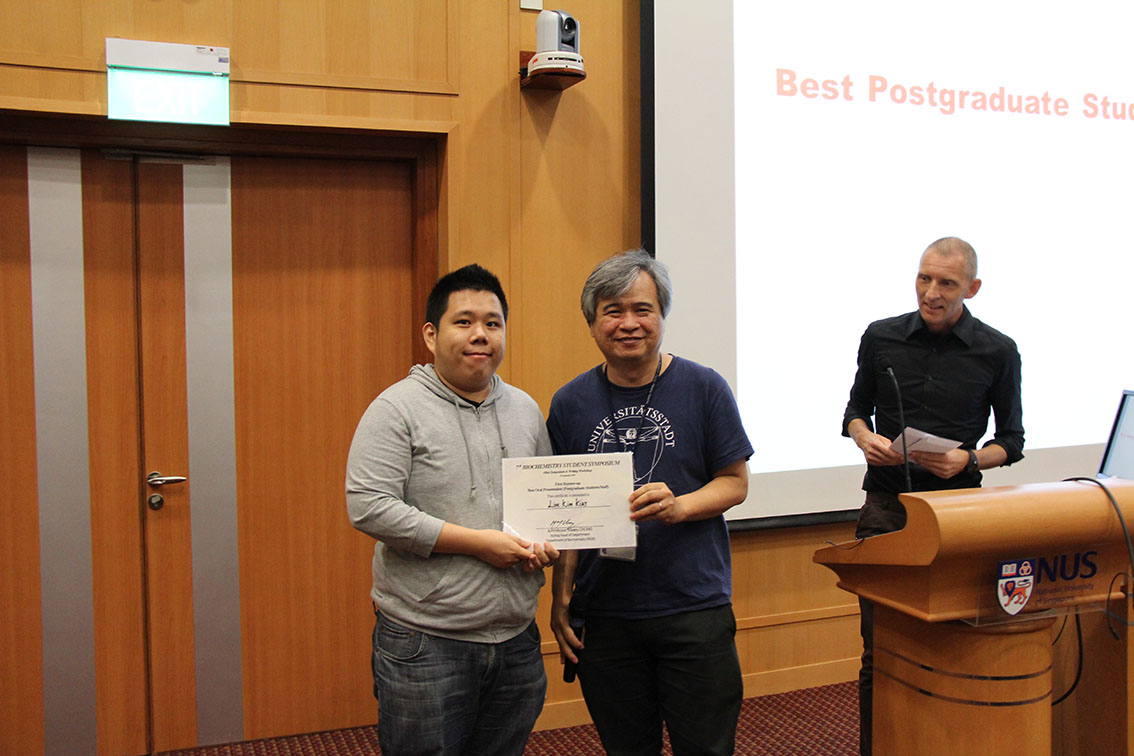
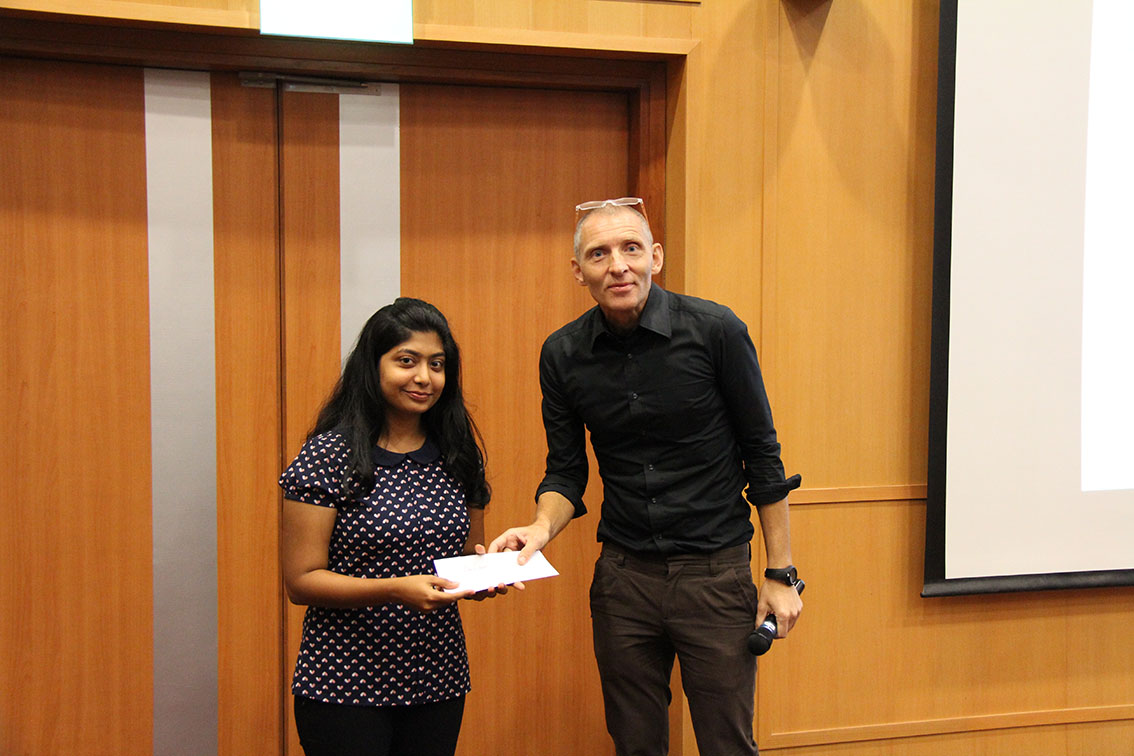
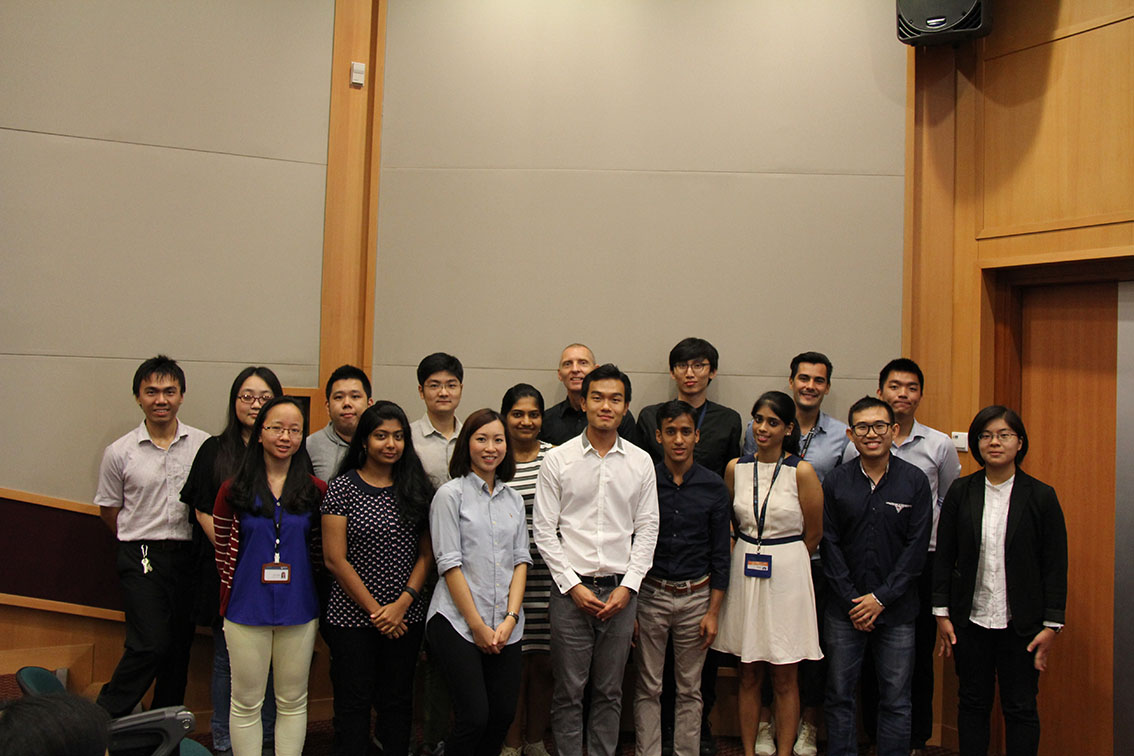
The student committee that left the deepest impression on the department was our final one: BIGSA, an acronym that stood for Biochemistry Graduate Student Association. BIGSA included our students Liew Wen Chiy, Samson Ali, Kakanga Moses, Michelle Fong, Alisha Ramos, Pierre-Alexis Goy, Maanasa Ravikumar and Luca Pignata.
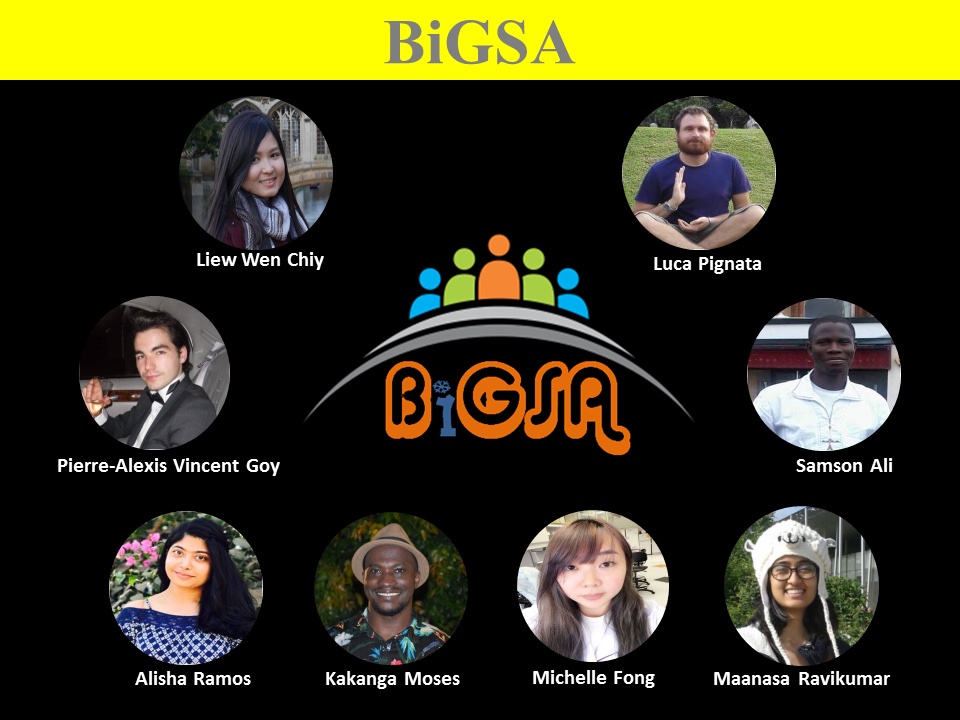
The committee organised many exciting events, such as new student welcome events, workshops, networking opportunities, film screenings, etc.
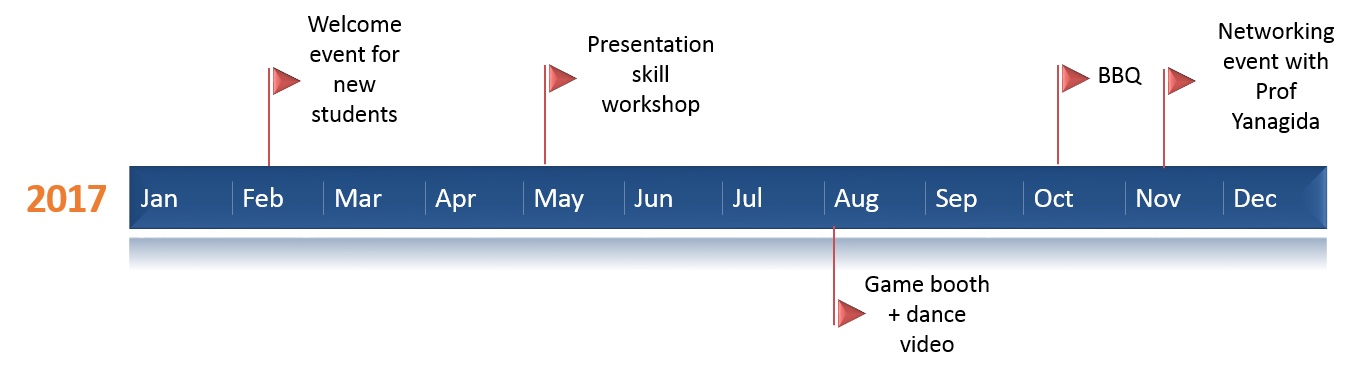
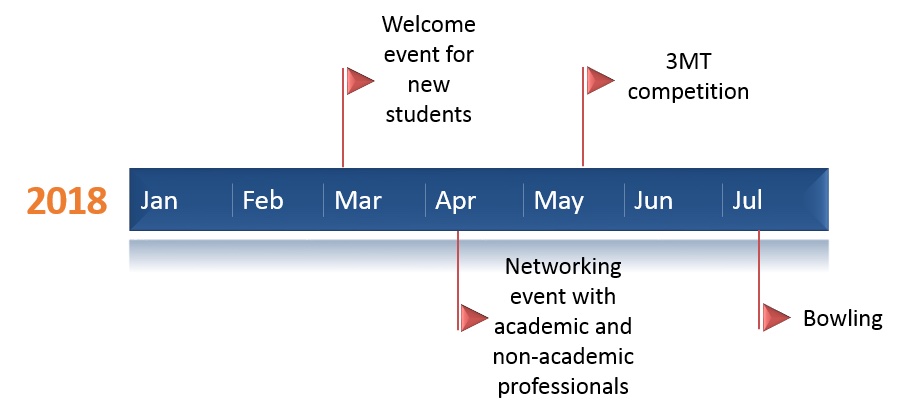
In 2017, BIGSA also produced an amazing video at our Department of Biochemistry 90th Anniversary celebration, which was one of the highlights of the celebration.
Although I have lost touch with most of our former postgraduate students, all the events we experienced together are still precious to me and recalling them makes me feel happy. I believe that many of our former students feel the same. Sometimes, it is important to recall these memories.
HIGHLIGHTS FOR WEEK OF 20 – 26 JULY 2026
Reflections on an era of vibrant postgraduate life in our department – Our Research in Progress seminars
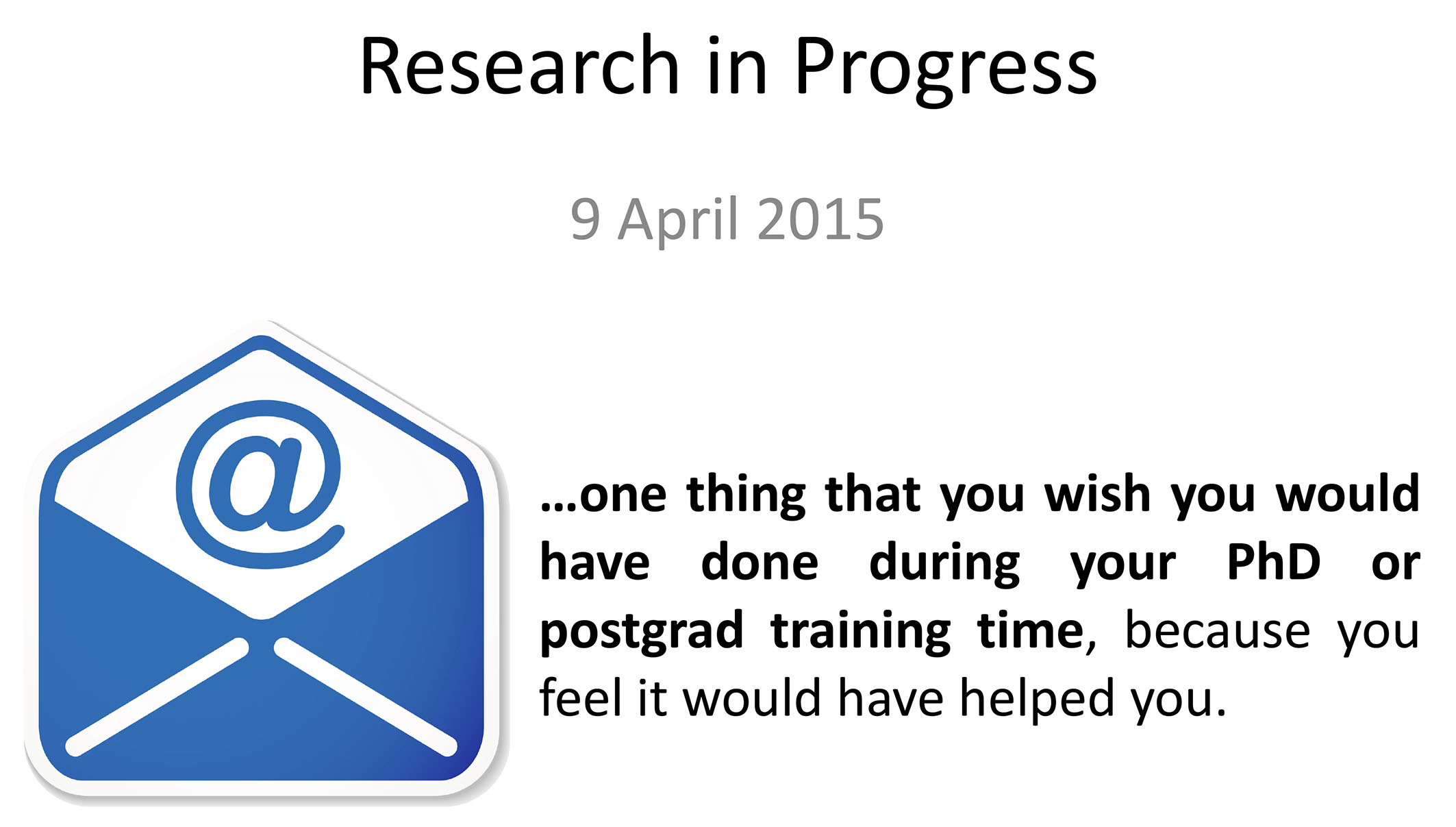
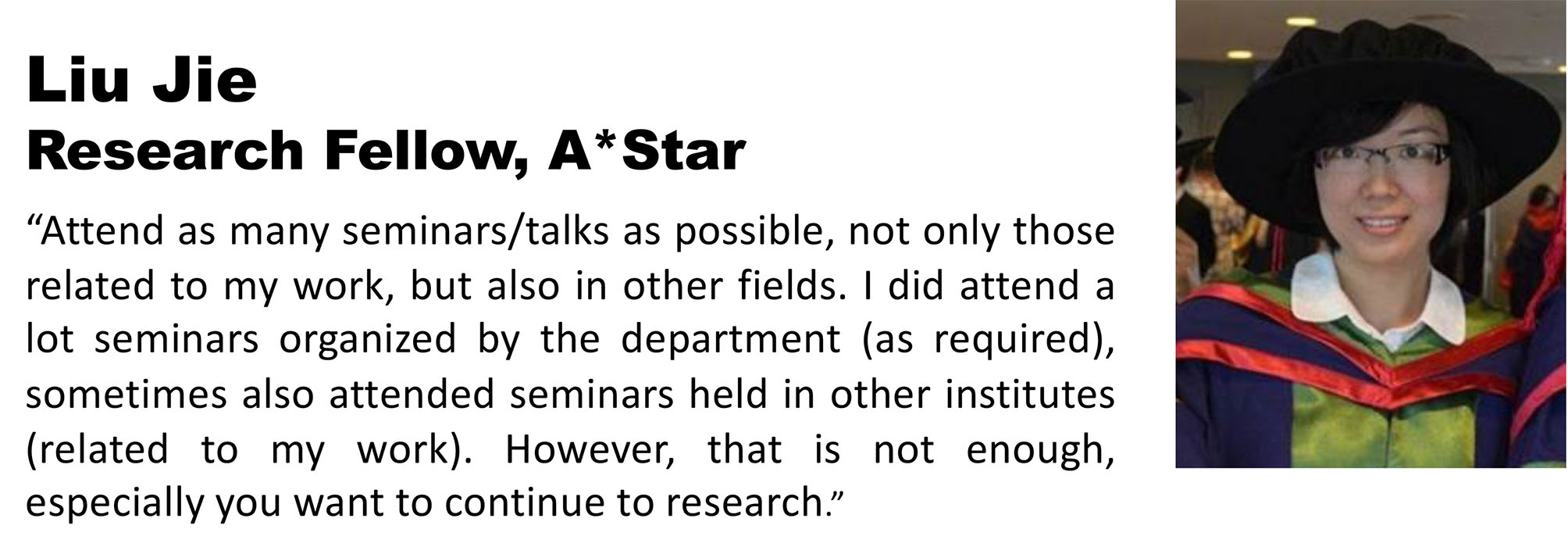
In 2015, I chaired the last of our departmental Research in Progress seminars, in which PhD students from our department presented their research. In preparation for the seminar, I asked recent PhD graduates from our department to reflect on “…one thing that you wish you would have done during your PhD or postgrad training time, because you feel it would have helped you.”
Three of the major regrets were ‘not having attended more seminars, ‘not having done more to build connections’, and ‘not having focussed enough on developing soft skills, such as the ability to present well’.
Seven years earlier, in 2008, I started our Research in Progress seminars to address precisely these goals. However, as apparent from what students regretted after their PhD, most students did not prioritise these goals during their PhD. This is the main reason why after seven years, I eventually gave up organising our Research in Progress seminars.
Back in 2007, I joined the Department of Biochemistry at NUS as an Assistant Professor. When I started my position, my expectation was that I would focus on establishing my research group and developing a research programme. What I did not foresee is that I would spend a large chunk of my time over the next years to promote graduate student life in our department.
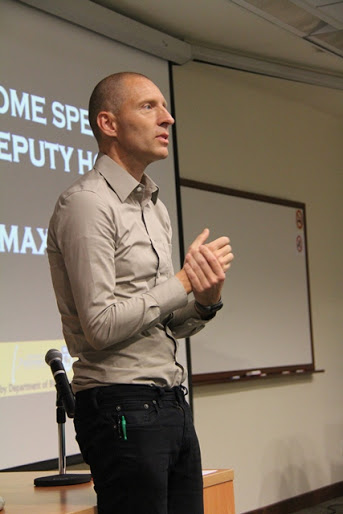
Soon after joining the Department of Biochemistry, I was put in charge of hosting our departmental Monday research seminars. At the same time, I noticed that there was no opportunity for our graduate students to present their work in front of the department. I had witnessed as an undergraduate and postdoc at Tufts University’s Biology department how the weekly graduate seminars were an important academic and social highlight of departmental life.
While at Tufts, I was impressed that the vast majority of professors made it point to show up at these seminars, ask questions and encourage students, even if their research interest was entirely different from that of the student presenters. As such, the seminars were a great opportunity for students showcase their work and obtain feedback, as well as to get to know students from other labs other over sandwiches after the seminar. The realisation that no similar structure existed in our department prompted me to start our Research in Progress seminars.
My appointment at the department coincided with the recruitment of Prof. Fu Xin-Yuan to take over the leadership of the department. One thing that really impressed me about Prof. Fu was his genuine passion for scientific research and fostering a departmental atmosphere of scientific exchange. As our Head of Department, he had the vision to create a culture where faculty, research staff and PhD students build connections and engage in scientific exchange. As such, he was highly supportive of our Research in Progress seminars as well as many other departmental activities.
Thus, with the strong backing and support from our Head of Department, I made it my mission to help promote a departmental culture of scientific exchange and a strong departmental community. Within nine months of my arrival, we launched our biweekly Research in Progress meetings, in which two PhD or Masters presented their research work. For the next seven years, the meetings became a fixture of our departmental life, allowing students to practice their presentation skills and interact over snacks after the meetings. The Research in Progress meetings likely also motivated students to make progress in their project in order to give a good presentation.
However, the major obstacle to the success of the meetings was student participation. There certainly was no lack of attempts and initiatives from my side to motivate students to attend. Thus, we routinely offered snacks after the seminars. We also let attending students vote on the quality of every presentation and awarded prizes for the best presenters at the end of each year. We even gave away “participation prizes” for students who attended the most seminars.
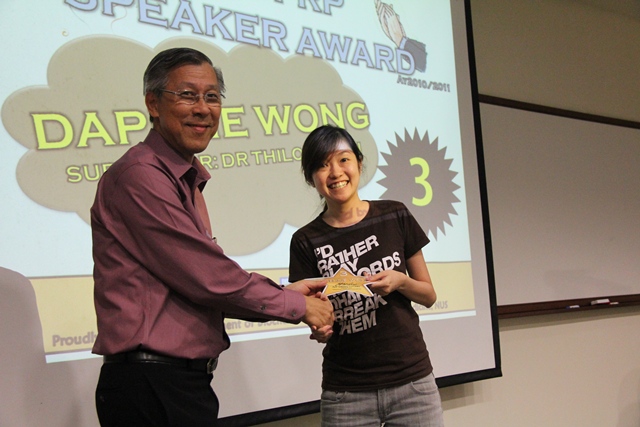
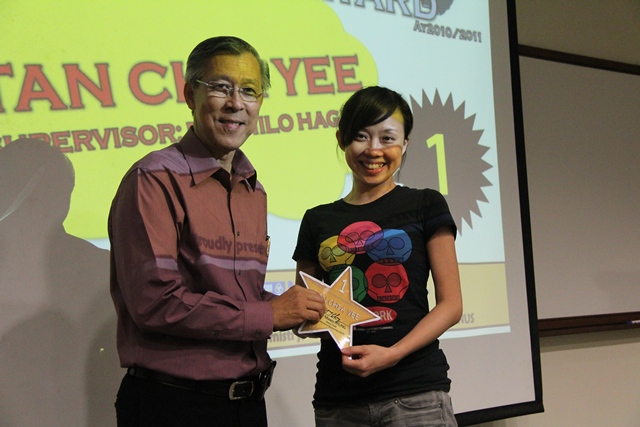
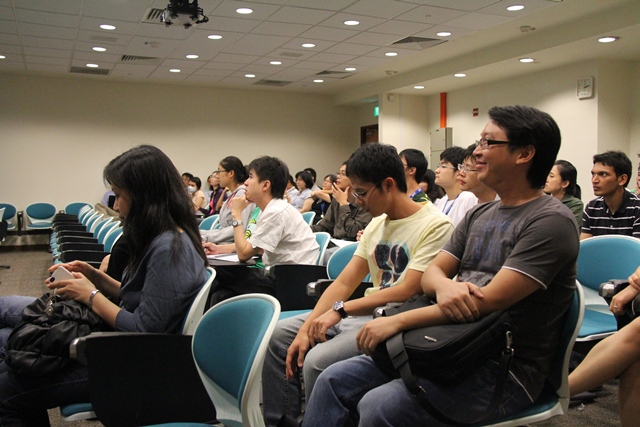
Ultimately, none of these measures really made a difference, because the two most important motivating factors for students were lacking: encouragement from the students’ supervisors to participate in the meetings, and participation by the supervisors themselves to lead by example. While I was at Tufts University’s Biology department, the majority of professors attended the graduate seminars, even though most talks were outside their area of expertise. This is clearly the best way to signal to students the importance of these seminars.
It is also important for supervisors to actively encourage students to participate. For example, as organiser of these meetings, I communicated to my students the benefits of attending and that I expected them to turn up. As a result, all my graduate and undergraduate students made it a priority to attend our Research in Progress seminars. Although this may not always have been convenient, my students told me that in the long run it was beneficial for them, because they were exposed to different areas of science from early on in their career and learned a lot about how to present well and how to use presentation tools effectively.
In contrast, most professors in our department likely did not actively encourage their students to participate. In fact, some professors even discouraged their students from attending or presenting, pointing out that it is more important for students to focus on their experiments. Moreover, only few professors showed up at the meetings, although there were some exceptions (most notably Assoc. Profs Deng Lih Wen and Chen Ee Sin and Asst. Prof. Takao Inoue!).
I continued an uphill struggle over the years to keep the meetings alive, until I eventually gave up. In hindsight, I do think about the success of the seminars differently. I now feel that I should have cared less about the number of attendees and more about the benefit for individual students who did attend. This mindset could have helped keep the meetings alive for longer.
That said, these days postgraduate student affairs are no longer handled by departments but by our School and the individual research programmes, and so we cannot bring back the past. But it is useful and enjoyable to sometimes remember it, which I will continue to do next week.
HIGHLIGHTS FOR WEEK OF 13 – 19 JULY 2026
Training humans to detect AI
Especially in education, there is a lot of talk about AI tools that can detect whether students have used generative AI to complete tasks. However, thus far, I have not come across efforts to train humans at getting better at distinguishing between what is AI- and what is human-generated content. That is until this week, when I read an interesting new paper in the scientific journal PNAS.
In the study, Dawel and colleagues tried to train humans to identify AI-generated faces.
The authors pointed out that commonly recommended strategies focus on detecting errors or anomalies (such as mismatched earrings or extra or missing fingers). But as generative AI gets better, such errors and anomalies are becoming increasingly less common.
In contrast to this, the researchers took a different approach. They argued that humans have an intrinsic ability to distinguish AI-generated and human faces, but are unable to unlock this ability without specific training.
In particular, the authors hypothesise that humans are likely to spot one specific difference between AI-generated and human faces: “… generative algorithms are inherently biased toward the mathematical average of the tens of thousands of faces on which they are trained. Consequently, AI-generated faces are perceived as more typical in appearance than real human faces.” According to the authors, humans are likely capable of detecting this “more average” appearance of AI-generated faces.
The researchers broke the appearance of human faces down into six specific impressions:
Distinctiveness (How much would this face stand out in a crowd?)
Memorability (How memorable is this face?)
Proportionality (How proportional is this face?)
Symmetry (How symmetrical is this face?)
Attractiveness (How pleasing or pleasant-looking is this face?)
Expressiveness (How emotionally expressive is this face?)
Previous research has shown that AI-generated faces are typically rated as more symmetrical, proportional and attractive compared to real human faces. On the other hand, AI faces are rated as less expressive, memorable, and distinctive. (Indeed, the researchers confirmed these differences in their study during the training phase, as discussed below.)
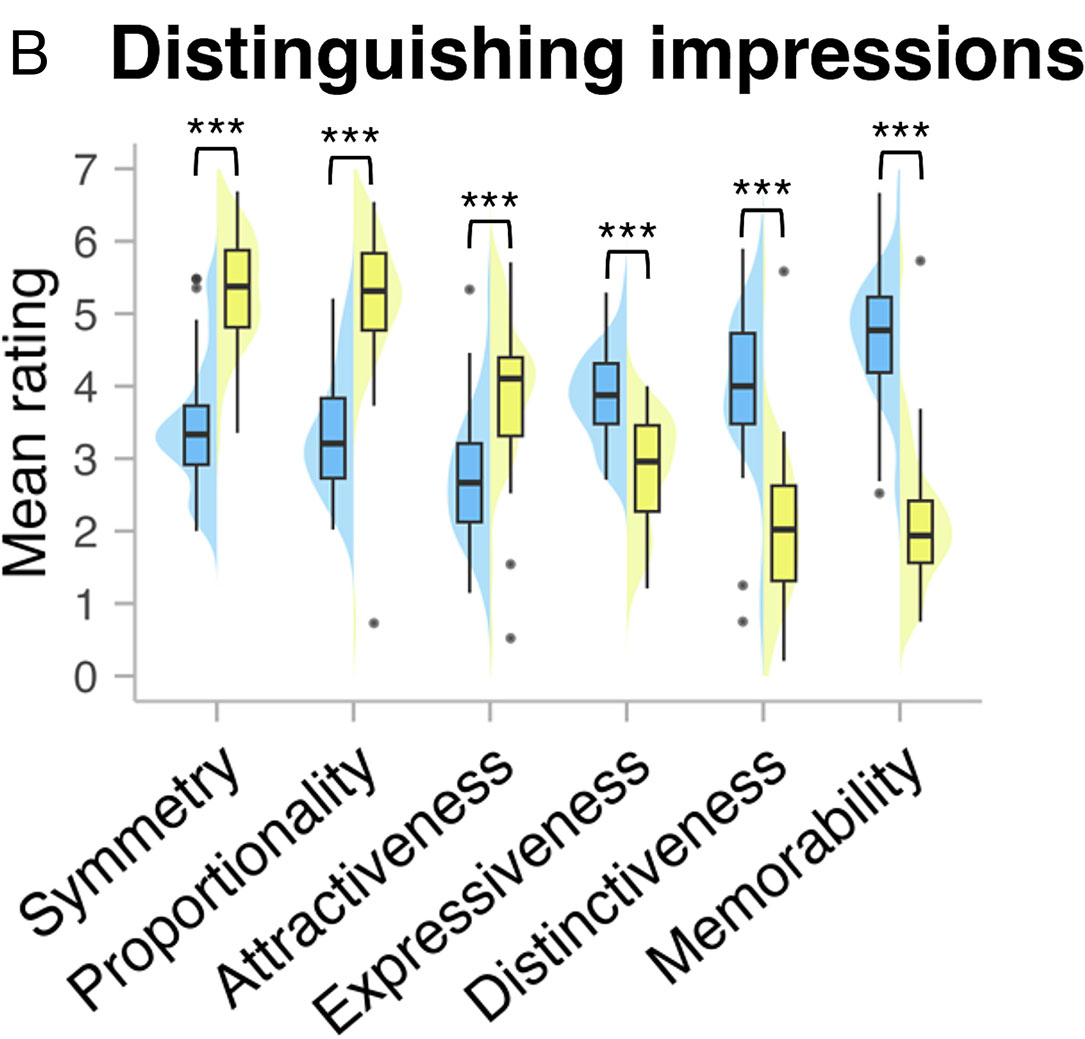
AI-generated faces (in yellow) are typically rated as more symmetrical, proportional and attractive, and less expressive, memorable, and distinctive, compared to human faces.
Hence, the researchers hypothesised that by training humans to detect differences in these six impressions, human ability to tell AI and human faces apart would improve.
To test this hypothesis, the researchers used the following study design:
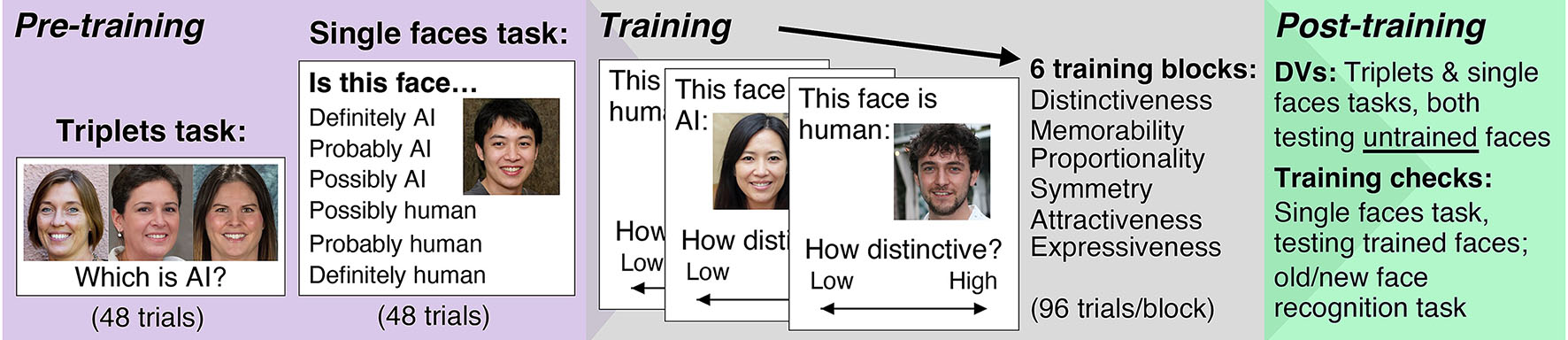
They first established a baseline by conducting Single faces AI-detection and Triplets AI-detection tasks. In the Single faces AI-detection test, participants judged whether individually presented faces were AI-generated or human using a six-point confidence scale. In the Triplets AI-detection task, participants were presented with three faces. One of the faces was AI-generated, which the subjects had to select.
The baseline ability of participants to identify AI-generated faces was around 50% in the Single faces AI-detection task, and around 40% in the Triplets AI-detection task, and as such, appeared little different from chance.
After determining the baseline, the researchers then conducted the training intervention. Here the participants were exposed to images of AI-generated or human faces. Each image was clearly labeled as either AI-generated or human. To “learn” the association of AI-generated and human faces with different facial impressions, the participants rated each face on the six different dimensions (facial distinctiveness, memorability, proportionality, symmetry, attractiveness, and expressiveness).
After the training, subjects were then re-tested using the Single faces AI-detection and Triplets AI-detection task with new faces, and the percentage of improvement was determined.
The results were remarkable. Training was highly effective and nearly doubled the average prediction accuracy from 41.4% pre-training to 81.1% post-training. The authors pointed out that some ‘high performers approached near-perfect accuracy’.
The improvements were similar for Asian and White faces, irrespective of whether the subjects themselves were Asian or White. This is interesting because typically Whites tend to find it much more difficult to distinguish Asian faces and vice versa.
In conclusion, the results of the study demonstrate that human AI-face detection is highly trainable, which makes me wonder whether similar approaches are possible for other AI-generated content.
On the other hand, sadly, I also learned this week that AI is also being utilised to undermine the ability of humans to detect genAI usage. Thus, a recent commentary in Nature describes a ‘Humanizer’ tool that can erase signs of AI-written text. The tool works by “personalising” the tone of research papers and grant applications written with an AI programme. Unsurprisingly, as pointed out by the author, the tool is alarming scientists.
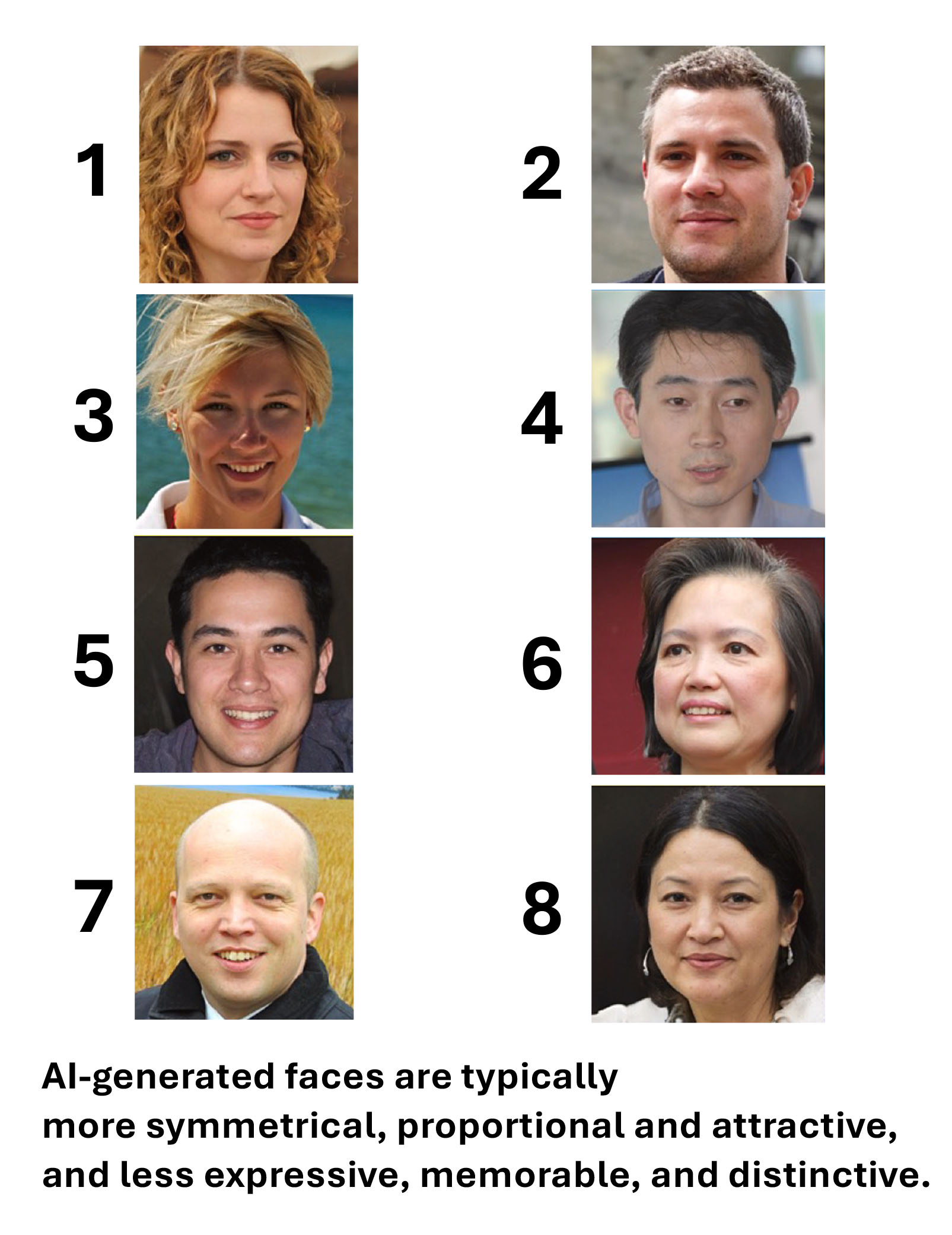
So finally, based on the discussed criteria, can you tell which four of these faces are AI-generated? (The answer can be found at the bottom of the page.)
HIGHLIGHTS FOR WEEK OF 6 – 12 JULY 2026

One week of training for my triathlon
I am currently preparing for my first triathlon in 35 years, and my longest and most ambitious one ever. And so in this post, I am looking back at one week of training.
On Monday, I went cycling, trying to head for Lim Chu Kang. But seeing the dark sky ahead, I ended up doing five back and forth circles on Jalan Buroh along Bedok reservoir. This was not fun, but there are no major traffic lights and I still managed to do two hours of intense riding. Right after the cycling, I continued with a 13 km run to and around West Coast Park. This was my longest distance after cycling thus far and was really tough. What made it easier was listening to an amazing Rest is History podcast about Nelson Mandela and the South African National Anthem, which brought back memories of Clint Eastwood’s great movie Invictus.
Tuesday was swimming day. I usually swim during or after lunch at Clementi pool, even though it might be easier to use the NUS pool. But I prefer the anonymity of the public pool. Also, it feels nice to be away from work in a different environment during work time. The pool is very empty during the daytime and all this makes the swimming experience a little less painful. Surprisingly, I realised that I became faster compared to the previous week, which thus far I thought to be almost impossible.
On Wednesday at lunch time I went for a run at Rail Corridor, one of my favourites running spots, especially during the day on a weekday when there are very few people. Because it was very sunny, I cut my usual 15 km run short by 2 km. But clearly, of all the triathlon disciplines, running is the most fun and I actually look forward to it!
On Thursday I went swimming again. As always, I was dreading having my head mostly under water and feeling exhausted while counting down laps for 45 min. But I finished my 1600m of swimming, and afterwards, I felt happy that I did it.
On Friday afternoon at 5:30pm I headed off to cycle again, this time riding to Tuas. But this was a mistake because of the two and a half hours on my bike, I spent a large portion waiting at (unnecessary) traffic lights. Going forward, I will try to go to Lim Chu Kang or East Coast Park (if I am riding during the day when it is not as busy). After my bike ride, I followed up with another 13 km run, and although it was tough, my heart rate at the end of it felt lower than after previous cycling and running sessions, which is definitely a good sign.
Saturday was rest day, so I took a walk from NUS to Harbourfront, which was a lot of fun.
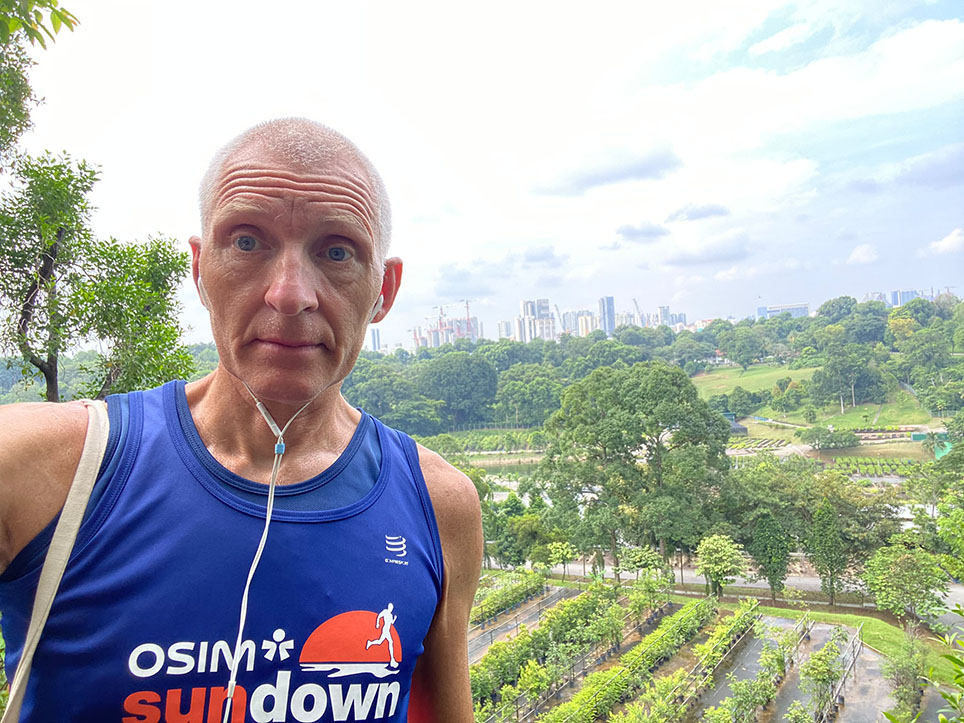
Thus far, it had been a good training week. And so on Sunday, my plan was to go for a long cycling session. However, I ended up not going. I simply could not motivate myself to go.
What made it so difficult?
It seems that I unconsciously knew that I did well this week and concluded that it was okay to skip this session and relax instead. Knowing this, I put a lot of things that I wanted to do into my morning schedule. And by the time I was finally ready to go out, it was already very late.
It goes to show that following through on plans when there is no urgency is difficult. In principle, it is, of course, okay not to follow one’s plans all of the time, because very few people do.
On the other hand, we usually plan the things we do because they make us feel good (or because we know that we feel good afterwards). In contrast, if I abandon my plans I often end up not relaxing or doing fun things, but to wasting time. This Sunday, I initially tried to take a walk, but it was cut short by rain. I then read and subsequently listened to music for a couple of hours, which was enjoyable. But eventually I wasted close to three hours searching for new music.
This is a strong argument for me to try to follow through on my plans. Looking back, the main problem was likely that I planned to do too many things in my office beforehand. By the time I finished them, I feel so tired that I wanted to relax. And then it was hard to find the motivation to go out and cycle.
In conclusion, I need to plan to do less!
Finally, one obvious question is why do I spend so much time and effort on training sessions that are tough and that I do not always enjoy in the first place?
Firstly, I feel that it is good for me to try new things. (Technically, I have tried triathlons before as a student, but that was so long ago that my experience now is likely going to be very different.)
Secondly, I know from experience that it is beneficial for my mental well-being to have goals. It provides a purpose as well as excitement.
Finally, challenging goals create meaning in my life in a bigger sense. When I look back at the two marathons I completed over the past two years, they feel like major achievements. Remembering them gives me great joy, which definitely offsets the difficult training. And I already feel excited about other marathon challenges in the future.
CORRECT ANSWERS TO THE AI FACE DETECTION QUIZ: The AI-generated faces are #1,2,5, and 8.
FOR OLDER POSTS CLICK HERE